K-12 spending, absenteeism programs face risks as feds stop key monitoring, watchdog says
Sep 25, 2026 | 2:43 pm ET
Description
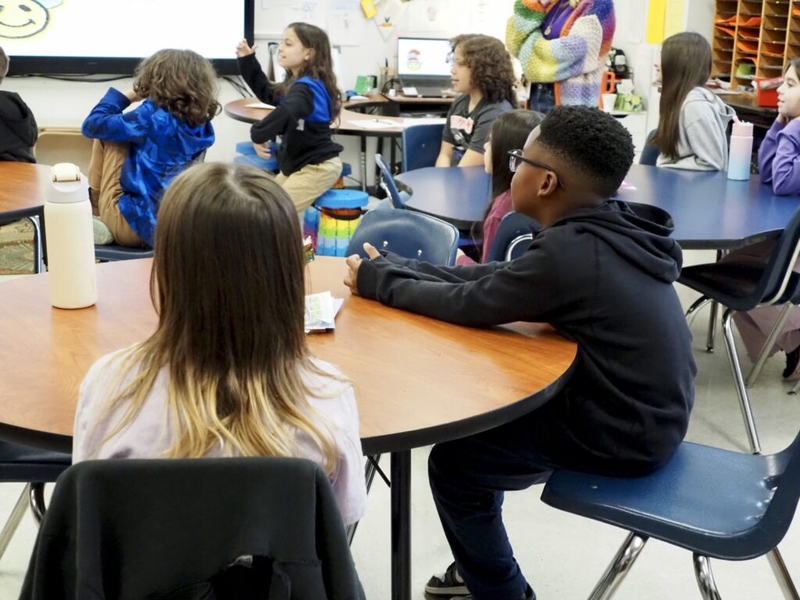
Fourth graders sit at their classroom tables in Oklahoma City. A new government watchdog report raises concerns about oversight of education spending and absenteeism data. (Photo by Nuria Martinez-Keel/Oklahoma Voice)
The U.S. Department of Education’s suspension this year of a comprehensive monitoring process puts billions of K-12 dollars at heightened risk of undetected waste, fraud and abuse, according to a new report by the nonpartisan U.S. Government Accountability Office.
The congressional watchdog’s report also raised concerns about the reliability of federal absenteeism data, noting that absenteeism rates were reported above 100% in some schools.
Officials from the Department of Education told GAO the department suspended its consolidated monitoring of Elementary and Secondary Education Act requirements while it develops a new approach. But as of August, the department had not provided a timeline for resuming the reviews or details on an alternative for making sure states comply with federal requirements.
The change heightens the risk for Title 1 funding, which is about two-thirds of the nearly $27 billion in total Elementary and Secondary Education Act funding in 2025, the report said. Under Title 1, states receive grants and use the money to support schools and districts with high concentrations of students from low-income families.
Education Department hands more states flexibility with federal dollars
States receiving Title I funding are required to develop statewide accountability systems, and all states had to report certain chronic absenteeism data. The Education Department defines chronic absenteeism as missing 10% or more of school days. Consolidated monitoring was fully implemented in 2019 but the Education Department suspended the process this year.
“As a result of suspending consolidated monitoring, Education will not be able to systematically assess whether states are complying with ESEA requirements and following their approved state plans,” the report said.
On chronic absenteeism, half the states remain unmonitored for reporting requirements that apply to all states, the report said.
The Education Department directs states to report the number of chronically absent students over a school year, but to report total enrollment based on a single date. “Calculating rates using mismatched timeframes has resulted in unreliable and implausible chronic absenteeism rates (e.g., rates over 100 percent),” the GAO said.
That was especially true in low-performing schools and for those housing career and technical education programs, the report said.
“Absent quality chronic absenteeism data, this nationwide data source cannot be used to reliably track trends or evaluate the effectiveness of accountability efforts and interventions to address chronic absenteeism,” it concluded.
States try new measures to get chronically absent students back to class
Chronic absenteeism, which has been linked with declining academic performance, has remained elevated following the COVID-19 pandemic. At least one-quarter of K-12 students were estimated to be chronically absent in recent years, the report noted.
But discrepancies in absentee rates, GAO found, were notable in low-performing schools where enrollment fluctuates more often and in shared-time schools, where students split their day between schools, often for career and technical education or other specialized programs.
More than 30% of shared-time schools had “implausible” chronic absenteeism rates, compared with under 2% of other schools. Among schools designated for Comprehensive Support and Improvement, a federal category for low-performing schools, nearly 13% had implausible rates over 100%, compared with about 2% of schools not in that category.
In Pennsylvania, GAO found 98% of shared-time schools there had implausible chronic absenteeism rates. By contrast, Delaware, Idaho, Maryland, Missouri, North Carolina and Rhode Island had no shared-time schools with implausible rates in GAO’s analysis.
Stateline reporter Robbie Sequeira can be reached at [email protected].