ISU study shows potential path for spread of highly pathogenic avian influenza
Dec 10, 2025 | 12:39 pm ET
Description
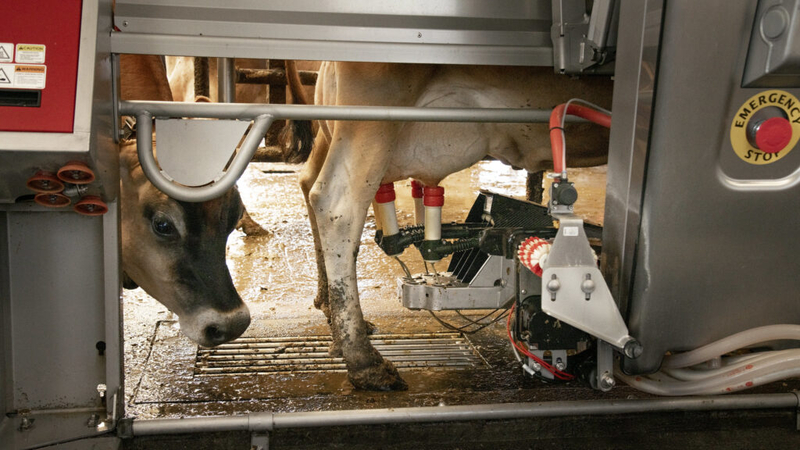
An ISU study found that other milking livestock and humans could be suitable hosts for the highly pathogenic avian influenza which has been detected in poultry, wild birds, dairy cattle and cats. (Photo courtesy of the USDA)
When the current outbreak of the highly pathogenic avian influenza virus was detected in dairy cattle in March 2024, a group of researchers at Iowa State University started to ask questions.
“If this virus can show up in cow milk, can it show up in other types of milk?” Todd Bell, a professor of veterinary pathology at ISU, recalled asking.
Bell, Rahul Nelli, a research assistant professor of veterinary diagnostic and production animal medicine at ISU, and more than a dozen other researchers examined the mammary glands of commonly milked livestock to find out.
Their conclusion: the milk-producing glands of production animals like sheep, goats, beef cattle and alpacas, as well as pigs and humans, have the same sialic acids that the virus was able to attach to in dairy cattle.
Nelli said in theory, this means there is a potential for the virus to bind to these sialic acids, which serve as receptors for the virus, and to start replicating in those cells.
“So far, we haven’t seen any such scenario yet, but that doesn’t mean it may not happen, because viruses always mutate,” Nelli said.
The team has other elements to research, like how efficiently the virus replicates in mammary glands and if the virus can infect other parts of the body from mammary glands, to fully understand the risk.
This information would later help regulating agencies, like the U.S. Centers for Disease Control and Prevention and the U.S. Department of Agriculture to develop policies to contain the spread of the virus.
The current outbreak of the H5N1 highly pathogenic avian influenza began in February 2022 and has since impacted more than 184.2 million commercial and backyard poultry.
The virus spread to dairy cattle in 2024 and since then has been detected in more than 1,000 cows across 18 states, including Iowa.
Detections of the virus in dairy have persisted in western states, but Iowa has not reported a detection in dairy cattle since July 2024, according to the USDA’s Animal and Plant Health Inspection Service.
Containing the bird flu has been a priority of U.S. Secretary of Agriculture Brooke Rollins since the start of the Trump administration, largely because egg prices had skyrocketed because of the virus.
Nelli said this is the first time the scientific community has seen an avian influenza infect mammary glands, but he said the “intriguing question” is whether or not these viruses have always infected mammary glands and no one thought to look there, or if this is unique to this strain of bird flu.
Bird flu viruses are typically known to infect respiratory tracts, but Nelli said now that it has been detected elsewhere, in the mammary glands, he believes researchers will have an “open mind” to look at other regions for infection.
Bell said while the human risk factor of H5N1 is currently rated by the CDC as low, it’s important for scientists to continue looking at all human-animal interfaces, because the risk can “change very quickly.”
There hasn’t been substantial research into the transmission of the virus from infected milk, however Bell said some infected dairy samples have shown “exceptionally high” amounts of the virus in raw, or unpasteurized, milk.
The ISU researchers said the best thing to do is to make sure dairy products – from all animals – have been pasteurized. The CDC holds that pasteurization kills the virus and makes dairy products safe to consume.
“Having this kind of information strengthens that argument of not having the raw milk, because there’s a chance of virus replicating in those glands, there’s a chance of virus coming out of those secretions from those glands, so there’s a chance of having the virus if you consume or inhale that that product,” Nelli said.
Bell said a main goal of the study, which was published Nov. 27 in the Journal of Dairy Science, is to help farmers and livestock producers to understand where the virus might show up on their farms.
Bell said future studies will look at other systems in the body, the respiratory tract, the gastrointestinal tract and neurological systems to see if those same receptors are there. He said that research, would help farmers to know potential areas where the virus could spread from animal to animal.
“If the virus is in large amounts in a water trough, could that potentially be a source of infection? If there’s large amounts on the ground, could that be a source of infection?” Bell said future studies would help to answer. “A lot of those questions haven’t been answered, and we’re trying to answer some of those because this virus is not behaving the way it normally does.”
In the meantime, the researchers suggested farmers remain vigilant to signs like sick animals and dead birds.
“Be vigilant that this is a time when the birds are flying through your farm,” Nelli said. “Make sure that they don’t interact with any of these animals we looked at, because they all have these receptors, so hence, all these animals, like the sheep, goat, alpaca, they all have a potential to be infected with this virus.”

Des Moines, IA