Iowa farmers behind on harvest as wet September comes to close
Sep 28, 2026 | 5:54 pm ET
Description
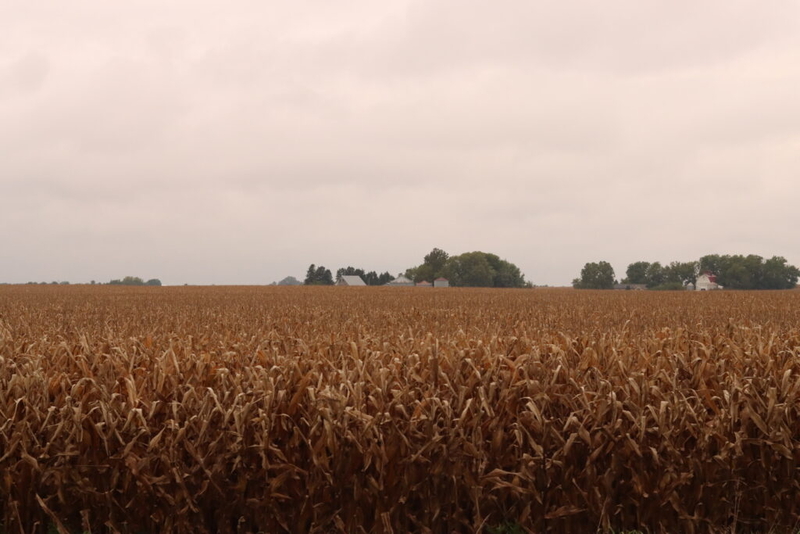
Rain over a corn field in late September 2026 near Minburn, Iowa. (Photo by Cami Koons/Iowa Capital Dispatch)
In typical years, according to crop progress and condition reports from the U.S. Department of Agriculture, farmers have harvested about 10% of corn acres and 15% or more of soybean acres by the end of September. The latest USDA report, however, shows just 3% of soybean acres and 5% of corn acres have been harvested in Iowa.
Farmers have had few days to get out in the field, as the state has had unseasonably wet conditions most of September. Iowa climate data shows this month as being one of the wettest Septembers on record.
The report noted farmers, on average, had just over one day of weather suitable for field work during the Sept. 21 through Sept. 27 reporting period. Between the latest reporting period and the week prior, corn and soybean harvest percentages have increased just 1%.
Corn and soybean maturity is also behind the five-year averages and the 2025 crops. In 2025, 78% of corn had reached maturity by the reporting period, compared to 72% of corn in the stage as of the latest report. Soybeans dropping leaves were reported on 62% of Iowa soybean acres in the latest report, which is significantly behind the 80% reported in 2025 at the same time period and 76% in the five-year average.
Iowa Secretary of Agriculture Mike Naig said in a statement that farmers are “eager to harvest their crops and will be ready to get combines rolling as soon as the fields dry out.”
Corn and soybean crops continue to rate highly, with corn at 75% good to excellent for the reporting period and soybeans at 74% good to excellent.
According to State Climatologist Justin Glisan, Iowa received a statewide average of 1.26 inches, which is only about half of an inch above the climatological normal. Glisan wrote that, “while rainfall was above normal across Iowa during the reporting period, it was not as unseasonably wet as the previous two weeks” when the state received more than a month’s worth of rain.
While Iowa had some drought conditions in northwestern portions of the state earlier in the season, the vast majority of the state, 87%, is not experiencing any drought conditions according to the latest map from the U.S. Drought Monitor.
Glisan said that areas of central and western Iowa, where precipitation totals were highest, received 1-2 inches more than normal during the reporting period.
The above average precipitation for the month has also meant a larger share of topsoil and subsoil have surplus moisture conditions. According to the report, nearly 40% of topsoil and nearly 30% of subsoil in Iowa had surplus moisture conditions as of the reporting period.
Glisan also reported that the state was abnormally cool for the week, with some stations reporting averages as much as three degrees below the normal of 60.7 degrees Fahrenheit. The statewide average temperature for the period was nearly 1 degree below the normal.
Des Moines, IA