Iowa Attorney General Brenna Bird, other AGs move to sue OpenAI in state courts
Oct 14, 2026 | 6:25 pm ET
Description
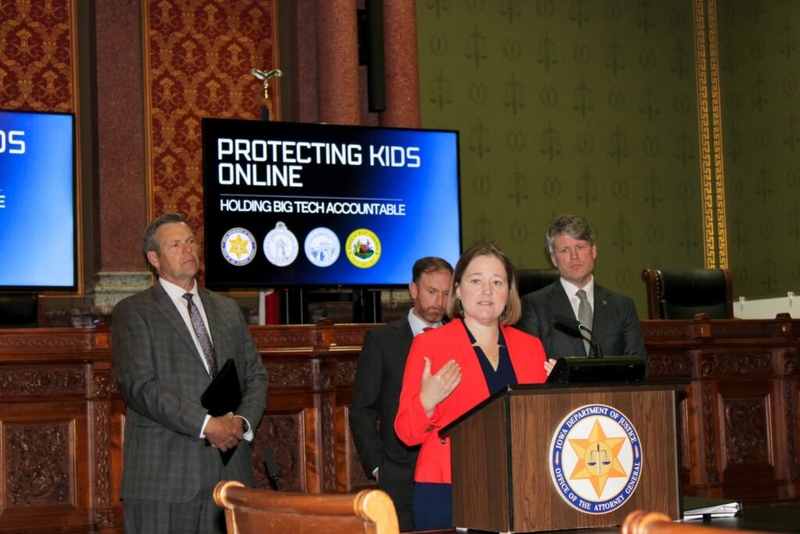
Iowa Attorney General Brenna Bird, joined by, from left, fellow state attorneys Kris Kobach of Kansas, JB McCuskey of West Virginia and Mike Hilgers of Nebraska, held a news conference Oct. 14, 2026 at the Iowa State Capitol on state AGs pursuing litigation against OpenAI. (Photo via Iowa Attorney General's Office's Facebook page)
Iowa Attorney General Brenna Bird and counterparts from three other states announced plans Wednesday to sue OpenAI in state courts, alleging ChatGPT harmed children and violated each state’s consumer fraud act.
Bird was joined by attorneys general Kris Kobach of Kansas, Mike Hilgers of Nebraska, and JB McCuskey of West Virginia at the Iowa Capitol to announce their planned litigation against the generative artificial intelligence company. Bird quoted OpenAI CEO Sam Altman, who recently told Politico, “we believe that the world should accept some bad things happening for the benefits of this technology and people having the agency.”
Bird said as attorneys general, “we refuse to accept that.”
“We will not just accept that any big tech company can make money by hurting Iowa’s kids and use them as lab rats, you know, in a race to be the first or the biggest or to have the most users,” Bird said. “When a big company does that, it’s time for me, as attorney general, to step in and … hold them accountable to our law and take them to court.”
The lawsuit filed in Iowa district court accuses OpenAI of failing to provide proper warnings or restrictions on the use of ChatGPT — particularly by minors — amid reports that the chatbot has issued responses that include false medical advice and that encourage violence or self-harm. The petition cites other lawsuits filed against OpenAI by parents who allege ChatGPT encouraged their minor child to commit suicide, and parents who say ChatGPT advised their teenage son it was safe to take a combination of drugs which ultimately led to his death.
Arkansas, Arizona, Idaho and Montana are also suing OpenAI in their respective state courts, alleging the company provided misleading statements about the safety of ChatGPT.
Kobach said many people may be used to attorneys general coordinating on litigation, pointing to lawsuits regarding the opioid crisis or tobacco.
“But usually, you don’t see us getting together to announce the lawsuit unless it’s really, really important,” Kobach said. “This is one of those lawsuits that’s really, really important, which is why I did the three-and-a-half hour drive (from Kansas) and Mike did a two-and-a-half hour drive from Lincoln.”
He said the litigation was a way to address ongoing safety concerns about the use of ChatGPT in states like Iowa and Kansas without needing to wait for Congress to take action on the federal level. Kobach said the lawsuits were filed because it would be “foolish” to wait for federal action to address this problem.
“Congress has been deliberating on this and holding hearings for more than a year,” Kobach said. “There are over 150 bills that have been submitted in Congress, and the vast majority of them have not even gotten a committee vote yet. The notion that we should wait for Congress to develop a universal solution, covers the entire country, and then apply that solution or apply those standards is foolish. We absolutely need to take action, because in the intervening year and a half or so, these harms that Attorney General Bird mentioned, have already occurred. And there will be more people … harmed by OpenAI if we continue to wait.”
The Kansas Republican added, “you also have the problem that many in Congress appear not particularly willing to oppose any significant restraint on the corporations engaged in AI.”
McCuskey said the lawsuits are not meant to be an impediment to the advancement of AI technology, “because there are so many remarkable things that AI is gonna do for us — It’s gonna cure cancer, it’s gonna help our military. it’s gonna make sure that we have the best processes for energy development that any other country in the world has.”
“But it can’t hurt our children,” McCuskey said. “And what we know is that it does. It is harming our children in real time, and what we’re doing today is we’re standing up and saying, ‘We believe that American exceptionalism is going to create an AI world that’s better than China, it’s better than Russia, it’s better than Iran, it’s better than our adversaries. But it’s going be safe for our children at the exact same time.”
Bird said the bipartisan group decided to pursue litigation on a state-by-state basis instead of as a group because it allows the attorneys general to sue OpenAI under their respective state’s laws, including state consumer fraud acts.
“The way the Iowa law works, it allows me, as attorney general, to step in on behalf of the whole group of Iowans who have been hurt under our consumer protection laws — and that is a state law, and so that is why we file it in our state court,” Bird said. “… We also know that there is power in numbers, and that OpenAI is a huge company, massive company. And so we know there is power in this bipartisan group of attorneys general coming together to stand up for their states, to stand up for the citizens of their state.”
Hilgers said filing separate state lawsuits allows each state to pursue action against the company on the basis of harm to their state’s citizens.
“I want to make sure that Nebraska parents are on a Nebraska jury to be able to determine what the Nebraska harm was, to hold them liable,” Hilgers said.
Des Moines, IA