Instead of closing, rural public schools losing enrollment could switch to Montessori education
Feb 19, 2026 | 5:55 am ET
Description
Some Montessori alumni include celebrities like George Clooney, Taylor Swift and Beyoncé.
(Getty Images)
Each year brings sad stories of more West Virginia public schools closing because of falling enrollment, especially in rural counties. Some causes are out-migration, an aging population, and a falling birth rate. But another cause is strictly political: a Republican-dominated state Legislature fixated on cultural issues and “school choice.”
The Legislature’s funding formula for schools seems highly democratic, based on equal funding per student and school choice. But student needs are different, and so are school performance outcomes. The democratic ideal is to graduate students who have 1) achieved a uniform educational standard and 2) developed their individual potential.
Our Legislature’s funding formula is undercutting both of these goals, especially in rural public schools — ironically, in a largely rural state and in districts many of the legislators represent. It’s time West Virginians elected some more enlightened representatives.
Under the current formula, rural public schools are being decimated because funding is based on enrollment. At the same time, the formula is drawing away enrollment from public schools by funding more Hope Scholarship vouchers for alternative schooling — in the home, online and in private or religious schools.
The resulting financial crunch is pushing rural counties toward school closings and consolidation, which brings new woes: the waste and expense of abandoning rural school buildings, enlarging the capacity of consolidated schools, losing experienced faculty in the process and centralizing administration/communication that becomes less responsive to fringe areas.
Rural students being transferred and moved about, especially the younger ones, will likely feel some loss, disorientation, stress and social distancing. The logistics for parents and students will become harder: earlier rising, getting to bus stops, bad weather and roads, longer bus rides, breakdowns and accidents, missing out on after school and weekend activities like sports.
The situation harks back to my high school days, each of which began and ended with a two mile dusty or muddy walk and a ten mile bus ride on treacherous mountain roads, except when I had to hitchhike after football practice. Town girls didn’t show much interest in me. I thought about dropping out, even though I made top grades.
Instead of closing low enrollment public schools, a better option is switching to Montessori education, which begins with children 2 to 3 years old, teaches the equivalent of three grades in one classroom, is sometimes bilingual, delivers better academic results, and develops traits like curiosity, self-motivation, cooperation, and creativity.
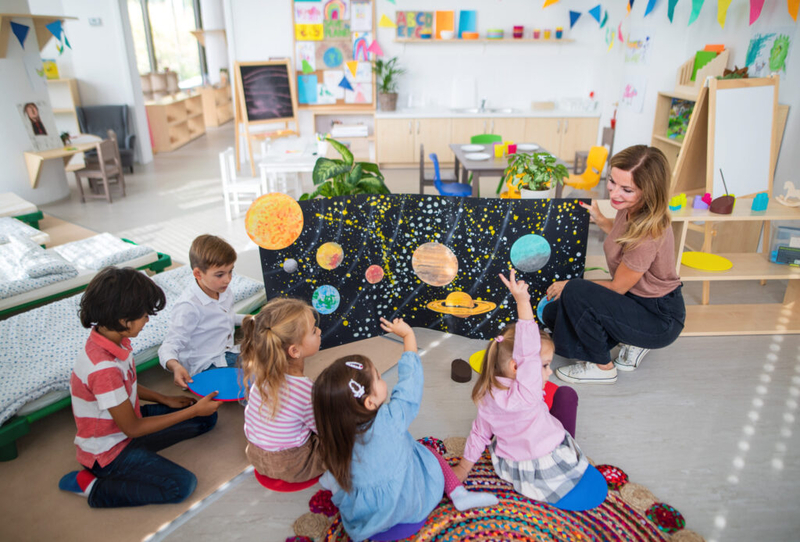
A Montessori classroom typically has one teacher trained in the method, an assistant, up to 30 mixed-age students who move around freely and talk but also concentrate on their choice of study, and a prepared environment with learning materials and child-sized furniture. It is set up to appeal to the prime stages of child development (like language learning), to encourage self-learning and peer sharing, and to be guided by the teacher and assistant, who can give either individual attention or presentations to variously sized groups.
Switching to Montessori education does require an initial investment in specialized equipment and teacher training, but it can be phased in over several years. Once Montessori classrooms are established, they cost less to run than traditional classrooms. A recent national study found the following: “Higher child-to-adult ratios in Montessori programs more than made up for costs of training and materials, saving districts an estimated $13,127 less per child over a three-year period.”
Free Montessori public schools operate the same as boutique Montessori private schools, which can charge up to $35,000 per year for preschool or elementary school in New York City. Some Montessori alumni include entrepreneurs like Jeff Bezos, Larry Page, and Sergey Brin; celebrities like George Clooney, Taylor Swift and Beyoncé; and royalty like Princes William and Harry.
While I was doing graduate studies for a Ph.D., my wife got a job as an assistant (later becoming a teacher) in a Montessori private school, where one benefit was free education for our two small sons. They both learned reading, writing and basic math in preschool, continued through Montessori elementary, and then excelled in ordinary public schools.
One became a physician recognized for his diagnostic skills; he might have treated you. The other became a software engineer who worked for companies like Sonos and SimpliSafe and as a consultant in the U.S. and Ireland; you might have used products he helped design.
Charleston, WV