Indiana agency surveys prevalence of artificial food coloring in school meals
Apr 28, 2026 | 6:30 am ET
Description
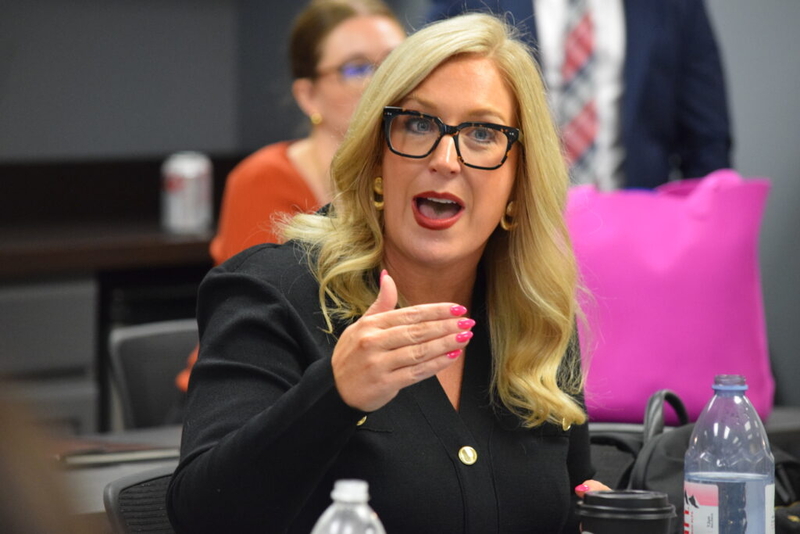
Indiana Secretary of Education Katie Jenner speaks during a 2025 meeting. (Photo by Casey Smith/Indiana Capital Chronicle)
The Indiana Department of Education is surveying public K-12 schools about the prevalence of artificial food dyes and additives following an order from Gov. Mike Braun last year directing state officials to assess the dangers of ultra-processed foods.
The voluntary survey went out to K-12 schools via a newsletter asking school officials whether they’ve observed a decline in artificial food dyes and additives served to students this year.
Braun directed Education Secretary Katie Jenner to survey schools, so the state could determine how common artificial food dyes and additives are in meals served to students.
He issued the executive order last April as part of U.S. Health and Human Services Secretary Robert F. Kennedy Jr.’s “Make America Healthy Again” campaign to curtail consumption of sugary and ultra-processed foods.
What’s in the survey
The survey asks school officials to confirm which dyes and additives are present in foods served to students who receive free or reduced-price meals through the National School Lunch and Breakfast Programs.
It singles out seven dyes of concern: FD&C Red No. 3, Red No. 40, Yellow No. 5, Yellow No. 6, Blue No. 1, Blue No. 2 and Green No. 3.
The survey asks school officials about their communications with food suppliers to determine whether suppliers are working to limit additives and provide electronic nutrient information and ingredient lists for schools.
The state also asks school officials to estimate the percentage of foods served to students on free or reduced-price meals containing artificial food dyes and additives.
Ultra-processed foods a target for conservatives
Braun issued a series of executive orders last year targeting ultra-processed foods and fitness.
The most well-known and controversial is an order to exclude soft drinks and sugary snacks from Indiana’s Supplemental Nutrition Assistance Program, or SNAP, food benefits for the poor.
‘A pain’: SNAP retailers, shoppers pan Indiana sugary drinks, candy ban
Braun directed the Indiana Department of Health to evaluate existing scientific research and assess the prevalence of artificial food dyes and additives in popular foods to identify potential risks for Hoosiers who consume them.
Another order asked Jenner, the state health commissioner and the director of the Indiana State Department of Agriculture to promote healthier food consumption in schools through locally-sourced and farm-to-school programs.
The same order directed Jenner to establish the Governor’s Fitness Test, consisting of exercises like push-ups, pull-ups, sit-ups and one-mile run, to promote fitness in K-12 schools.
Focus on schools
Lawmakers debated targeting ultra-processed foods served to K-12 students this year.
A bill introduced by state Rep. Julie McGuire, R-Indianapolis, would have restricted ultra-processed foods and beverages like sugary cereals and chicken nuggets from being served in school meals, including snacks and vending machines.
“Food is medicine,” McGuire said. “What we put in our body directly affects our health. … We know (food) is engineered to be addictive.”

McGuire said many families don’t have a choice when it comes to what their children eat at school, even if they would prefer healthier options, because they can’t afford alternatives.
Half of a child’s daily caloric intake happens in the school cafeteria, McGuire said, and nearly three-fourths of the foods a child eats in a day are ultra-processed.
McGuire is animated by concerns about rising rates of chronic disease and childhood obesity, an affliction she says often follows children through high school because they are not exposed to healthy food at school.
“It’s the cumulative effect of thousands of meals” from preschool to adulthood, she said.
The bill did not advance from the Senate Education Committee due to concerns from food processors and questions about how the state would define ultra-processed food, but McGuire said she intends to revisit the idea, especially if the federal government comes up with a definition for ultra-processed foods.
“We all see it growing up — how children are more overweight, and they’re going to struggle with that,” she said. “Sticking them on GLP-1s (weight loss medication) is not the answer. It’s controlling what they consume in a healthy way, not to be punitive, but to be supportive.”

Indianapolis, IN