Hudson residents join lawsuit against town over ICE detention center zoning
Sep 09, 2026 | 12:40 pm ET
Description
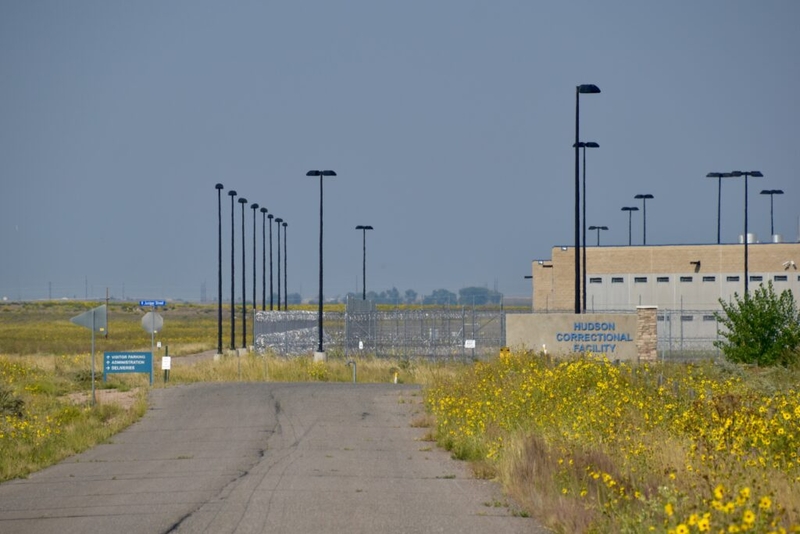
The dormant Hudson Correctional Facility is pictured on Sept. 4, 2025. (Photo by Chase Woodruff/Colorado Newsline)
The town of Hudson has refused for months to take any steps to review and enforce its zoning code as it applies to a planned immigration detention center there, say the plaintiffs in a lawsuit seeking to block the facility — and three Hudson residents are now joining them.
Wendy Homstad, Caden Grosshans and Emily Shanks, all residents of Hudson, were added as plaintiffs alongside Weld County resident Janet Carlson and the nonprofit Together Colorado, in an amended complaint filed Tuesday in state court, the group said. Carlson is a neighbor of the dormant prison known as the Big Horn Correctional Facility, which operated as a private prison for the Alaska Department of Corrections from 2009 until 2013, but her property is not within town limits.
The GEO Group, a private prison company, has announced a five-year contract with Immigration and Customs Enforcement to reopen the facility as a 1,200-bed immigration detention center. But the lawsuit, filed in July against the town of Hudson, its town council, its planning commission and Planning Director Jennifer Woods, alleges that a conditional use permit for the site, approved by voters in 2008, is now void after more than 12 years of vacancy.
“I’ve gone to meeting after meeting, and I’ve watched my neighbors do the same, and every time the answer is the same: it’s not our problem,” Shanks said in a statement Wednesday. “I’m not asking Hudson to take a side in a national debate. I’m asking Hudson to follow its own rules, the same rules it would make anybody else follow.”
Hudson officials have maintained that the town “does not have authority to approve or deny federal use of this private facility.”
Faith group, Weld County resident sue Hudson over ICE detention center zoning issue
Attorneys for the town filed a motion to dismiss the lawsuit last month, arguing the plaintiffs lack standing to bring the case. Together Colorado “lacks any connection to the Town,” they argued, while Carlson “lacks a direct connection to the Town,” and the injuries both plaintiffs claimed in the initial complaint were “presently speculative and cannot be determined until a remote time in the future.”
The amended complaint, however, points to Hudson’s own estimates, in its Water Supply Master Plan, that the reopened facility’s water consumption could reach 230 acre-feet annually, nearly doubling the town’s average water use over the last 20 years.
“The reopening of the (Big Horn Correctional Facility) will reintroduce demands that the Town has not anticipated for some time,” the plan says.
“Once the (facility) reopens, Hudson no longer can use the (Colorado-Big Thompson Project water) dedicated for the prison to meet other water demands within Town,” it continues. “This drives the need for Hudson to immediately shift its approach to use other water resources to meet its water demands.”
Other concerns cited by town residents in the new complaint relate to a projected increase in 911 calls, a trend observed in other rural ICE detention centers run by GEO, and the risk of public health emergencies like the tuberculosis case state officials have been barred from investigating at GEO’s facility in Aurora.
“After hearing about deaths and disease outbreaks in other detention centers, including a tuberculosis outbreak at the GEO-operated facility in Aurora, Plaintiffs Homstad and Grosshans have also grown concerned about the public health risks posed by the Facility, which could spread to the community through Facility staff and visitors, and the strain on the Town’s limited emergency services infrastructure,” the complaint reads.
Despite months of residents raising concerns about the facility through public comment periods and other official channels, town officials have declined to formally explain their position, review the alleged violation, “adopt an official code revision, or issue a conditional use permit” for the facility, the suit alleges.
“Hudson has had every opportunity to sit down, answer questions, and follow the process laid out in its own code,” said David Seligman, executive director of Towards Justice, the progressive legal advocacy group representing the plaintiffs. “Instead it has chosen silence, and now litigation.”

Immigration advocates and Colorado Democrats have been staunchly opposed to the Hudson facility’s potential use as an ICE detention center since last year. The Aurora facility, which has long been the target of criticism from activists over allegations of inhumane conditions and dehumanizing treatment, is Colorado’s only currently operational ICE detention center.
GEO seeks to intervene
In his second term, President Donald Trump has pledged to carry out the “largest domestic deportation operation in American history,” aiming to remove all of the estimated 12 million immigrants in the country without permanent legal status, regardless of how long they have been in the country, the legal status of their family members or whether they have criminal records.
Together with CoreCivic, another large private-prison company, The GEO Group is expected to be the prime beneficiary of a multibillion-dollar windfall for expanded immigration detention services authorized by Republicans’ 2025 spending and tax cut law. Last year, GEO chairman George Zoley spoke during an earnings call about the “attractive opportunity for investors” presented by “the unprecedented growth opportunities we anticipate will materialize over the balance of this year and next year.”
Attorneys for GEO moved to intervene in the case last month so that the company “can seek dismissal of this lawsuit and, if necessary, defend its substantial interest in performing its contracts with the property owner and ICE.”
The plaintiffs say their case only concerns the town of Hudson’s application of its zoning laws. They’re seeking a court order requiring town officials to comply with the “relevant procedures for amending the Land Development Code and/or granting or amending a conditional use permit.”
“This case concerns only the Town’s own authority and duties under the LDC — not the validity, meaning, or performance of any contract to which GEO is a party,” the plaintiffs in an Aug. 31 filing said. “GEO’s efforts to intervene in this matter will do nothing other than needlessly complicate this litigation.”

Denver, CO