House Democrats say GOP discord dashed deal on a skill games bill
Oct 21, 2026 | 5:00 pm ET
Description
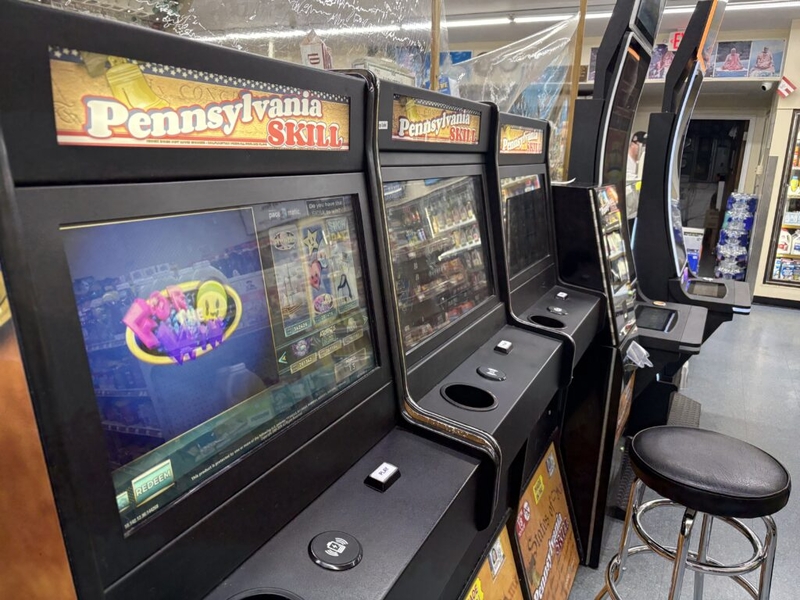
Pennsylvania Skill Games in a Delaware County convenience store. (Photo by Peter Hall/Capital-Star)
(This article was updated at 6:45 p.m., Wednesday, Oct. 21, 2026, to include comments from House Majority Leader Matt Bradford and Senate Minority Leader Jay Costa.)
A deal between state lawmakers to legalize and tax skill games is dead, leaders in the Democratic-controlled House said Wednesday.
House Appropriations Committee Chairman Jordan Harris (D-Philadelphia) said Senate Republicans were unable to muster votes needed to pass a skill games bill in the upper chamber, dashing hope for an agreement before the end of the legislative session next month.
“I think it’s the worst kept secret in this building that over the last couple days we’ve been negotiating, trying to get skill games done,” Harris told the Capital-Star. “But at this juncture, the Senate Republicans have created a problem and have killed the solution, and therefore I don’t see that happening.”
Speaking to reporters after lawmakers adjourned, House Majority Leader Matt Bradford (D-Montgomery) said that caucus leaders had “a 100%, comprehensive deal,” but pinned the inability to finalize negotiations on a “dysfunctional, incoherent and incompetent” Republican-controlled Senate.
“Today’s failure, spectacular as it was, not to get over the line of the issue of skill games is emblematic, frankly, of what we’ve seen for the last two years under this Senate that is hopelessly divided,” said Bradford. “Senate Republicans left town today, tail between their legs, with no idea how to proceed forward.”
He claimed that Republican leadership couldn’t get enough votes on the package but wouldn’t rely on Senate Democrats, who supported the proposal. He declined to share details in the hopes of reaching a consensus in the session days after Election Day.
“We recognize that even at this late, late hour, we are optimistic that either a future Senate — or, God willing, a future (Democratic) Senate majority … will present an opportunity to get a deal done,” he continued.
Recent election forecasts predict a favorable midterm election for Democrats, who currently control the state House and the governor’s office, meaning the party could control the upper chamber for the first time since 1993.
Senate Majority Leader Joe Pittman (R-Indiana) did not respond to a request for comment.
An unfinished ‘laundry list’
House and Senate Democratic leaders also criticized Republicans in the Senate for stymying progress on a “laundry list” of issues in addition to skill games, including: increasing the state’s minimum wage, addressing an incoming mass transit financial cliff or legalizing recreational cannabis.
Notably, the two chambers didn’t come to a consensus on felony murder, otherwise known as second-degree murder. Currently, there are no sentencing guidelines for the charge, which is levied when someone kills another — even if it’s not intentionally — during the commission of another felony, such as armed robbery or burglary.
“I think it’s another example of not being able to come together and reach a compromise or consensus on what needs to be done,” Senate Majority Leader Jay Costa (D-Allegheny) said.
After Wednesday, only two session days for each chamber remain on the calendar in November. The General Assembly’s next session begins in January.
State lawmakers have been working over the last four years to pass a regulatory and taxing scheme for skill games. The effort intensified this summer after the state Supreme Court declared in June that the slot machine-like games are gambling devices required to be licensed by the state Gaming Control Board.
Before the ruling, skill games occupied a legal gray area created by lower courts that found the devices are distinct from casino slot machines because they give players a chance to win back their bets by completing puzzles and memory games. In the past decade, they became common in taverns, restaurants and private clubs, where owners said they depended on the extra money the machines brought in.
Recognizing the upheaval its decision would cause as an estimated 70,000 machines became contraband, the Supreme Court delayed enforcement of its ruling for four months. That Oct. 14 deadline prompted eleventh hour efforts to extend the deadline and find common ground between lawmakers who differed on details of a regulatory scheme.
Harris said he would not discuss the details of the proposed legislation, but debate has centered on how much skill game hosts, operators and distributors would be taxed, whether the Gaming Control Board would have regulatory authority, and how the additional revenue would be used.
“We’re still here if the Senate wants to run a bill out of the Senate, send it over,” adding that the House has bills that are already most of the way through the legislative process that can be amended to include skill game oversight.
Previous proposals
Gov. Josh Shapiro proposed a 52% tax rate — comparable to casinos — as part of his 2026-2027 budget proposal. His office estimated it would eventually generate $2 billion in revenue for the state’s general fund. Shapiro said earlier this month in a debate against state Treasurer Stacy Garrity, the Republican nominee for governor, that he would use a core portion of the money for mass transit.
Sen. Camera Bartolotta (R-Washington) told the Capital-Star last week that she and other rural senators opposed sending the lion’s share of the money to Philadelphia, where it is needed to offset a funding shortfall for the Southeastern Pennsylvania Transportation Authority (SEPTA).
Gaming industry sources said there was “still lots of disagreement” about competing proposals, including one to provide a portion of the revenue to the commonwealth’s ailing horse racing industry, which the state’s original gaming law was intended to support. Another point of discord centered around how licenses would be distributed and whether the games would be limited to establishments with liquor licenses.
Among the lawmakers pushing for an extension of the Supreme Court’s stay was Sen. Gene Yaw, whose district includes Miele Manufacturing, which produces physical skill game devices. He disagreed with House Democrats’ assertion that leaders had agreed on a bill to put up for a vote but conceded no action could be taken in the remaining days of the session.
“Quite frankly, it’s too late to do anything now,” he said.
While Senate leaders had endorsed a proposal to tax skill games at 35%, Yaw offered a competing proposal at 16%. Then as the deadline approached, Yaw and Sen. Anthony Williams (D-Philadelphia) proposed replacing the tax structure with a monthly $500 per-machine fee that would generate $300 million annually.
Senate Bill 1079 also would have addressed pop-up casinos, or store fronts that serve as skill game parlors with no other associated business, Yaw said.
He noted that the commonwealth’s skill game industry, which includes not only distributors like Georgia-based Pace-O-Matic, but also amusement companies that operate the machines and the establishments that host them, employs about 40,000 people. Yaw said some operators in his district and elsewhere have laid off dozens of workers since the ruling took effect.
“My goal was to protect the jobs,” he said. “So where that income went, as long as it wasn’t starting some new pie-in-the-sky program, I would have gone along with it.”
Harrisburg, PA