House and Senate set Aug. 19 Veto Day, amid Ayotte’s record vetoes
Aug 04, 2026 | 2:03 pm ET
Description
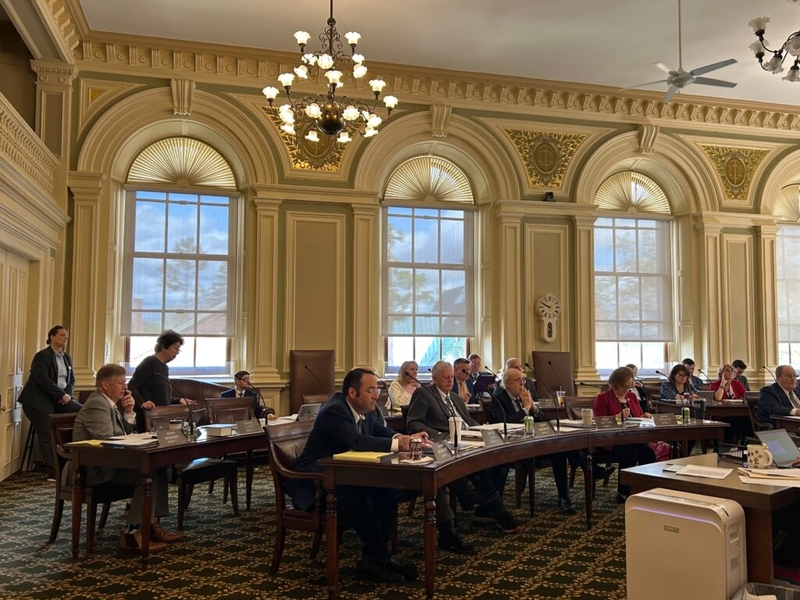
Republicans hold a 16-8 majority in the New Hampshire Senate. (Photo by Molly Rains/New Hampshire Bulletin)
The New Hampshire House and Senate will meet Aug. 19 to take up 31 of Gov. Kelly Ayotte’s 33 vetoes this year, after the Republican governor broke a modern record for vetoing the most bills in one year passed by a Legislature of her own party.
This year’s Veto Day, which will occur 20 days before the Sept. 8 state primary, could highlight profound disagreements among moderate Republicans, conservative Republicans, and Democrats. Many of the bills Ayotte vetoed touch on incendiary cultural issues.
Three vetoed bills are nearly identical: Senate Bill 268, Senate Bill 552, and House Bill 1442 would all allow businesses to require patrons to use bathrooms, locker rooms, and other facilities that correspond to their biological sex at birth — and require that separation in state jails, prisons, and hospitals. Republicans have repeatedly submitted the legislation, known as the “bathroom bills,” despite Ayotte’s previous vetoes, arguing they want to send a message. Democrats and LGBTQ+ advocates have denounced the bills as attacks on transgender adults, and Ayotte has said they would cause discrimination.
Lawmakers will also take up Ayotte’s vetoes of Senate Bill 434, which requires public schools to adopt procedures to allow books to be challenged and removed; House Bill 1358, which would create a study commission to explore converting public schools to charter schools; House Bill 232, which would expand the “rights of conscience” of medical professionals to refuse to assist in abortions; House Bill 1422, which would allow convicts to introduce new evidence to prove their innocence beyond the current three-year limit; Senate Bill 627, which would raise turnpike tolls for drivers without New Hampshire E-ZPass transponders; House Bill 2026, the 10-year transportation improvement plan that also raised tolls; and House Bill 1336, which would allow landlords to request an additional month’s rent security deposit for tenants with low credit scores or lacking landlord recommendations.
Most of the Republican-led legislation will likely not be overturned. Lawmakers need a two-thirds majority of all elected members of both the House and Senate in order to override a veto. Senate Republicans, who hold a 16-seat supermajority in the 24-member chamber, can achieve that threshold without Democratic votes, but House Republicans, who hold a smaller majority, need Democratic support.
The bills will be taken up by the body in which they originated: Senate bills in the Senate and House bills in the House. They will advance to the other chamber only if they pass the first chamber by two-thirds.
The House has already voted on and failed to override two of Ayotte’s vetoes this year: House Bill 349, which would have allowed optometrists to perform certain laser procedures, and House Bill 451, which would have required paint manufacturers to operate and pay for a recycling system.
To see the full list of vetoed bills, click here.
Concord, NH