As he worked to advance the Intel project, an Ohio senator’s wife was invested in it
Aug 28, 2026 | 3:55 am ET
Description
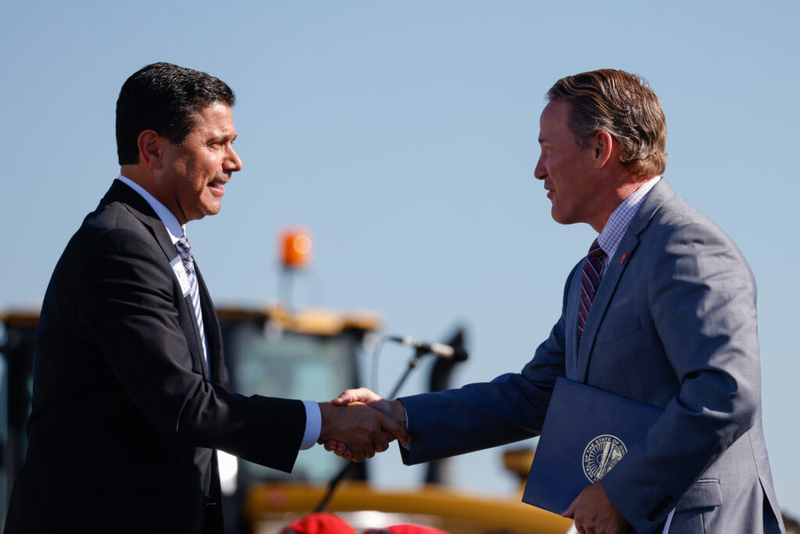
Then-Lt. Gov. Jon Husted (right) welcomes President and CEO of JobsOhio J.P. Nauseef to the podium at a groundbreaking ceremony for Intel’s new semiconductor manufacturing site on Sept. 9, 2022, in Licking County, Ohio. (Photo by Graham Stokes for the Ohio Capital Journal / Republish photo only with original story)
Ohio U.S. Sen. Jon Husted’s wife had as much as $15,000 invested in the struggling Intel megaproject in New Albany as her husband worked to push it forward, financial disclosures show.
At least since Gov. Mike DeWine appointed Husted to the Senate at the beginning of 2025, Husted has had communications with Intel about potential deals with other businesses to revive the project.
Husted, a Republican, also said he pushed the Trump administration to make its controversial $9 billion taxpayer investment in the beleaguered chipmaker last year.
News of the investment and the potential deals substantially increased the value of Intel stock when it became public.
Husted has also received thousands in campaign contributions from Intel lobbyist Josh Rubin, whom DeWine appointed to be chairman of the JobsOhio board in September 2023. Husted was DeWine’s lieutenant governor at the time.
A quasi-governmental entity that has spent billions in what at least used to be public dollars, JobsOhio has given Intel more than $27 million for the Ohio project. The state, of which Husted was the second-ranking executive at the time, gave Intel more than $600 million.
JobsOhio chairman lobbies for Intel, a company that got millions from JobsOhio
Husted’s communications team didn’t respond to questions for this story — including whether he thought trading of individual stocks by members of Congress should be banned.
Catherine Turcer, executive director of the good government group Common Cause Ohio, said Husted’s relationships with Intel and Rubin raise questions about whom Husted is serving.
“The problem has to do with how very cozy everything is,” she said. “It would be so very easy to make decisions based on what benefits your boss, what benefits yourself, and not what benefits Ohioans. And that’s where the challenge is. Whenever you have stock, an investment in a company, it’s very hard to look just at economic policy.”
Blockbuster project
To great fanfare, the DeWine-Husted administration in 2022 announced the massive Intel project about 20 miles northeast of Columbus.
It promised to be at least a $20 billion investment — and it promised to serve the strategic goal of bringing microchip production back to the United States.
It came with a price. The DeWine-Husted administration said it would put up $2 billion in state incentives and JobsOhio pledged another $150 million.
The project began to hit snags. At the start of 2024, Intel announced that it was delaying its construction timeline, citing sluggish chip sales.
Hemorrhaging money in July 2025, the company announced that it was laying off 24,000 people worldwide, abandoning two construction projects in Europe and further delaying the Ohio project. Originally slated to begin production by the start of this year, the facility now won’t start making chips until 2030 at the earliest.
As the problems grew, so did the DeWine-Husted administration’s entanglements with the chipmaker.
Rubin, a former campaign manager and longtime advisor to DeWine, signed on as a lobbyist for Intel in 2022, the year the Ohio project was announced.
The same year, he and his wife made nearly $15,000 in contributions to Husted’s political committee, Jon Husted for Ohio, records at the Ohio Secretary of State’s office show. A year earlier, they made at least $20,000 in such contributions.
Rubin also contributed generously to DeWine’s committee. Campaign-finance watchdog Transparency USA reports that Rubin has given $60,000 to Mike DeWine for Ohio over the years.
In September 2023, DeWine appointed Rubin, a lobbyist with dozens of clients, as chairman of JobsOhio, an entity that has passed out more than $2 billion to businesses in the form of incentives. JobsOhio gets its money from the state liquor franchise, which the state allows it to lease for far less than it’s worth.
Controversial ‘private corporation’ JobsOhio gets billions more without paying more to state
Lobbying disclosures show that Rubin continued to actively lobby DeWine and Husted on behalf of Intel at least until earlier this year.
They also show that Rubin was registered to lobby JobsOhio — whose board he headed — for Intel until the end of last year. Despite his and his partners’ registrations, they didn’t file any reports showing that they actively lobbied the agency after Rubin joined its board.
Intel was asked how much it had paid Rubin and his firm, how much it paid after Rubin joined the JobsOhio board, and whether any of that money was specifically to lobby JobsOhio after Rubin was part of the organization. The company declined to comment.
Rubin didn’t respond to calls and emails about these matters. DeWine’s press secretary insisted that Rubin didn’t have a conflict of interest.
JobsOhio is exempt from most state ethics and transparency laws.
A spokesman for the agency said it has its own strong anti-conflict rules. He didn’t respond to repeated questions asking whether Rubin had ever declared a conflict or recused himself from funding decisions, even though he and his partners had been registered to lobby DeWine, Husted, and JobsOhio on behalf of Intel and multiple other clients.
Inside track, personal investment
Lobbying disclosures also show that Rubin actively lobbied Husted for Intel from 2022 until DeWine appointed his lieutenant governor to fill the Senate seat vacated by JD Vance when he became vice president in January 2025.
Husted’s office didn’t respond when asked what was discussed regarding the Intel project when he talked with Rubin, or whether Rubin had a conflict in his dual roles as Intel lobbyist and head of a quasi-public entity that had given Intel millions.
It also didn’t respond when asked whether Husted himself had a conflict stemming from a family investment in a company to which his administration had given $600 million in the form of a “reshoring” grant.
Husted’s Senate lobbying disclosures show that as of Jan. 21, 2025, his wife owned as much as $15,000 worth of common stock in Intel. His most recent financial disclosure — for calendar year 2025 — shows that investment as well.
State lobbying disclosures require different information than those at the federal level. DeWine’s disclosures show he had big enough investments in Intel to generate $14,000 in dividends from 2021 through 2023.
Since Husted disclosed his wife’s Intel investment, multiple news reports indicate that Husted was privy to developments that resulted in rises in the value of Intel stock:
- Last August, the Trump administration announced that it would take a 10% stake in Intel. Critics said the government was picking winners and losers, but Intel’s stock surged 6% on the news. Husted told The Columbus Dispatch, “It’s foundational. It’s a big deal. It’s the perfect relationship. And they had no relationship before. It’s something I’ve been working on and hoping for for some time.”
- In May, Husted told The Dispatch that he had discussed with Intel a preliminary chipmaking deal with Apple. Intel declined to confirm it to the newspaper. After Trump later wrote about the deal in a social media post, Intel stock rose 10%, CNBC reported.
- In July, Husted told The Columbus Dispatch that Intel informed him of a potential partnership with a South Korean Firm, SK Hynix. The Street reported that Intel shares jumped nearly 9% when the news broke — even though SK Hynix denied the deal.
Reform efforts
There have been efforts to stop the perception that members of Congress might be profiting from information to which they have special access.
Last year, separate, bipartisan bills were filed in the U.S. Senate and U.S. House that would ban members of Congress and their families from trading individual stocks because they might be privy to such insider information.
One measure passed the House last month, but Democrats opposed it after Republicans inserted an unrelated voter ID measure.
Channel 4 WCMH in February reported that Husted didn’t take a position on a trading ban. Ohio Democratic U.S. Rep. Joyce Beatty opposed it, saying it would allow the “government to control my personal financial decisions.”
Meanwhile, Husted’s Democratic opponent in the February midterms, former Ohio Democratic U.S. Sen. Sherrod Brown, supports a ban on congressional ownership of individual stocks — and on lawmakers becoming lobbyists after they leave office.
A review of Brown’s federal financial disclosures since 2012 didn’t appear to show he had any such investments. In an email, Brown slammed his opponent for what he called Husted’s “corruption.”
“Jon Husted has spent his entire career helping corporations and billionaires at the expense of Ohioans,” Brown said. “While Husted is busy lining his own pockets and rigging the system even further for hardworking families, Ohioans are being crushed by record high prices on their groceries, gas, health care, and utilities. Ohio doesn’t have to continue accepting Husted’s corruption. It’s why we are going to hold him accountable this November.”
Columbus, OH