Guns, drugs, budget cuts, AI join traditional maladies at public health forum
Oct 21, 2026 | 5:00 am ET
Description
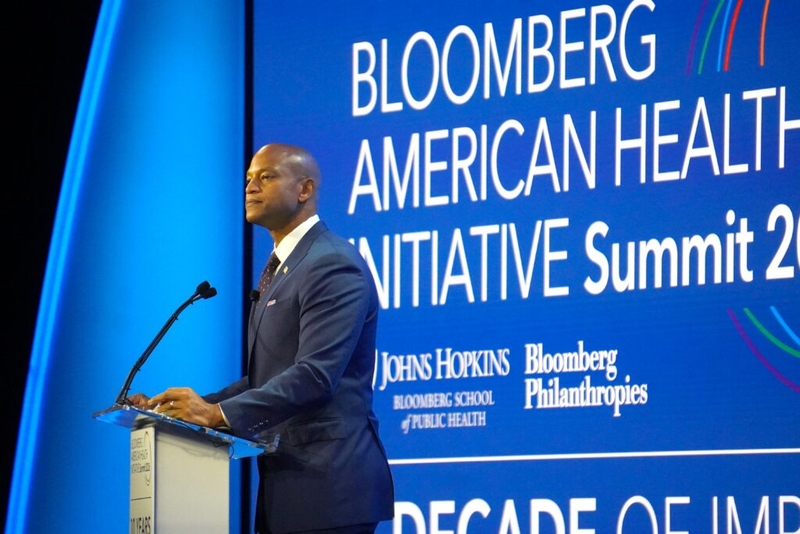
Gov. Wes Moore speaks at the ninth annual Bloomberg American Health Initiative forum in Baltimore, to highlight recent state healthcare policies like the Vax Act. (Photo by Danielle J. Brown/Maryland Matters)
A daylong public health forum in Baltimore on Tuesday touched on health challenges that likely aren’t found in any medical textbook: gun violence, artificial intelligence, social media and “the ravages of Washington” under the Trump administration.
Those were just some of the wide-ranging topics at the 2026 Bloomberg American Health Summit, the ninth annual gathering of more than 500 fellows with Bloomberg American Health Initiative and local and national leaders in public health research and policies.
Topics in the Baltimore Marriott Waterfront event also included more typical, and persistent, public health concerns like combating drug overdoses and diverting patients from emergency rooms as a first resort.
Gov. Wes Moore (D) and Baltimore Mayor Brandon Scott (D) were featured speakers at the event, where elected officials and health officials discuss where city and state policies can help combat emerging public health challenges.
Moore told the room full of Bloomberg fellows he was grateful for their work as “the ones to tackle the problems that are difficult…. You’ve been the ones who have made the impossible, possible.” He said that those efforts are needed “now as much as ever before,” as recent changes to Medicaid and federal funding cuts threaten to strain health systems in Maryland and across the nation.
“We have a federal administration that is willing to take away healthcare for more than 10 million Americans … and in Maryland we are protecting our people from the ravages of Washington,” Moore said.
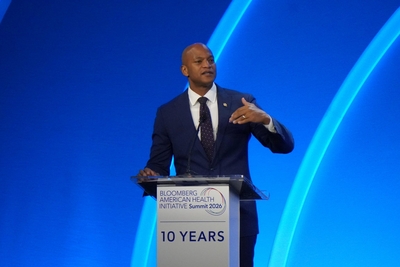
He highlighted $25 million in new funding to help offset an anticipated rise in uninsured Marylanders seeking medical care at the emergency department, due to changes under the 2025 budget reconciliation bill, H.R. 1.
“That money will help members of our community who have lost healthcare coverage because of H.R. 1 to be able to get healthcare at a local community health center and at our health departments,” Moore said. “And it will help to keep them out of costly emergency rooms.
“I do not understand a philosophy where simply thinking that putting people into emergency room care is somehow either good medicine or, frankly, good economically,” he said.
The funds were approved in July by the Health Services Cost Review Commission, and the Maryland Health Care Commission has opened applications for federally qualified health centers and certain local health departments to apply for that grant funding. Those funds will help boost access to preventive care so that individuals are less likely to seek out care at Maryland’s already struggling emergency departments.
Moore also highlighted the new Vax Act, which grants the state health secretary authority to recommend vaccine policies different from those set by the federal government, due to the Trump administration sowing doubt on the effectiveness or safety of certain vaccines.
Gun violence as a public health issue
At several points throughout Tueday’s summit, Scott was praised for the rapid decline in Baltimore homicides from gun violence in recent years, including from Michael R. Bloomberg of Bloomberg Philanthropies.
Scott urges local leaders to develop response plans following last year’s mass overdose events
“Baltimore has been leading the way under Brandon Scott, he deserves a round of applause,” Bloomberg said. “Over the past three years, the city murder rate has fallen by 60%, further and faster than any other major American city … He’s the real thing and he’s doing a real good job.”
But for Scott, the job is not done, as more than 100 people still died by gun violence last year.
“Gun violence is the reason that I, at the ripe old age of 7, decided I wanted to be the mayor of Baltimore,” he said. “When you grow up in a neighborhood where I’ve been a victim of gun violence, I was robbed … had a gun to my head, it hits differently for you.”
While other cities have also seen gun violence decrease, Scott has framed gun violence prevention efforts as a public health problem. That was initially an unpopular approach, but it has grown in recognition over time.
“We have to think about public safety through a lens of public health, and how it impacts everyone and everything,” Scott said. “You do the right thing no matter how unpopular it is and no matter that it means that you might not keep your job…. Your job is to save as many people as possible.”
Struggles with AI
The effects of digital technologies, social media and AI has gained more attention in recent years, due in part to a recent $17.1 billion settlement involving social media company Meta. Washington, D.C., 47 states and three U.S. territories alleged that Meta-owned platforms like Facebook and Instagram were harmful to kids and designed to be addictive.
Maryland is set to receive up to $327 million from the settlement, and policymakers are already discussing how those funds should be used to help the state’s youth navigate digital platforms and new technologies.
One of the emerging challenges that public health researchers, providers and officials are concerned over is the effect of artificial intelligence on the mental health of children and teens.
Emily Haroz, deputy director of the Johns Hopkins Center for Suicide Prevention, said that almost 20% of 12- to 18-year-olds have used AI chatbots for mental health reasons. She said that AI programs may be helpful as a screening tool to identify which kids are facing severe mental health challenges to connect them with other resources.
But some fear that AI chatbots can worsen mental health challenges for kids. Laura Reiley, a journalist with the Cornell Chronicle, said her daughter died by suicide last year after having lengthy conversations on her mental health with an AI chatbot.
“Her chatbot functioned as her doctor, said it was her therapist,” Reiley said. “And when she said, ‘I have decided to kill myself after Thanksgiving,’ it said, ‘You are so brave to tell me that.’”
Reiley said that there need to be more safety measures in place.
“Chatbots need to say upfront what they are and what they aren’t … They are not clinicians, they are not people,” she said. “I also think every iteration of these chatbots need to be tested with clinicians … these conversations, the safeguards around them are pretty good in the short conversation but things go off the rails the longer that conversation goes.”
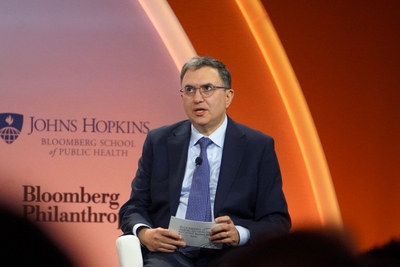
Haroz said that some states are trying to limit the negative effects of AI, with limitations of its use in schools and other policies, but data on what works is very limited right now.
“Thinking about regulatory approaches is really important, and states have been carrying a lot of this work on their own, but it’s also been in the absence of a lot of evidence,” Haroz said. “Ultimately we’re doing this without really knowing how they are helping or hurting people.”
Dr. Joshua Sharfstein, director of the Bloomberg American Health Initiative and former chair of Maryland’s hospital rate regulating board, announced that the initiative was going to start a program designed to tackle youth mental health in digital environments.
“It’s going to be part of our adolescent health work, more details will be forthcoming, but we’re really excited to be engaging a bunch of fellows and organizations in that work,” Sharfstein said. “We’ll be involved in research to understand what’s been happening and develop ideas for policy, including policy on how to spend some of the money that’s coming in through these settlements.”
Annapolis, MD