Group tasked with exploring how to pay for regional rail tosses task back to legislators
Aug 19, 2026 | 8:00 am ET
Description
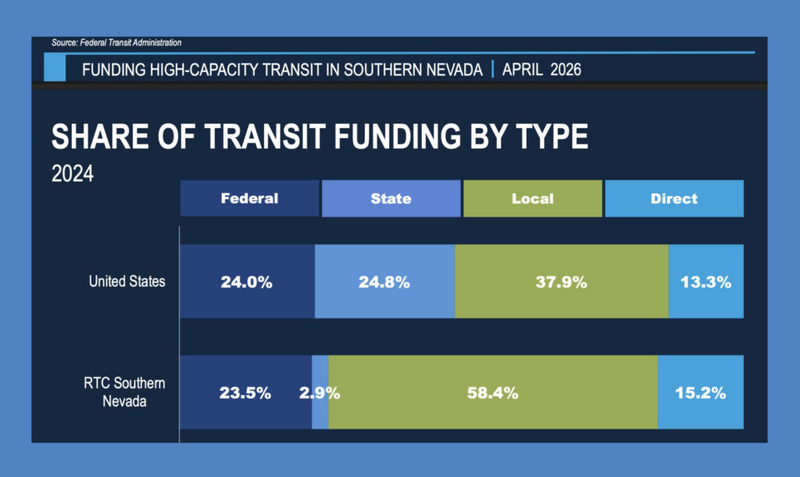
On average nationally, states contribute nearly ten times more to the cost of their public mass transit systems than the state of Nevada pays to support public transit in the Las Vegas metropolitan area. (Graphic: Guy Hobbs, financial advisor to RTC)
State lawmakers on Tuesday approved a slate of legislative recommendations proposed by a regional rail working group that are supposed to aid the state to potentially develop mass transit, such as light rail, in metro areas.
None of the proposals, which are expected to be discussed in the 2027 Legislative Session, include concrete suggestions about what stable revenue streams or taxes should be considered to pay for a potential rail system, let alone to address overarching concerns around how public transit at large could be funded in the state.
The interim Committee on Growth and Infrastructure instead approved drafting legislation to “support the planning, construction, operation, and maintenance of high-capacity transit in metropolitan areas.”
The bill draft requests approved also includes formulating a separate study on funding sources and creating a statewide group to coordinate the development of rail transit.
State lawmakers didn’t publicly discuss the proposals, nor any of the rail working group’s findings, prior to approving the measures Tuesday.
The proposals look as though the state Legislature created “a committee that recommended forming another committee to recommend ways of actually implementing rail,” Willie Chalmers, president of Las Vegas for Better Transit, told lawmakers Tuesday.
“With all due respect, I do not believe we need another study,” he said. “I asked that the committee draft legislation that allocates funding from the state’s general fund to support the planning and construction of high capacity and, ideally, rail-based rapid transit in the region.”
Assembly Bill 256 passed in the 2025 session authorized the creation of a Regional Rail Transit Working Committee and charged it with identifying sources of state, federal, private and nonprofit funding that could potentially be used to develop and support regional rail.
After six meetings, the group concluded in June with general consensus that the state would benefit from a mass transit system in metro areas like most states.
Speakers from nonprofits, business industry, environmental groups that address the working group this year laid out a plethora of benefits Nevada could see from building out rail infrastructure, specifically in the Las Vegas and Reno metropolitan areas.
Chalmers reiterated on Tuesday that funding transit is about helping the “everyday people who power this economic region” move across cities.
The working group came up against deeper structural issues about the state’s lack of revenue streams, Democratic Assemblymember Max Carter, who chaired the working group, said in an interview
“I will say that in my two terms now, it’s become abundantly clear that Nevada has a revenue problem,” Carter said. “Every single issue out there that needs to be done in our state hits the same block wall of revenue streams.”
Between a reluctance to embrace specific revenue sources and a 7-month timeframe for the group to complete its recommendations, there wasn’t enough time to “find a magic funding stream,” Carter said.
“I don’t believe there was a shortage of time, but rather a shortage of ambition for creating robust transit in Southern Nevada,” Chalmers said in an interview, adding that “It’s not like what we’re trying to do in Nevada is completely unprecedented,” pointing to light rail systems in the neighboring states of Utah and Arizona.
The state’s existing public transportation infrastructure, which is operated at the local level, already is experiencing funding issues, the committee was told.
The Regional Transportation Commission relies on local funding one and a half times higher than the national average, Guy Hobbs, financial advisor to the RTC of Southern Nevada, said during an April meeting.
Across the country state general fund dollars make up on average a quarter of public transit funding. In Nevada, state contribution to public transit is less than 3%.
The members of the working group weren’t named until December, first met in January, and then had until July 1 to submit their findings to the Legislative Counsel Bureau.
Cater said it wasn’t enough time to dive deeper into revenue streams and tax structures, kicking it to the 2027 session to carry on the work of finding a funding stream.
“We think the (committee) should use one of their committee bills to do what we said: find a way to fund this, and not only fund high capacity but also sustainable funding for existing mass transit,” Carter said during the working group’s final meeting in June. “Get the thinking caps on and make some hard decisions.”
Don’t say taxes
When it comes to paying for public transportation, most states rely on a combination of federal, state, and local funding sources, Hobbs told the working group in April.
Other states have “general fund appropriations, different identified and earmarked revenues, income tax, which are words we never say here, property tax, fuel tax, tolls, and sales tax,” Hobbs said.
In Nevada, local transit’s primary funding source is sales tax revenue, which is unpredictable.
“That is a revenue that is not a linear growth revenue,” Hobbs said. “It experiences ups and downs, and right now we’re going through somewhat of a flat period.”
Hobbs added that if he could give sales tax as a revenue source “little stars for stability and predictability, it might get a half a star.”
Though sales tax revenue can fluctuate and be unpredictable, “no funding source is without limitations,” M.J. Maynard-Carey, the CEO of the Regional Transportation Commission of Southern Nevada, said in an email, adding that “the goal is to identify a long-term funding strategy that can preserve essential service, keep pace with growth and provide a reliable foundation for future transit investments.”
“The conversation isn’t about any one funding source,” Maynard-Carey said. “As our policymakers consider future transportation needs, there may be opportunities to examine how other states fund transit and determine what approaches best fit Nevada’s needs and priorities. It’s also important to recognize that Nevada’s Constitution prohibits the use of motor fuel tax revenues for public transit, which shapes how transportation funding is structured in our state.”
A list compiled by Hobbs presented at the April meeting of the working group listed taxes other states rely on to fund public transportation and rail transit including wealth taxes, payroll taxes, real property transfer taxes, casino revenue taxes, corporate income taxes, congestion pricing, lodging rental fees, and a live entertainment tax.
Hobbs again noted the list included “things that are not to be spoken of” in Nevada, where personal income taxes are unconstitutional, and taxes on wealth and corporate income have never garnered significant support from elected officials, be they Republican or Democratic.
When asked about the various taxes identified on that list, Carter said changing some of those structures, including property taxes or payroll taxes, could hurt Nevadans already struggling to get by.
As for the gaming tax, Carter said “I don’t think we need to mess with that.”
The majority of Nevada elected officials in both parties have historically avoided efforts to raise Nevada’s lowest-in-the-nation gaming tax unless the state’s most powerful industry has signaled acceptance, as was the case when Republican Gov. Brian Sandoval, a close ally of the industry, and a bipartisan group of legislators enacted a gross receipts tax in 2015.
“People compare our tax structure on gaming to other states, but we’re not like other states,” Carter said. “I believe they’re doing their fair share. If we raise taxes on them, then we impede the ability to pivot, to constantly grow.”
Carter said if any new taxes are created or current tax rates increased, he’d prefer to see voters do it instead of legislators like himself. “I would like to see it put on the ballot.”
Las Vegas, NV