Good wasn’t good enough: what Tennessee’s election results are trying to tell us
Nov 06, 2026 | 4:16 pm ET
Description
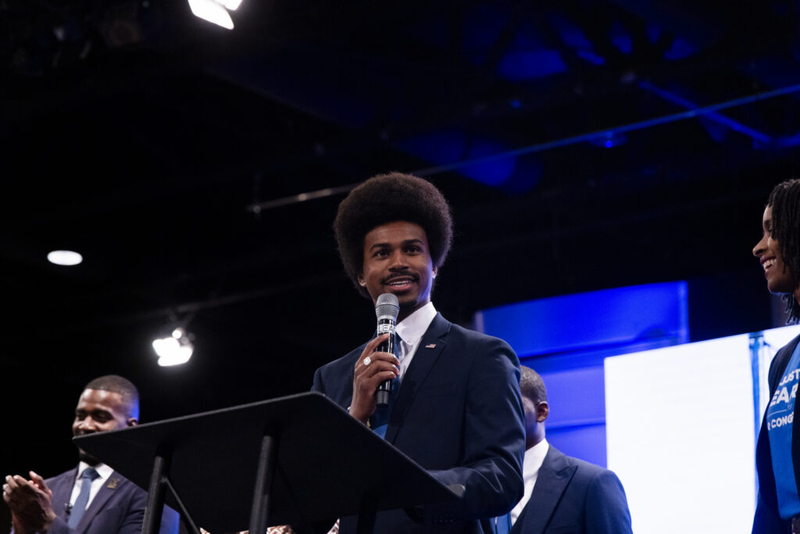
MEMPHIS, TN -- Rep. Justin J. Pearson speaks during his Election Night Watch Party at the Power Center in Memphis. (Photo by Brad Vest for Tennessee Lookout)
I started this election cycle saying that the moment demanded the highest level of spiritual, political and emotional maturity we could muster.
Not enough of us summoned it. And it showed up in the vote count.
Shelby County did good. We did significantly better than four years ago. Turnout increased. But good was not what this moment required. We needed to be great. More than 300,000 registered voters in Shelby County still did not participate. Imagine just 100,000 more of them showing up. Not all 300,000. Just one-third.
That level of participation could have fundamentally altered the political landscape across all three congressional districts touching Memphis and, given the narrow statewide gubernatorial margin (approx. 53,000 votes), could have transformed that race as well.
That is why I agree with everyone who says this is not the season for finger-pointing. But we must understand the difference between blame and accountability. We spend so much time focused on the former that we often escape the latter altogether.
Accountability means asking who had the power, resources, platform, influence and responsibility to do something, then honestly assessing whether they did everything they reasonably could. The burden should not be distributed equally because capacity is not distributed equally. Somebody with 500 followers (or dollars) should not bear the same responsibility as somebody with 50,000 constituents, institutional resources, political machinery and an oath of public service.
Pearson accepts loss in U.S. District 9 race, but says ‘Tennessee politics will never be the same’
Every one of us should ask ourselves: Did I do my best?
And extraordinary circumstances require extraordinary standards. Conventional political etiquette designed to protect egos, personalities, relationships and future aspirations should have been subordinated to the urgency of this moment. Anything less represented a failure of political maturity, especially from people who have sworn to put the public interest ahead of their personal feelings.
That brings me to something else that irritates the hell out of me: describing Tennessee’s 9th Congressional District as simply a Republican “flip.” It was not the same district.
Republicans dismantled the old 9th, split Memphis among three congressional districts and constructed an entirely new district carrying the same number. The new district had voted for Donald Trump by roughly 21 points in 2024. Yet Brent Taylor defeated Justin Pearson by only 2,539 votes, roughly one percentage point. Calling that an ordinary “loss” misses the point.
If a boxer is forced into the ring with one hand tied behind his back and loses by one point on the judges’ cards, the story is not simply that he lost. The story is that somebody tied his damn hand behind his back and he still almost won.
Pearson is right to challenge the traditional parameters of victory and defeat. He should give them hell in the Tennessee House and then come back for that congressional seat. And the larger Tennessee numbers should shake loose some longstanding assumptions.
In 2022, Republican Bill Lee defeated Democrat Jason Martin by about 32 percentage points. This week, Marsha Blackburn defeated Jerri Green by less than 3 points. That is a nearly 30-point movement in the gubernatorial margin in four years. AP analysis also found that every Tennessee county moved toward Democrats compared with the 2024 presidential election. Democrats flipped six Republican-held state House seats, their biggest multi-seat gain in decades.
And, perhaps most deliciously, Republicans’ congressional redistricting scheme did not accomplish its ultimate aspiration. They wanted nine Republican congressional seats. They got eight.
While Republicans captured the newly reconstructed 9th, Democrat Victoria Broderick won the 4th District by roughly 280 votes. They essentially traded the traditional Democratic 9th for a new Democratic 4th.
All that happened with national Democratic investment that, relative to how competitive Tennessee ultimately proved to be, was nowhere near what this state warranted.
Sound familiar?
Before Georgia turned blue, organizers were told Georgia was red. Before Texas became genuinely competitive, people dismissed Beto O’Rourke’s statewide campaign as another noble Southern loss. Stacey Abrams did not transform Georgia in one election. Organizers contested supposedly unwinnable terrain until the terrain changed. Tennessee is on that continuum.
Some of us have been saying for years that this state is not “ruby red.” The data is finally making that argument harder to dismiss.
But there is another lesson, and it is less comfortable. Some people showed us who they are during this election.
We. Must. Believe. Them.
Some stood on the sidelines because of bruised egos, personality conflicts, political calculations and immature impulses. Now that the results demonstrate how close these races were, some will suddenly rediscover the movement. Some are already emerging from the shadows.
I cannot pretend I did not see who showed up and who did not. Receipts matter.
Going into 2027, we should know what organizations organized, what elected officials mobilized, what institutions invested, who communicated with their constituencies and who merely commented from the sidelines. Nobody should be too important, too established or too grandiose to show their work.
Because 2027 brings one of the most consequential municipal election cycles of our lifetime.
If Memphis learns to harness the political power sitting dormant inside hundreds of thousands of registered voters, we can shape our own destiny. If we do not, we may watch a blue, perhaps even Black, wave carry other cities and states forward while Memphis crashes out on the shore.
We did good. Next time, good cannot be good enough.
Nashville, TN