Following ant-Arab remarks, RFK Jr. promotes faith-based recovery program at Detroit visit
Oct 27, 2026 | 4:53 pm ET

Description
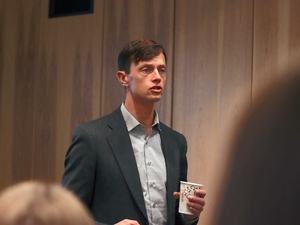
U.S. Secretary of Health and Human Services Robert F. Kennedy Jr. speaks to reporters following a visit to the Detroit Wayne Integrated Health Network on Oct. 27, 2026. (Photo by Katherine Dailey/Michigan Advance)
DETROIT — A day after Health and Human Services secretary Robert F. Kennedy Jr. made anti-Arab remarks at a get-out-the-vote rally for Republican candidates in Grand Rapids, he declined to address the comments during a stop in Detroit to promote a new care program for homeless individuals.
Kennedy said Monday evening that Arabs do not contribute to research in science and literature, blaming the Muslim Brotherhood for “destroying” the Muslim tradition that “produced all of these great foundational discoveries in science and medicine and biology and navigation” — remarks that have been largely condemned as racist and Islamophobic.
“There are five hundred million Arabs in the world. And yet they don’t produce science,” Kennedy said. “They don’t win the Nobel Prize. They don’t win the Fields Medal. They don’t win the Wolf Prize.”
The comments stand in stark contrast to the long history of Arab researchers taking home these top prizes — including just last year when Palestinian-American scientist Dr. Omar M. Yaghi was awarded the 2025 Nobel Prize in Chemistry. Yaghi also received the 2018 Wolf Prize in Chemistry.
Dawud Walid, the executive director of the Michigan chapter of the Council on American-Islamic Relations, called Kennedy’s rhetoric “reprehensible” and said that in this election cycle in Michigan, there has been an “unprecedented anti Muslim vitriol coming from elected officials.”

Kennedy’s statement came while campaigning against U.S. Senate candidate Abdul El-Sayed, specifically in reference to his Muslim faith and his family’s Arab background — similar to Islamophobic remarks that have been made throughout Michigan’s 2026 Senate race.
Former U.S. Rep. Mike Rogers (R-White Lake), the GOP nominee running against El-Sayed, and many of his campaign surrogates, including top federal elected officials, have repeatedly tried to tie El-Sayed to the Muslim Brotherhood, a group that El-Sayed has consistently denied any involvement with and has publicly disavowed.
“That’s part of propaganda and hateful rhetoric,” Walid added of the fact that Kennedy’s remarks about Arab academic contributions were demonstrably untrue. “People get in front of crowds to rile up individuals into a frenzy, based upon lies.”
The national Council on American-Islamic Relations has called for Kennedy’s firing in the wake of his remarks, stating that the use of “fabricated, white supremacist talking points is utterly disqualifying for public office.”
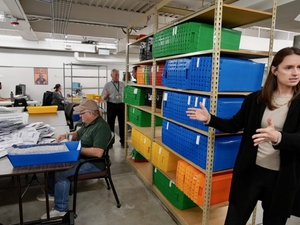
Kennedy did not address his comments while answering questions from reporters following his visit to the Detroit Wayne Integrated Health Network — instead focusing his remarks on what he saw as the need in Detroit for the Safety Through Recovery, Engagement, and Evidence-based Treatment and Support (STREETS) program. Funded through a $12 million grant to the Detroit Health Department, it coordinates systems of care for people who are homeless and have serious mental illness or substance use disorders.
Detroit is one of the eight cities in which the program will be launched, which Kennedy said will have a “new emphasis on faith-based recovery.”
He spoke to the press after a roundtable with health and social services leaders, saying, “It gave me so much hope, not only about the success of this program, but also just the future of Detroit. There are people of this caliber that are reaching out to the most destitute, lonely, isolated, decrepit community, and giving them the opportunity for redemption and recovery.”
Kennedy emphasized the need for long-term support, as opposed to short-term stints in detox or rehabilitation facilities, to prevent relapses among those struggling with addiction.

Detroit Wayne Integrated Health Network (DWIHN) President and CEO James White similarly said that the program in Detroit will seek to combat the barrier of housing insecurity to accessing services for mental health or addiction recovery.
“We know the influence of social determinants of health,” White said. “This is going to give us an opportunity to meet people where they are, get them into services, and really look towards their long-term outcomes and returning them to their lives. We’re going to use the data to drive our decision making and really work with our faith-based community to ensure that these programs are being implemented appropriately.”
The grant, which will provide $12 million over the span of four years, will not go just to DWIHN from the City of Detroit Health Department, White said. He added that the city is “going to be our primary partner” at DWIHN, and that “there are a number of providers that will be a part of that program as well.”
White noted that DWIHN serves 123,000 people annually, but that the analysis of how many people would be served by the new HHS program was still going on.
Lansing, MI