Florida Supreme Court opens door to some lawsuits against insurers
Oct 22, 2026 | 5:59 pm ET

Description
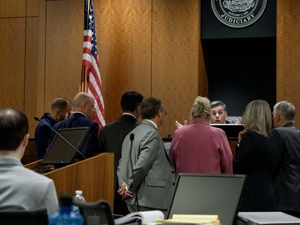
The Florida Supreme Court seal, displayed in front of the chamber. (Photo by Jay Waagmeester/Florida Phoenix)
Florida homeowners got an important ruling Thursday from the Florida Supreme Court.
The high court put to rest a years-long legal controversy over whether a sweeping 2021 law that required policyholders to give their insurance companies 10-days notice before filing a lawsuit applied retroactively or prospectively.
In a unanimous decision, the justices said the law, which took effect July 1, 2021, didn’t apply to a lawsuit initially filed in 2021 over a claim made in 2019.
Florida Justice Reform Institute President William Large said he was disappointed by the ruling but that it should put to rest any future disputes as to whether a law, insurance-related or otherwise, can be applied retroactively.
“This is probably the clearest articulation of what is necessary to make something retroactive,” Large told the Phoenix Thursday. “And if it’s not clearly stated in the legislation, it’s not going to be retroactive. I think that there was a lot that was a gray area that led to a lot of litigation. So, I think the court tried to answer that question once and for all today.”
The underlying case involves a lawsuit Rebecca Hughes filed in August 2021 against her homeowner’s insurance company, Universal Property and Casualty.
The lawsuit involved a 2019 water damage claim Hughes had filed. Universal, Hughes’ insurance carrier from April 24, 2019, through April 24, 2020, reviewed the claim and issued a payment. Hughes, who had gotten three different quotes to repair the damage, sought more.
Unable to reach an accord with her carrier, Hughes on Aug. 4, 2021, sued Universal.
The company, though, moved to dismiss the claim, alleging Hughes hadn’t complied with the new 10-day notice requirement. The provision was included in SB 76, a far-reaching bill passed by the Legislature earlier that year.
The insurer argued that requirement on its face applied to all suits.
The lawsuit

Hughes argued that the pretrial requirement didn’t affect her claim. The trial judge disagreed and dismissed her complaint.
Hughes appealed to the Sixth Circuit Court of Appeal.
While she awaited a ruling on her challenge, the Fourth District Court of Appeal reviewed a similar lawsuit on appeal, Cole v. Universal Property and Casualty Co.
In that case, the Fourth Circuit found that the pre-suit notice requirement applied retroactively to insurance policies in effect at the time the law changed. The court opined that “[i]f the legislature had intended to limit this pre-suit notice provision to policies issued after the statute’s effective date, the legislature would have included language stating so.”
Meanwhile, following the Cole ruling, the Sixth District issued its ruling in the Hughes’ lawsuit, finding that pre-suit notice didn’t apply retroactively.
Following those two rulings the First, Second, and Fifth District courts of appeal issued rulings on the pre-suit requirement, finding it applied prospectively. The Third District Court of Appeal also issued a ruling finding the pre-suit notice applied retroactively.
Given the conflicting opinions, the Florida Supreme Court agreed in January 2024 to hear the case.
Large’s Florida Justice Reform Institute, joined by the American Property Casualty Insurance Association, the National Association of Mutual Insurance Companies, and the Personal Insurance Federation of Florida, filed an amicus brief in support of Universal.
Writing for the court, Justice John D. Couriel relied on precedents establishing that when the Legislature doesn’t say directly how a law should be interpreted, that legislative silence is not “clear evidence of retroactive intent.”
Justice Adam Tanenbaum agreed with the majority that the pre-suit requirement didn’t apply retroactively but wrote a separate opinion explaining how he reached that conclusion.
The precedents are “not needed to answer the question here. The Legislature has told us expressly that “[e]ach amendment” to the insurance code … shall be construed to operate prospectively, unless a contrary legislative intent is specified,” he wrote.
Tallahassee, FL