First course at University of Iowa’s Center for Intellectual Freedom pushed to March
Jan 23, 2026 | 8:30 pm ET
Description
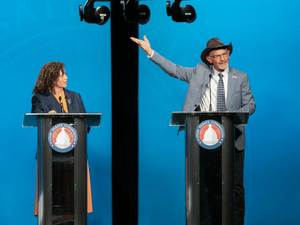
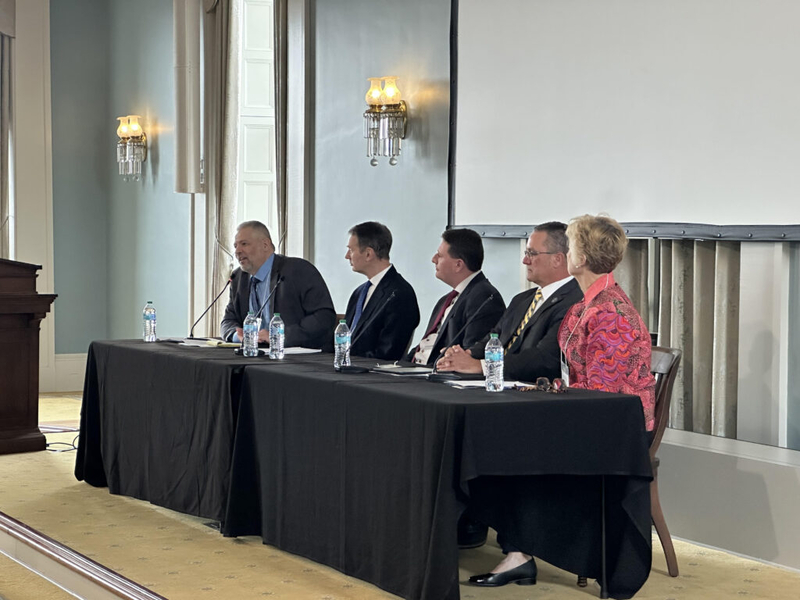
Panelists speaking Dec. 6, 2025, at the Center for Intellectual Freedom at the University of Iowa, from left, are center Interim Director Luciano de Castro, U.S. Assistant Secretary for Postsecondary Education David Barker, state Rep. Taylor Collins, state Sen. Kerry Gruenhagen and Regent Christine Hensley. (Photo by Brooklyn Draisey/Iowa Capital Dispatch)
Courses at the University of Iowa Center for Intellectual Freedom are launching later than expected this semester, with the center’s interim director canceling the first iteration of an American politics class.
Meanwhile, lawmakers who codified the center’s creation are pushing to make programming the center will offer a requirement for all students at the university. Lawmakers heard an update this week on what civics centers at the three state universities are doing.
Certain courses offered by the centers in the future could become required as part of general education courses as bills in the Iowa Senate and House of Representatives to change core curriculum moves ahead. Legislation to require public university students take courses in American history and government has passed out of subcommittee in both chambers.
While the original schedule for the Center for Intellectual Freedom at the University of Iowa had courses running the entire semester, the center’s interim director, Luciano de Castro, said in an interview the inability to hire faculty, figure out lecturer schedules and adequately advertise to students led him to cancel the section set to start in January and only offer courses starting in March. He said he canceled the course early in December and will use the first half of the spring semester to make students aware of it.
Both of the seven-week courses, titled “Political and Economic Institutions in the United States” and “American Culture and Values,” will operate with pass/fail grades and invite outside speakers to give lectures to students on various topics. According to his presentation to the committee, the cultures and values course will cover topics like the costs and benefits of freedom, freedom of speech, American literature, “self-reliance as an American value” and “why capitalism rocks.”
De Castro said he wanted to offer the political course twice this semester, but scheduling was more challenging than expected, especially with his focus on the center’s inaugural event that took place in December.
When asked how many students had enrolled in the center’s first course before its elimination from the schedule, de Castro said he couldn’t remember. Those students were transferred into the course taking place in the second half of the semester.
With the semester started, de Castro said he and center staff are connecting with student organizations in the hopes of engaging more with students and ensuring they know about the center and its activities.
De Castro told lawmakers this week the center has contracted with the Common Sense Institute to conduct a market demand assessment, and hired a research assistant to aid them. The center paid the Common Sense Institute $18,600 for the contract, he said in an interview, and the study should be complete by the end of the semester.
With the study underway, de Castro said during the meeting the center’s next steps are requesting funds from the UI to hire faculty.
“I will prioritize hiring adjunct faculty, they are called teaching faculty or temporary faculty, because this will allow more flexibility for the permanent director to define things on a long term basis,” de Castro said in the interview.
The executive committee within the center’s advisory council will handle the search for a permanent director. No advisory council meetings are currently scheduled, de Castro said, as they are waiting to hear back on firms that could be contracted to aid in the search. Quotes should be coming back in late February, he told the committee.
After hearing from directors of the other university centers, de Castro said he’d like to work with them on coordinating with some of the speakers they brought up as being invited to campus.
University civics centers report on activities
Nearly one year after he presented to the then-new committee on the benefits of bringing a school of intellectual freedom to the University of Iowa, de Castro spoke to the higher education committee this week about the center’s advisory council, its first event and upcoming plans for courses and the search for a permanent director.
He was joined by Center for Cyclone Civics Co-Directors Karen Kedrowski and Kelly Shaw and University of Northern Iowa Center for Civic Education Director Allison Rank. Each center has already started hosting events and seeking information from students about their current civic knowledge and what they’d like to see from their centers, and are beginning to find ways to work with each other.
“All of the centers are in their infancy, so we have just begun the effort of this collaboration,” Kedrowski said.
Iowa State University Center for Cyclone Civics
Officials at the Center for Cyclone Civics at ISU have spent the past months studying its students, developing programming and seeing just how far they can reach — potentially to each county in Iowa.
Interns at the center created a program titled “Byte Sized Civics” for Iowa State University Extension and Outreach last spring, Shaw said. The program includes short videos covering different aspects of state and local government, how they work and interact.
The center also conducted surveys in spring 2025 of then-seniors to better understand their knowledge of civics and government and examine their political attitudes and voting trends. While the data from the civics survey is still being mined, Shaw said scores of 20 multiple choice questions are averaging at 17 — in the B range for a grade.
During the fall semester and looking ahead to this spring and beyond, Shaw said the center has focused on the 250th anniversary of America’s founding. Local and national speakers came to campus throughout the semester to give talks on related topics, and more are planned in February through April.
The first discussion of the semester, hosted by Ames pastor Rev. Mark Vance, will cover the “importance of honesty and debate in an age of political tribalism,” the center’s presentation stated.
“Increasingly, students go to their corners and come out swinging, if they come out at all,” Shaw said. “But we really want to help create a way for students to have these difficult conversations moving forward.”
The center has also developed its first course, Shaw said, which will go over many of the topics raised by de Castro in his presentation about founding documents, capitalism and “why are we the way that we are 250 years later.”
Center for Civic Education at the University of Northern Iowa
Allison Rank, director of the Center for Civic Education at UNI, agreed that students need to start engaging more with viewpoints they wouldn’t gravitate to usually, and UNI faculty believe the same. That is why one of the events put on by the center was focused on how faculty can foster discussion in the classroom when students don’t want to talk.
It was the best-attended professional development session she’s had, Rank said, and she has already begun working on similar professional development sessions to bring to community colleges like Des Moines Area Community Colleges and Iowa Lakes Community College.
“We seek to be a nationally recognized leader in research, teaching and public outreach for both free speech and civic education, and the way that the center hopes to do that in terms of its vision is about university students, supporting pre K through 12 students, and also thinking about the broader public by developing and implementing civic learning strategies, respectful dialog across difference and educational resources,” Rank said.
As the state’s “teacher training college,” Rank said UNI is working to “specifically foster civic learning among Iowa’s pre-service and in-service teachers” while also aiding in professional development and curricular shifts at other universities.
One way the center is meeting this goal is through a $1.2 million grant UNI received in the fall to establish the Iowa Civic Educators Institute, which will provide professional development, seminars and course materials in American political traditions, government and history, as well as state-focused history and politics.
“We know that what teachers want is sort of this high quality, directly connected research that they can take into their classrooms,” Rank said, “and that’s what we aim to provide from this center.”
UNI students are also being engaged by the center through a birthday party for the U.S. Constitution thrown last year and upcoming programming, including a “civic culture ideation session” where around 100 students in small groups will identify issues relating to civics education and what they’re seeing on campus, develop solutions and pitch them, hopefully in a “Shark Tank-style.” The top solutions will go in the center’s strategic plan for the 2026-2027 academic year.
Rank said she is hoping to launch a program which she called the “Challenging Perspective Series,” where two individuals with “distinct viewpoints on a similar topic” would speak before students head into small groups to discuss what they heard. She is currently working on a survey to give to students who participate in center events to learn about their political viewpoint so in future events groups are made up of mixed perspectives.
“I like this idea of consistently trying to have two people on a similar topic that are articulating different approaches to understanding that topic, whether it’s different diagnoses of the cause of the problem, different ways of solving what they both agree is the same problem, but actually modeling for students both having that conversation, ensuring that you got both perspectives at the same time,” Rank said.
Des Moines, IA