Federal permitting bill splits South Dakota Republicans, causing some to align with Democrats
Nov 17, 2026 | 6:19 pm ET
Description
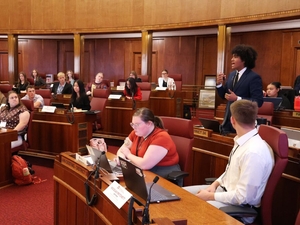
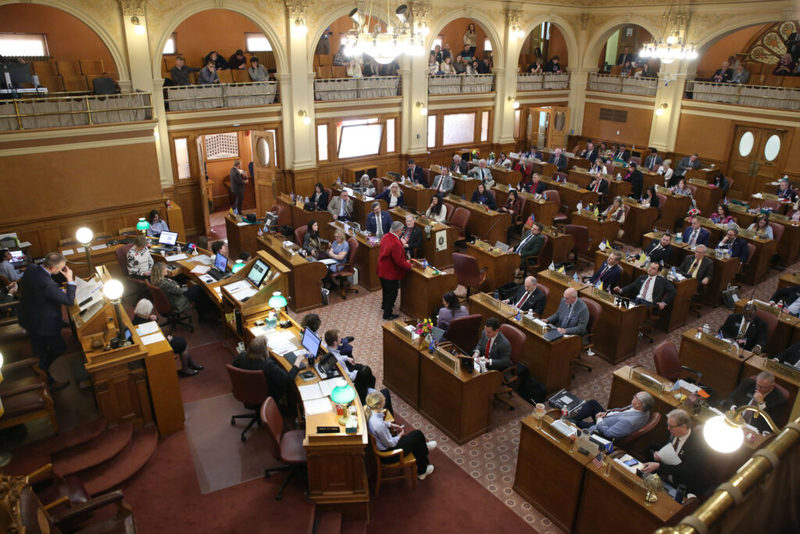
The South Dakota House of Representatives meets at the Capitol in Pierre on Feb. 10, 2026. (Photo by Makenzie Huber/South Dakota Searchlight)
Federal legislation that could accelerate permitting for large energy and infrastructure projects has scrambled political allegiances in South Dakota, leading two Republican U.S. senators to vote differently while splitting Republican state lawmakers and causing some of them to align with Democrats.
Fifty state lawmakers and lawmakers-elect from South Dakota — including 37 Republicans, 12 Democrats and one independent — sent a letter on Monday to Republican U.S. Senators John Thune and Mike Rounds urging opposition to the Bipartisan American Affordability and Jobs Act. It would streamline federal review and approval for projects including power plants, transmission lines and pipelines. It would also require data centers to cover their electrical infrastructure costs.
Supporters say the changes would reduce project delays and costs, while critics say they would weaken environmental oversight, local control and public input.
The letter says economic development, affordable energy and infrastructure investment “must not come at the expense of environmental protections, agricultural interests, private property rights, tribal sovereignty, local control, or the health and well-being of our communities.”
State senators Joy Hohn, R-Hartford, and Red Dawn Foster, D-Pine Ridge, were the first two signers of the letter. Foster is a member of the Oglala Sioux Tribe. Hohn, who won reelection earlier this month, is a vocal opponent of a carbon-capture pipeline that was proposed to run through eastern South Dakota.
“This bill is an incremental erosion of our fundamental rights,” Hohn told South Dakota Searchlight.
Other letter signers include a county commissioner and various Republican Party officials.

Lawmaker disagreement
State lawmakers sometimes approve resolutions urging support or opposition of federal actions. A news release from Hohn and Foster about the letter said that because lawmakers don’t begin their annual legislative session until January, they “do not have the opportunity to formally address this issue through a legislative resolution.”
“Recognizing the concerns being raised by constituents throughout South Dakota, participating legislators have come together through a joint letter to ensure those voices are heard at the federal level,” the news release said.
Judging solely by the signatures, the letter does not have enough support to pass as a resolution, partly because some of the signers lost their bids for reelection or did not run for another term. The letter has 20 signatures from state House members who will be in office in January, short of the 36 needed for a majority, and 12 signatures from state Senate members who will be in office in January, short of the necessary 18.
Sen. Casey Crabtree, R-Madison, the state Senate’s majority leader-elect, did not sign the letter. Nor did any other member of the incoming Republican legislative leadership teams in the state House or Senate.

Crabtree said he supports the federal permitting legislation and said lawmakers should commend U.S. Senate Majority Leader Thune for working in a bipartisan manner to “deliver affordable electricity, fix our roads and bridges, upgrade our telecommunications systems and maintain strong protections for South Dakotans.”
“The American people are united behind the issue of affordability,” Crabtree said.
All of the members of the incoming Democratic legislative leadership teams in the state House and Senate signed the letter. That includes both of the party’s Senate members who will be in office in January, and 10 of the 12 Democrats who will be House members in January.
Senate Minority Leader-elect Erik Muckey, D-Sioux Falls, said trying to cut red tape for infrastructure development may sound great on its face.
“But the thing is, you can accomplish that without having to have very drastic, negative impacts on environmental law, the Endangered Species Act, the Clean Water Act, all the way to the utter disregard of tribal sovereignty, local control and even, frankly, the state Public Utilities Commission,” Muckey said.
House Minority Leader-elect Eric Emery, D-Rosebud, acknowledged that federal permitting needs work. He said the bill goes too far.
“As a Native legislator from Rosebud, I can’t get past what this bill does to tribes,” he said.
Emery said the bill narrows what states and tribes can review under the Clean Water Act, and it allows 150 days to challenge a federal permit in court, which he said is too short. He also opposes what he described as a watering-down of tribal consultation requirements. The Great Plains Tribal Chairmen’s Association and some other tribal organizations oppose the legislation.
“Consultation on sacred sites and cultural resources is part of what the United States owes tribal nations under the treaties. It shouldn’t be optional,” Emery said. “This is one issue where I agree with a lot of my Republican colleagues here at home. Local control and tribal sovereignty don’t belong to one party in South Dakota.”

Not just lawmakers opposed
South Dakota Public Utilities Commission Chair Chris Nelson, a Republican, said the commission is “adamantly opposed” to provisions that would allow transmission line developers to seek federal approval if state regulators deny a permit or impose conditions developers consider too burdensome.
“What it really does is it takes away the South Dakota PUC’s ability to evaluate projects fairly under our statute and to work with landowners here, to work out their concerns, and make a final decision here,” Nelson said.
Nelson also raised concerns about federal eminent domain authority and whether federal regulators would be required to consider landowner objections. Eminent domain is a legal power granted to some developers for gaining access to land without landowner consent, while paying just compensation to the owner. It’s been a divisive issue in South Dakota the last several years because of a proposed multi-state carbon capture-pipeline that would have passed through the eastern part of the state. The Legislature and Republican Gov. Larry Rhoden banned eminent domain for carbon pipelines last year.
Bill moves forward in D.C.
Sen. Rounds was the only Republican to cast a procedural vote against the legislation earlier this month. Afterward, he posted comments on social media expressing some of the same concerns expressed by Nelson. Rounds said at the time that he hoped to work with his colleagues to address the concerns.
The bill passed that procedural vote 73-25 and awaits a final vote in the Senate.
Permitting overhaul splits SD’s US senators but advances with tepid bipartisan support
Thune voted to advance the bill and has said permitting reform is necessary to lower energy costs, create jobs and prevent infrastructure projects from being delayed for years by federal bureaucracy.
“Too often, projects are bogged down in bureaucratic delays for months, and often years, at a time,” Thune said during a Tuesday speech in the Senate. “Delays cause project budgets to balloon, which then leads to higher costs for American consumers.”
Thune said the bill would also reduce permitting burdens on farmers and ranchers, provide technical assistance to communities considering a data center, and require data centers to cover their own energy-related costs.
“Whether that’s their operating and construction costs or the cost of grid improvements needed to accommodate them,” he said. “This legislation ensures those costs don’t show up on household utility bills.”
Thune’s office told South Dakota Searchlight the legislation would not override South Dakota’s ban on eminent domain for carbon pipelines.
U.S. Rep. Dusty Johnson, R-South Dakota, shared his support for the bill last week on social media, calling it “the most important affordability bill in decades.”
“If we want lower taxes, lower energy bills, better roads and bridges, we have to right-size our regulatory approach,” Johnson said, adding that the bill “does that while protecting property rights and forcing data centers to pay their fair share.”

Pierre, SD