Federal government seeks summary judgment against Alabama Department of Corrections
Sep 03, 2026 | 1:28 pm ET
Description
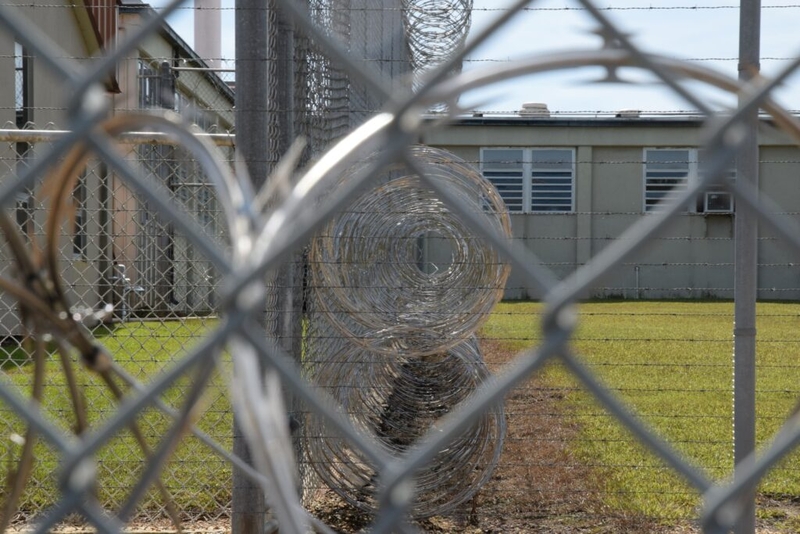
Barbed wire seen behind a fence at an Alabama prison. The federal government filed a motion on Wednesday seeking summary judgment in its lawsuit against the state of Alabama alleging that the violence in men's prisons violates inmates' Eighth Amendment protections against cruel and unusual punishment. (Brian Lyman/Alabama Reflector)
Federal prosecutors Wednesday filed a heavily redacted motion for summary judgment ahead of a scheduled November trial over whether violence in Alabama’s prisons violate inmates’ Eighth Amendment protections against cruel and unusual punishment.
The 260-page motion from the U.S. Attorney’s Office for the Northern District, which includes evidence and testimony from the incarcerated and current and former Alabama Department of Corrections officials, asks U.S. District Judge Harold D Mooty, III to rule in the government’s favor on charges ADOC failed to protect people in prison from physical violence, sexual violence and the use of excessive force by correctional staff, as well as failing to provide safe conditions for people while incarcerated.
“Alabama’s prisons are pervasively violent. Homicides, stabbings, beatings, and sexual assaults occur routinely,” the motion said. “Officers use excessive force. Alabama does not maintain the physical condition of the prisons, putting prisoners’ health and safety at risk. Alabama’s own conduct has created these conditions, and Alabama has failed to respond reasonably.”
A message was sent to the Alabama Department of Corrections on Thursday seeking comment. Carla Crowder, the executive director of Alabama Appleseed, a nonprofit focused on criminal justice reform, said in a statement that the motion “spells out a level of systemic incompetence and mismanagement that has not previously been spelled out so clearly.”
“What’s new is the thorough and unmitigated complacency and disregard for human life on the part of highly paid and experienced ADOC officials to address a crisis they’ve known about for nearly a decade,” the statement said.
Cindy Hamilton, whose son is currently incarcerated, expressed concerns with the amount of redactions in the motion.
Legislators look to upcoming audit as frustrations with Alabama prisons mount
“The public should know everything,” she said in an interview Thursday. “The really sad thing is nothing has changed. Nothing. The same thing is still happening every single day in every single one of these facilities.”
The November trial would come nearly six years after the U.S. Department of Justice sued the state in December 2020 over conditions in men’s prisons in the state. The charges followed the release of reports in 2019 and 2020 detailing the use of excessive force by corrections officers against inmates and physical and sexual assault of incarcerated men in the state’s prisons.
A similar DOJ investigation of sexual abuse and harassment inmates in the Julia Tutwiler Prison for Women in Wetumpka led in 2015 led to a nearly-decade long consent decree between the state and the DOC. The decree led to improvements in safety and staffing at the facility.
However, Alabama Attorney General Steve Marshall in 2020 rejected a consent decree over the violence in men’s prisons, leading to the lawsuit.
‘There’s no safety, man’
The motion filed Wednesday alleges that there is a “substantial risk of violence and sexual violence” in Alabama’s correctional facilities and that the state’s conduct and failure to act “puts prisoners at risk.”
The motion also alleges that the leadership within the ADOC “does not supervise what occurs in the prisons” and that the agency fails to “effectively investigate or exercise oversight regarding uses of force.”
More than half of the 260-page motion consists of testimony from incarcerated people and current and former leadership; documents highlighting violence and extortion within state prisons and statistics on overcrowding and staff shortages.
Formerly incarcerated people, family members describe Alabama prison violence
One page recorded almost 10 “died by homicide” episodes that happened in 2019 alone.
“A prisoner testified, ‘There’s no safety man. You don’t feel safe. Anything liable to happen,’” the motion states.
Testimony from ADOC staff indicated the violence is underreported.
“ADOC staff testified: ‘Some days they just — and then if you’ve got a facility with 12 – 2,000 inmates and 15 officers, you’ve got one officer trying to cover three dorms, well, it’s very, very possible that nobody sees that. They get into fights every day. It’s a lot of them that we don’t see,’” the motion states.
The motion also provided messages sent by people incarcerated within ADOC who extorted the families or other people who are incarcerated with threats against their loved ones.
“I need at least 100 of my money tonight or I’m going to start stabbing your son point blank period … So I need to be hearing SOMETHING ABOUT MY MONEY!!!!” one message said.
The motion also said incarcerated individuals use sexual favors for protection, illicit drugs and to repay debts.
“There is also unreported sexual violence in ADOC, hidden behind sheets draped from top bunks to conceal what is happening on lower bunks, all occurring in the absence of staff,” the motion states.
The motion also accuses ADOC staff and leadership of being responsible for the violence and the influx of contraband into prison facilities, including illicit drugs.
The motion states that staff “repeatedly introduced contraband to prisoners in ADOC” and that “Alabama leadership does not supervise what occurs in the prisons.”
For example, the motion said former ADOC Commissioner John Hamm told people who took his statement that wardens must ensure the presence of adequate security staff, and that important posts are staffed appropriately because the agency uses overtime.
It also quotes Hamm saying he did not monitor information about sexual assaults or receive reports on overdose deaths in prison, though he asked about overdose deaths “periodically.”
The motion also quotes current ADOC Commissioner Greg Lovelace, who was the chief deputy commissioner at the time, as saying in a statement to the government that he spent most of his time on the construction of a new 4,000-bed men’s prison in Elmore County, “and has not seen any reports regarding the extent of violence, contraband, or sexual assaults in the system.”
Montgomery