Federal fights leave funding for Alabama infrastructure program uncertain
Jul 24, 2025 | 7:59 am ET
Description
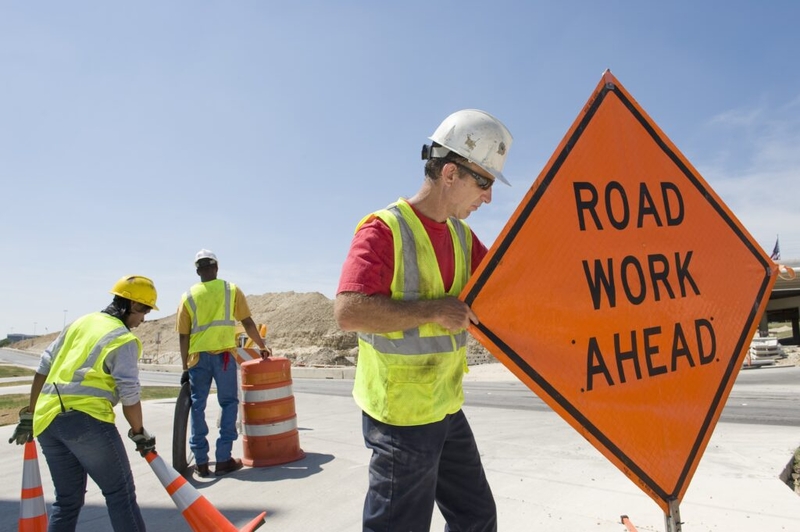
Workers moving equipment and road signs on a highway. A state road-building program, ATRIP-II, is facing challenges in its final year due to the loss of a 2% federal funding increase, potentially hindering some infrastructure projects across Alabama. (Getty Images)
A state road building program could face challenges related to federal funding.
Edward Austin, chief engineer with the Alabama Department of Transportation (ALDOT), told the Legislature’s Joint Transportation Oversight Committee Wednesday that the state faces significant transportation issues, particularly with the Alabama Transportation Rehabilitation and Improvement Program-II (ATRIP-II) which was approved for five years and is approaching its final year, because Congress couldn’t come to a consensus on the funding amount in the continuing resolution, dubbed the “One Big Beautiful Bill Act,” that passed in mid-July.
“The numbers you will see for this fund allocation plan from the federal side, the total dollar amounts are going to be pretty close to what you saw last year,” Austin said.
The ATRIP-II program — created by the Rebuild Alabama Act of 2019, which received increased federal funds from the Infrastructure Investment and Jobs Act (IIJA), also known as the Bipartisan Infrastructure Law — is an ALDOT-administered grant program for transportation infrastructure projects in historically underserved areas. Austin said that the program is still receiving applications, with six to seven times the number the program can fund.
Eligible projects aim to improve state-maintained highway systems, with local roads and bridges only included if “incidental work that is necessary in order to complete the improvements to the state route,” Austin said. Any local governmental entity (county or municipality) within Alabama is eligible to apply, but project sponsors are limited to submitting one application per year.
Austin said that Congress passed a full year continuing resolution, providing funding for the last year of the approved program. But it won’t receive the 2% increase that the program has received yearly in the past, reverting to the amount from the previous fiscal year.
“We lost that 2% escalation this year, which is a meaningful number. That’s multiple projects that we could end up not being able to address because the funding is not there,” Austin said after the meeting, adding that the program’s future is uncertain until Congress authorizes another five year extension.
ATRIP-II has allocated or awarded funds to a wide array of transportation projects over the last five years. In FY 2020, 28 projects aimed at addressing intersection improvements and widening projects were awarded a total of $39.65 million, with ATRIP-II contributing $30.14 million and local governments providing $9.51 million.
The program’s funding increased each year, with fiscal year 2021 seeing 27 projects totaling $46 million ($30.27 million from ATRIP-II), and FY 2022 funding 32 projects for $52.21 million ($40.31 million from ATRIP-II). In fiscal year 2023, 33 projects received $47.10 million with ATRIP-II providing $40.08 million and 26 projects were awarded $58.94 million in total, with $40.27 million from ATRIP-II, in fiscal year 2024.
For the last fiscal year, which Gov. Kay Ivey announced in January, 24 projects were awarded a total of $56.48 million, with ATRIP-II contributing $40.19 million in federal funding.
Austin also discussed the Rebuild Alabama program, funded entirely with state dollars. He said that a priority for the project is to address 17 counties that do not have a four line connection to the interstate. He said that this lack of connectivity is a significant concern for locals.
“We can’t entice a good industry to come here, because whether it’s on time delivery or some other issue, if they’re constrained with only a two way route,” he said to the committee.
Montgomery