Establishment frustrations, calls for local representation fueled McKinney’s primary win
Aug 07, 2026 | 1:17 pm ET
Description
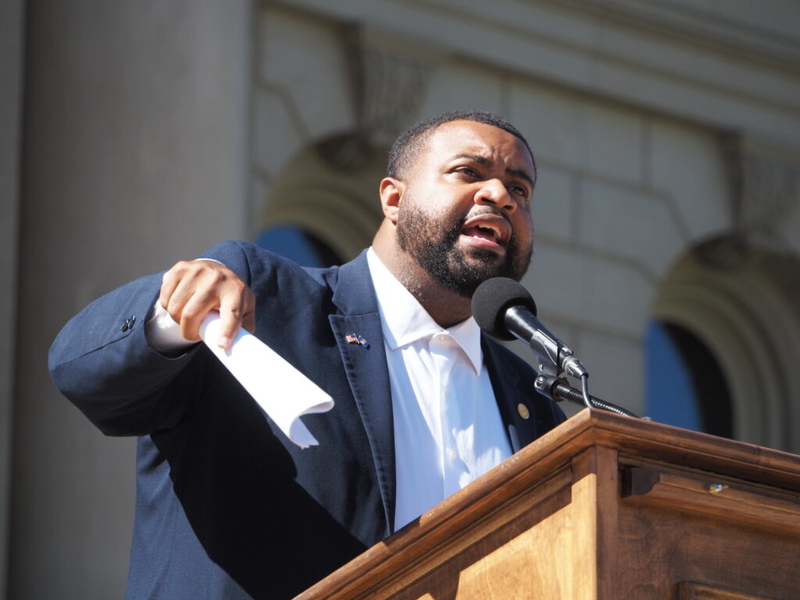
Michigan state Rep. Donavan McKinney (D-Detroit) speaks at a rally advocating against a proposed 24% wholesale tax on marijuana for the next fiscal year. Sept. 30, 2025 | Photo by Ben Solis/Michigan Advance
Shri Thanedar, the second-term Democratic U.S. representative for Michigan’s 13th Congressional District, will not be up for reelection come fall, following a successful primary challenge from state Rep. Donavan McKinney, a native Detroiter who has promised to fight for a Democratic Party that represents the interests of working people.
Following his primary success in the deep blue Democratic district, which includes portions of Detroit, as well as Grosse Pointe and the Downriver region, McKinney is heavily favored to win against Republican T.P. Nykoriak, who ran uncontested.
In 2016, Nykoriak was sentenced to 16 months in federal prison for stealing U.S. savings bonds from a church.
Heading into election night, McKinney was at a significant funding disadvantage with $142,853 in cash on hand compared to Thanedar’s approximately $5 million. Despite that financial advantage, Thanedar had long faced criticism from residents and public officials in his district over his constituent services, with then-Detroit Mayor Mike Duggan telling reporters in 2024 “He’s not a bad person; he’s just not helping.”
At the end of the race, unofficial results show McKinney defeating his opponent with 51.9% of the vote.
In an interview with Michigan Advance, Democratic political consultant Michael Radtke, who also is a Sterling Heights councilman, pointed to two major dividing factors in the race: Black representation for Detroit and the willingness to directly address constituent concerns.
From 1955 to 2022, Detroit’s congressional delegation included at least one Black member of Congress. Since 2023 the majority Black city has been represented by Thanedar, who immigrated to the U.S. from India, and Rep. Rashida Tlaib, who is Palestinian American.
McKinney’s grassroots approach to campaigning and anti-corporate politics were also essential, Radtke said.
Denzel McCampbell, the city councilmember for Detroit’s 7th District and one of the local officials who endorsed McKinney, noted the state representative’s background, growing up poor in northeast Detroit, where he was raised by his mother and grandmother.
Understanding what brings those challenges, their solutions, and that there are folks living in the district who share similar stories is what leads to representation that can relate to residents’ experiences, McCampbell said, whether that’s having a representative who is from Detroit, or who shares experiences with Black residents in a district where they are the plurality.
McCampbell said McKinney provides that representation and understands that bold solutions are needed to address the issues that residents of the 13th are facing.
During a press conference following McKinney’s victory, Rev. James Michael Curenton of Mayflower Congregational United Church of Christ said “We know that Donavan is one of us. Donavan is accessible to us. And Donavan will be accessible to us once he gets into Congress. We have someone that we know that will be there to represent our interests.”
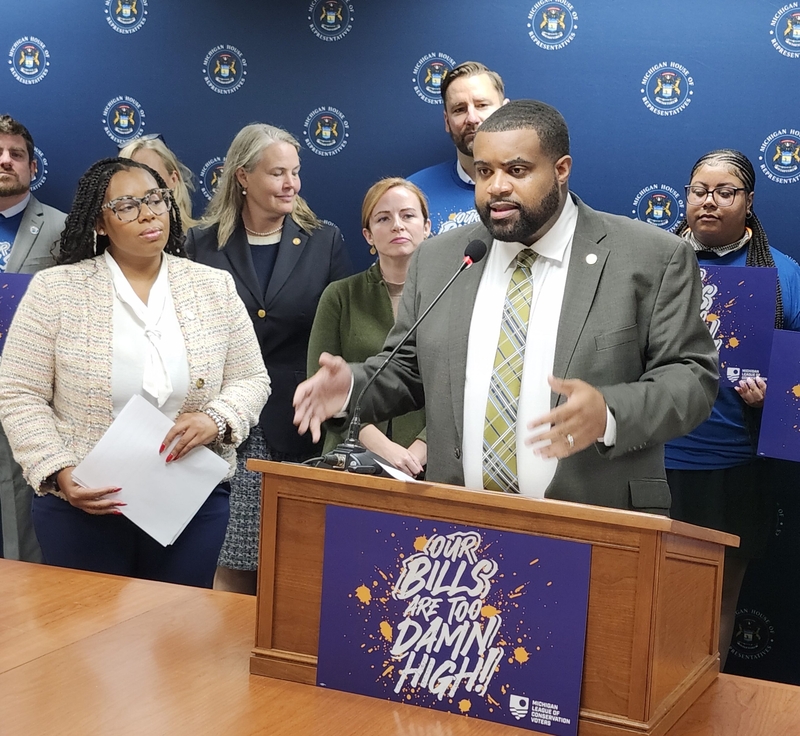
During his campaign, McKinney took a stance against corporate influence in politics, emphasizing that “We didn’t take a dime of corporate PAC money,” and speaking out against corporations like DTE Energy, which provides electricity for much of southeast Michigan. For years the company has faced criticism from customers over high rates, poor reliability and lengthy power outages.
That type of messaging was essential in pulling off the win, Radtke said, noting that the 13th Congressional District is among the poorest districts in the nation.
“I think that in the coming days we’re going to start to realize that people are very frustrated that their needs are not being met,” Radtke said, pointing to the rising costs of basic needs like food, gas and energy.
People are tired of the status quo, McCampbell told Michigan Advance, explaining that when you have a candidate like McKinney, who pledges to hold corporations accountable, and is not taking their money, that makes a difference.
While national media outlets have counted McKinney’s win among a trend of Democratic socialist victories both in the state and across the U.S., Radtke argued McKinney’s success was rooted more in the candidate than in the ideology.
“Donavan is someone who could live on your block. He’s got a young family. He understands the travails of the current world, you know, he’s not a millionaire,” Radtke said, drawing contrast with Thanedar.
“I think the people of this district don’t care what you call yourself if you show up to work for them every day in Detroit and in Washington D.C.,” Radtke said.
However, McCampbell, who ran for city council as a member of the Democratic Socialists of America, said you can’t separate the candidate and the ideology.
“When I was talking to people on the doors, it wasn’t about what tag or ideology that I had,” McCampbell said. “It was about: Are you going to deliver on our needs? Are you going to have a responsive city council office? Are we going to be someone that you’re going to push bold policies to stand up for us in the neighborhoods against you know corporations and folks that just want to build playgrounds downtown. That was what resonated with folks.”
Democratic socialists and the DSA are presenting a vision that seeks to address issues like affordability, economic justice and the influence of corporations as a way of doing things differently, McCampbell said, arguing people should embrace that idea, rather than looking at Democratic socialist candidates as a negative.
“We should be listening to our electorate. We should be listening to our constituents. We should be listening to our community,” McCampbell said, noting that people are resoundingly pointing to the influence corporations are having on politics and demanding a change.
What’s next for Thanedar
On Wednesday morning, Thanedar called McKinney to congratulate him on his victory, offering him his full cooperation for a smooth transition between offices.
In a text message to Michigan Advance Thursday, Thanedar said he was honored to serve the 13th District and that he would continue to fight to bring home dollars for the district during his remaining time in office.
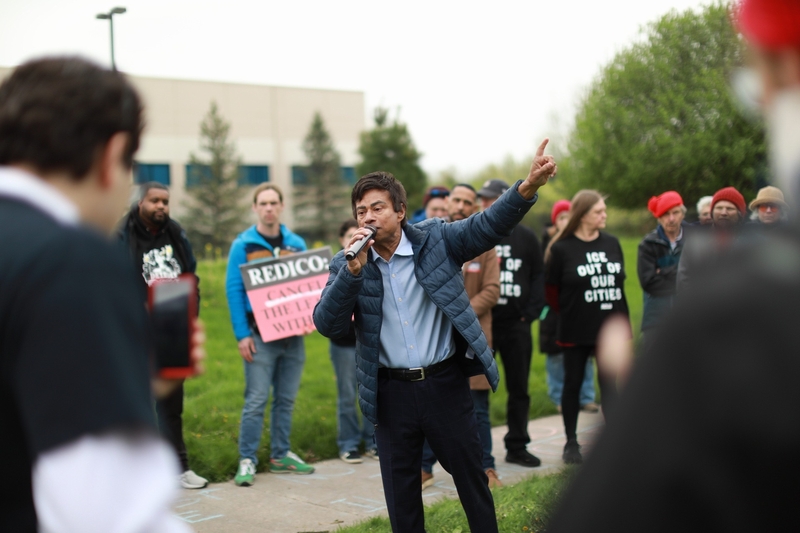
While speaking to the Advance later Thursday afternoon, Thanedar carried a gracious tone, noting he had received almost 10,000 additional votes this year compared to the 2024 primary election.
In 2024, 80,000 people turned out to vote, while 110,000 came out in 2026, with Thanedar attributing the rise in turnout to frustration with President Donald Trump’s administration or the pull of Democratic Senate nominee Abdul El-Sayed, who he says may have inspired people to come out that previously wouldn’t have voted.
“I think they kind of bought into the narrative that Abdul and the Democratic Socialists are putting forward,” Thanedar said.
Ultimately, Thanedar said he was feeling good heading toward the end of his tenure in office and was grateful to the people for giving him the opportunity to serve in Congress to begin with.
By the time his term is over, Thanedar noted that he will be 72 years old, and that Tuesday’s results had given him an opportunity to say “What else can I do?”
While he didn’t rule out another run for public office, Thanedar said he’s not looking to grab the next position he can find.
“I feel I’ve been blessed, and I’m going out with a lot of gratitude towards my constituents,” Thanedar said.
Lansing, MI