Elbows up in Washington state over Canada’s proposed oil tanker terminal on border
Oct 20, 2026 | 7:00 am ET
Description
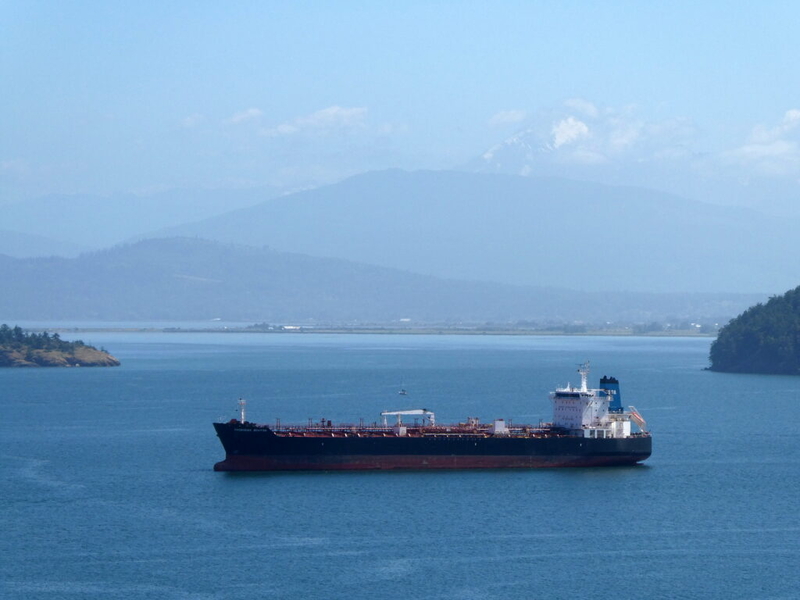
Medium-sized tankers, like this one anchored near Anacortes, could be joined in the Salish Sea by much larger crude oil supertankers if Alberta, Canada succeeds in building a new pipeline and export terminal to the southern British Columbia coast. (Photo by Tom Banse)
Canadian Prime Minister Mark Carney and comedian Mike Myers made the phrase “elbows up” a national rallying cry in the midst of a trade war incited by the Trump administration.
Canada’s economic pivot away from the U.S. includes fast-tracking a new oil pipeline from Alberta to a proposed marine terminal in British Columbia, practically on the border with Washington state.
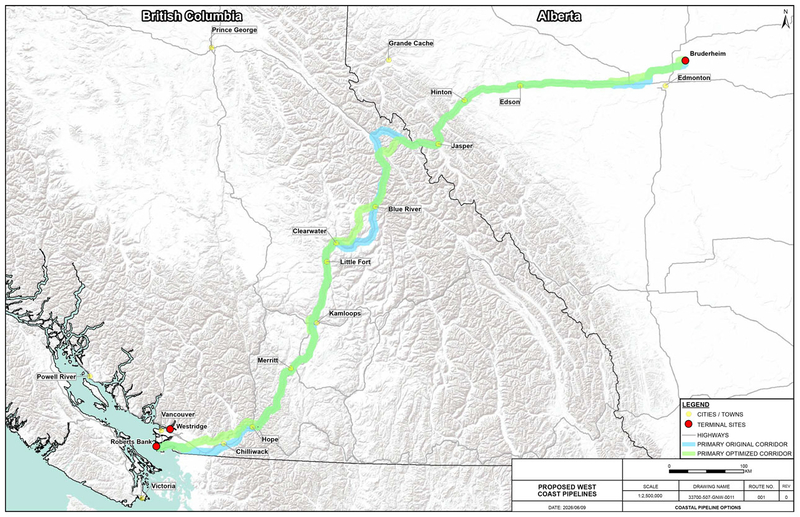
The proposed Pacific Link crude export project entails a 775-mile pipeline from Alberta’s northern oilsands region to a new tanker loading terminal on the Strait of Georgia in the Vancouver suburb of Delta. As proposed, the pipeline will be capable of delivering up to 1 million barrels per day to a pair of supertanker berths located less than two miles from the maritime border with Washington.
The massive undertaking has environmentalists, tribes and Democratic politicians in the Evergreen State sharpening their own elbows. They are deeply concerned about increased tanker traffic and oil spill risk in the shared Salish Sea and are working to coordinate their opposition efforts with like-minded British Columbians.
But how can this Washington state-styled “elbows up” influence a project to be built entirely on Canadian soil?
“We recognize that there are conflicts between our countries that are much greater than us. We are not going to be able to solve those issues. But on this issue, we can coalesce for the good of the environment and for the good of our communities,” said San Juan County Council Chair Justin Paulsen about the council’s collaboration with counterparts in the Canadian Gulf Islands.
Paulsen said the San Juan council has coordinated with councilors in the Islands Trust government to raise concerns about increased vessel traffic. If the new pipeline becomes operational in the early 2030s as planned, many more oil-laden tankers would travel through the narrow passageways between the Gulf Islands and San Juan Islands, then down Haro Strait and out to sea past Victoria and Port Angeles.
“The U.S.-Canada border is not going to stop a spill, right?” said Lovel Pratt, marine policy director for the group, Friends of the San Juans.
Pratt found common ground with environmental groups on the other side of the border, including the Georgia Strait Alliance and Raincoast Conservation Foundation. Together they are sounding alarms about the risk to endangered orcas, the danger of rampant underwater noise and the potential damage of a catastrophic oil spill.
Friends of the San Juans is collecting signatures on an online petition to Washington Gov. Bob Ferguson and Ecology Department Director Casey Sixkiller. It asks those two leaders to use “every available regulatory, diplomatic, technical, and legal avenue to oppose the Pacific Link pipeline.”
“Governor Ferguson was our attorney general for many years. I would hope that if there were any legal challenges that could be made to oppose the project that he would find the options to pursue,” Pratt said. “I don’t know what those are.”
Ferguson met last month in Seattle with the Canadian ambassador to the U.S., but the governor’s office won’t say what they talked about. Ferguson and Sixkiller subsequently issued a statement in which they called on the Canadian government to fill anticipated gaps in oil spill response capabilities.
Ferguson’s joint statement and a separate Friends of the San Juans post with qualms about the Canadian oil project drew a high proportion of negative responses on social media from Washingtonians more concerned about high gas prices. “Drill baby drill” and “What Canada does is Canada’s business” were common refrains.
Alberta responds
The government of Alberta is taking the lead in promoting and defending the new pipeline and supertanker terminal project. Provincial leaders have made a two-pronged case to address the potential of a tanker accident and oil spill.
A YouTube video produced by the government opens by noting the exemplary safety record of the oil tankers serving the existing crude export terminal in suburban Burnaby, B.C.
“In B.C. waters, there hasn’t been an oil spill in more than 50 years. That strong track record has continued even with increased tanker traffic,” the narrator intones.
Preliminary documents submitted by the province for federal review said the Pacific Link project would build upon major upgrades in spill prevention and response capabilities that accompanied a recent Trans Mountain Pipeline expansion. All of the tankers departing the proposed new export terminal would be double-hulled and have extended tug escorts.
The new energy infrastructure will be built with tens of billions of Canadian taxpayer dollars – 45% from the government of Alberta, 45% from the federal government and the remaining 10% from private investor Pembina Pipeline Corporation. The partners have been clear that a prime objective is to lessen Canada’s dependence on the United States by increasing capacity to ship crude to customers in East Asia and as far away as India.
The federal and Albertan governments are pushing to finalize the pipeline route and complete the regulatory review by Sept. 1, 2027. Construction could start as soon as next autumn with oil flowing in 2032 or 2033.
“Canada has a once-in-a-generation opportunity to become a global energy superpower,” Carney said in Alberta at the beginning of this month. “We have to do this.”
Tribal opposition spills across border
Though the Pacific Link pipeline has undeniable political momentum, it could have an Achilles heel due to misgivings among Indigenous groups along the route to the West Coast. South of the border, there is outright opposition.
Delegates to the annual convention last month of the Affiliated Tribes of Northwest Indians passed a resolution enumerating more than four pages worth of perceived transboundary threats.
“ATNI stands in solidarity with Tribal Nations and Indigenous peoples working to protect their territories, waters, salmon, cultural resources and future generations from the impacts of the proposed West Coast Oil Pipeline and associated tanker traffic,” the resolution said.
The Swinomish Indian Tribal Community in Skagit County portrayed the stakes in starker terms in a statement provided to the Standard. Tribal Chairman Steve Edwards noted the Swinomish exercise treaty fishing rights in the San Juan Islands.
“Shipping such a huge new amount of oil in these narrow internal waterways represents an existential threat to Swinomish’s Treaty fishing rights, our salmon and shellfish, our cultural lifeways and our friends the Southern Resident killer whales,” Edwards wrote.
“A single spill of this highly toxic tar sands oil would poison the Salish Sea for generations because there is no technology in existence to recover tar sands oil once it hits the water,” he wrote.”
One northern Washington tribe, the Lummi Nation, may try to demand a seat at the table in British Columbia for consultation and project review. Lummi leaders assert that the project proponents have a legal duty to consult and accommodate their concerns because the tribe’s traditional territory extended to the Fraser River estuary prior to the establishment of the international border.
The transboundary rights of American tribes along the border are an evolving area of Canadian law. The Lummi Nation has recent experience with it through dueling in Canadian court with the Vancouver Fraser Port Authority. The Lummis express grave concern about the cumulative impact of big infrastructure projects around the Fraser River estuary – not just the proposed supertanker terminal, but also an adjacent container terminal expansion and a liquefied natural gas project.
Supertankers might be a leverage point
Plans to build a deepwater terminal capable of serving supertankers could provide another point of leverage for opponents. They don’t fit in Vancouver’s Inner Harbour where Alberta crude is currently loaded for export in medium-sized tankers. Supertankers have been banned from Washington’s inland waters for nearly 50 years.
The appearance of supertankers greater than three football fields in length in the Salish Sea would be unprecedented. A selling point for what are known in the industry as Very Large Crude Carriers is that they can move more oil with fewer trips. The flip side is that the worst-case grounding or collision can result in a bigger oil spill.
Fred Felleman is a longtime marine protection advocate and elected Port of Seattle commissioner. He said the prospect of an even more catastrophic spill motivated him to research in his private time what strategies the U.S. government could pursue to keep supertankers out of the shared border waters.
“All the king’s horses and the king’s men will not put Humpty Dumpty back together again if a supertanker spills here,” Felleman said. Maritime law could be used to force Canada to the bargaining table, he said.
Felleman is preparing a white paper that would explain how the U.S. could declare a breach of a 1979 vessel traffic agreement if Canada allows passage of supertankers through the border waters. Another move could be to threaten to block free passage of Canadian-bound tankers that routinely use the shipping lanes on the U.S. side of the maritime border, he said.
“This is like State Department level stuff. It’s international treaties,” Felleman said.
Getting the U.S. Department of State and Coast Guard on board with such a pressure strategy could be difficult. However, if Democrats hold majorities in both chambers of Congress next year, U.S. Rep. Rick Larsen and U.S. Sen. Maria Cantwell of Washington, both Democrats, will be in position to chair the respective committees with oversight over the Coast Guard.
“The people I represent have serious concerns about this new pipeline and how it could harm the Salish Sea,” Larsen said in early October. “They deserve answers to their questions and updated spill response plans that account for more oil tanker traffic, and I will keep fighting to get them both.”
Olympia, WA