Early detection is the most practical way to improve cancer outcomes in Alaska
Sep 02, 2026 | 9:02 pm ET
Description
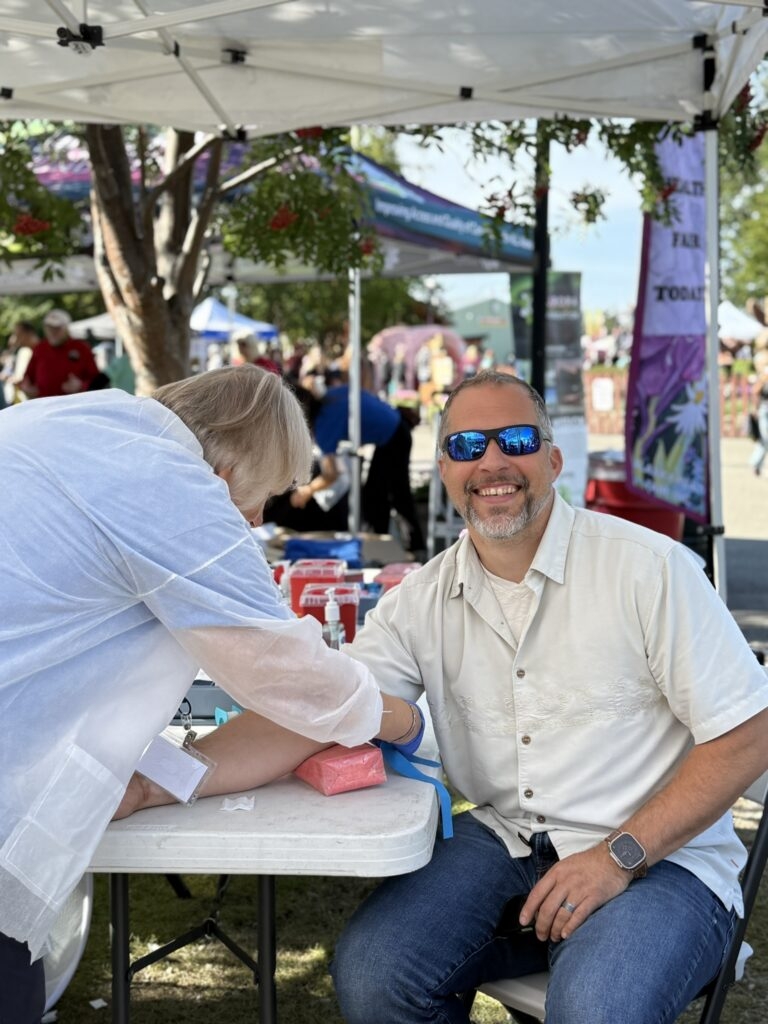
A participant in the second annual Cancer Screening Day at the Alaska State Fair on Aug. 27, 2026 gets a blood draw for a prostate cancer screening. (Photo courtesy of the Aurora Integrated Oncology Foundation)
Every August, Alaskans gather in Palmer for the State Fair. They come for the exhibits, the food, and the chance to see neighbors from across the state. On Thursday, Aug. 27, a good number of them also came for something less festive and more useful: cancer screening.
That day was the second annual Cancer Screening Day at the Alaska State Fair, organized by Aurora Integrated Oncology Foundation and a group of clinical and community partners.
In six hours, 443 people received screenings or related preventive services. Staff and partners recorded 1,922 community engagements — conversations with fairgoers about prevention, risk, and how to get care. The weather cooperated. The lines moved. People left with information they did not have when they arrived.
The numbers are straightforward. Partners provided 181 skin cancer screenings, 146 PSA blood draws for prostate cancer, 52 mammograms, 22 oral cancer screenings, and two HPV vaccinations. In addition, 40 people began the process for at-home colorectal screening. Those are not program slogans. They are individual Alaskans who chose to do something about their health in a place they were already going.
Cancer is the leading cause of death in Alaska. It accounts for about one in five deaths in the state. Breast, prostate, lung, and colorectal cancers make up roughly half of new diagnoses. For several of those cancers, screening finds disease earlier, when treatment is more effective and less burdensome. That is not a slogan. It is how medical evidence works.
Alaska makes this harder than it should be. Distance, weather, work schedules, insurance status, and a thin health workforce all get in the way of routine preventive care. A substantial share of women who should be current on mammograms are not. Colorectal screening still lags recommended levels. Late-stage diagnosis remains too common, and late-stage care is harder on patients, families, employers, and the health system. Anyone who has worked on infrastructure or economic development will recognize the pattern. Deferred maintenance is expensive. The same is true of deferred screening.
That is why the Foundation exists. Aurora Integrated Oncology Foundation is a nonprofit that operates radiation oncology centers in Anchorage, the Mat-Su Valley, the Kenai Peninsula, and Juneau. Our purpose is to improve the quality of, and access to, cancer prevention, treatment, and supportive care for Alaskans — regardless of insurance status. Treatment is essential. So is finding disease before it requires the most intensive treatment. Screening Day is one way we put prevention in front of people instead of waiting for them to navigate an appointment they may never make.
We did not do this alone. The Alaska State Fair gave us a setting where thousands of Alaskans already gather, and the Fair staff were steady hosts. Clinical partners brought the equipment, the clinicians, and the follow-up capacity. Our team handled the unglamorous work that makes a public event function: scheduling, supplies, patient flow, and problem-solving when something did not go as planned. Events of this kind succeed or fail on logistics. I am proud of the efforts of our staff and community partners. It was a resounding success.
Those partners include: Alaska Breast & Cervical Health Check, Alaska Health Fair, Alaska Men’s Run, American Cancer Society, American Lung Association, Anchorage Neighborhood Health, ANTHC, Breast Cancer Detection Center, Let Every Women Know, Connect Mat-Su, Mat-Su Public Health, Providence Imaging Center, Abbott Cancer Diagnostics, Mat-Su Dermatology, Palmer Fire & Rescue all alongside Aurora Integrated Oncology Foundation.
I have spent most of my working life on questions of investment and return in this state — in energy, infrastructure, workforce, and civic institutions. Health belongs on that same ledger. A screened population is a more productive population. Early treatment keeps people at work and at home. It reduces the travel and lodging burden that so often accompanies a late diagnosis in Alaska. It is also simply the responsible thing to do.
Screening Day will not, by itself, change statewide cancer statistics. One afternoon at the Fair is not a substitute for a primary-care relationship or a regular mammogram schedule. It is a demonstration that if you remove friction — cost, travel, time, and uncertainty — Alaskans will take the test. The task now is to keep removing that friction the other 364 days of the year.
If you were among the people who stopped between Raven Hall and the farm exhibits last Thursday, thank you. If you were not, the invitation still stands. Talk with your clinician about the screenings appropriate for your age and risk. Do not wait for a fairgrounds booth to appear. And if you are in a position to support screening access in your community — as an employer, a clinic, a borough, or a neighbor — do that. Early detection is not complicated. It is work. Alaska is capable of the work.
Juneau