Dozens sue for justice for alleged ICE abuse during Operation Metro Surge
Nov 09, 2026 | 7:00 am ET
Description
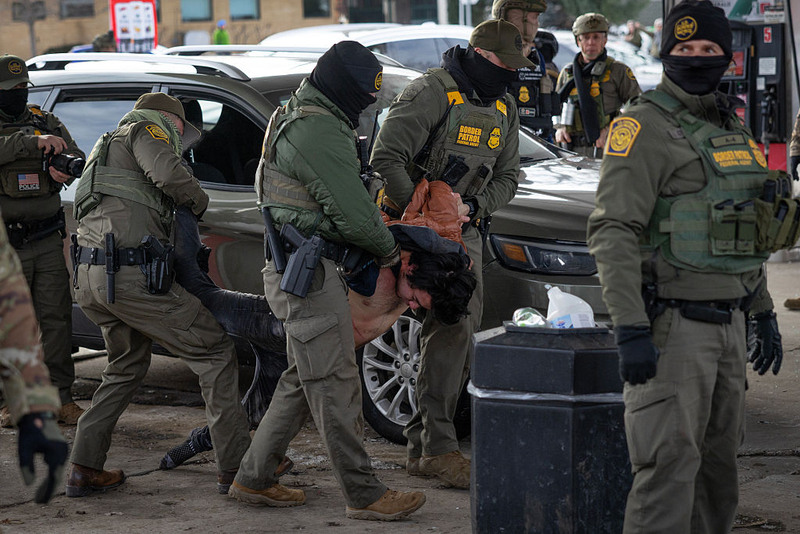
U.S. Border Patrol agents detain Orbin Mauricio Henriquez Serrano after he failed to present citizenship documentation at a gas station on Jan. 11, 2026 in St. Paul, Minnesota. (Photo by Scott Olson/Getty Images)
In the 10 months since U.S. Immigration and Customs Enforcement agent Jonathan Ross shot and killed Renee Good through her car windows in south Minneapolis, no criminal charges have been filed against Ross.
Ross violated department policy and law enforcement best practices by walking in front of Good’s car and shooting at her as the vehicle was moving, its wheels turned away from Ross.
Local law enforcement officials are investigating the shooting, but the federal government has refused to cooperate or turn over key evidence — let alone file their own charges against Ross. Even if local prosecutors file charges in Good’s killing, Ross would likely succeed in moving the case to federal court. He could assert immunity under the so-called Supremacy Clause, which protects federal officials from state criminal prosecution if they are “reasonably carrying out their duties,” a phrase with lots of room for interpretation.
With criminal charges against Ross unlikely to succeed anytime soon — if they’re filed at all — the Good family is among dozens seeking justice for ICE agents’ abuses through the civil court system.
There is no federal law, however, that allows citizens to sue federal agents for constitutional violations.
Instead, the Good family and others are filing claims under the Federal Tort Claims Act, or FTCA, which allows for the financial compensation of people harmed by federal employees’ wrongful or negligent in the course of their duties. (The Good family has also filed a second lawsuit, testing a legal theory that the behavior of ICE agents during Operation Metro Surge was part of a broader conspiracy to deprive people of color of their constitutional rights.)
Other people who have filed FTCA claims include Patty O’Keefe and Brandon Sigüenza, who were pepper sprayed and arrested while they were following and observing ICE; Aliya Rahman, who was dragged from her car while she was driving to a doctor’s appointment; Orbin Mauricio Henriquez Serrano, who was choked unconscious during his arrest at a St. Paul Speedway; and Quentin Williams, an employee of Roosevelt High School in Minneapolis, who was tackled to the ground and arrested when Border Patrol agents showed up at the school hours after Good’s killing.
“All my clients want change. They all want this never to happen again,” said Jessica Gingold, senior counsel at the MacArthur Justice Center in Chicago, who is representing Rahman and Williams. She hopes some economic pain will deter the government from continuing its brutal tactics. “If it is really expensive for them to pull off this system because everywhere they go, they violate people’s rights, and then people make them pay for those violations, it can’t continue, right?”

Among notable claimants in recent years: Sutherland Springs church mass shooting victims, who won a settlement after the U.S. Air Force failed to report a domestic violence conviction to the national background check registry, which may have otherwise prevented the shooter from buying guns he used in the massacre. The victims of Larry Nassar’s sexual abuse also settled with the federal government after the Department of Justice’s Office of the Inspector General issued a critical report of the FBI’s handling of the case.
The FTCA, however, has some limitations. Judges, not juries, decide the outcome of a lawsuit. The process can be tedious: Plaintiffs must first notify the federal government of their intention to file a claim, and the government has six months to respond and settle the case before the plaintiff can file a lawsuit. (Attorneys interviewed by the Reformer have not received settlement offers and expect most — if not all — of their claims to proceed in the courts once the six-month deadline has passed.)
The lawsuits don’t name the individual agents responsible for the harms, listing the U.S. government as the sole defendant.
The FTCA also caps the amount of money that can be paid out — plaintiffs can only win compensatory damages, that is, money meant to cover the actual cost of the harms, rather than punitive damages, which seek to punish the defendant. The payouts also don’t cover attorneys’ fees, and the percentage of the payout that can go to the lawyer is capped at 25% — less than the market rate for personal injury attorneys — meaning many lawyers decline to take on such cases.
The FTCA also doesn’t allow people to sue for violations of their constitutional rights, though many of the qualifying events — assault, battery, false imprisonment, false arrest, deceit, slander — are essentially proxies for violations of the Constitution, said Ian Bratlie, a former ACLU attorney representing 18 people in FTCA claims.
While data on FTCA claims isn’t available, it’s clear that dozens of Minnesotans have filed them over the behavior of ICE agents. The ACLU dropped a class action lawsuit, Hussen v. Mullin, in order to pursue FTCA claims on behalf of the plaintiffs.
“While money damages can provide a partial remedy for illegal harms inflicted by federal agents, it cannot return time lost to illegal detention and family separations, or a life lost,” said Ben Casper, senior attorney with the ACLU of Minnesota. “Nor do FTCA actions result in a court order barring the federal government from inflicting similar abuses again in the future.”

At a press conference announcing the filing of the Good family’s two lawsuits against the federal government, Antonio Romanucci, one of the family’s lawyers, said that Congress should pass a law allowing citizens to sue individual federal officers.
“There is a lack of accountability on behalf of federal law enforcement officers that exists in this country right now, and that, folks, is by design,” Romanucci said.
Gingold and a number of other social justice-minded attorneys have taken on FTCA claims in hopes of making the federal government pay for the abuses committed during ICE operations in Minnesota, Chicago and elsewhere.
While the FTCA has its limits, it still offers opportunities for accountability, they say.
“You’re suing the U.S. government, so you don’t have to identify the agent. You don’t need to know their name or where they’re from or anything like that,” Bratlie said. “Those are actually good advantages, especially in Metro Surge, where they’re wearing masks and you have no idea who these people were.”
Agents may be brought in for depositions during the legal process, Gingold said.
“So even when you’re not suing, you know, Officer Smith, who was the one who actually sprayed the pepper spray in your face, you still can get Officer Smith under oath in your lawsuit and ask him questions and make him explain what happened there,” Gingold said.
Bratlie said he believes there are a number of Minnesotans who were victims of abuses by federal agents who may qualify for an FTCA claim.
“It doesn’t have to be an extreme, ‘Oh, they broke my face. They broke my nose,’ things like that,” Bratlie said. “Anyone who is violated — getting pepper sprayed, having a gun pointed in your face, getting arrested and detained at Whipple for two hours — any of those things are valid FTCA claims, and people should look for lawyers and bring those.”

Saint Paul, MN