Divorce becomes next battleground as states debate family values
Sep 11, 2026 | 5:00 am ET
Description
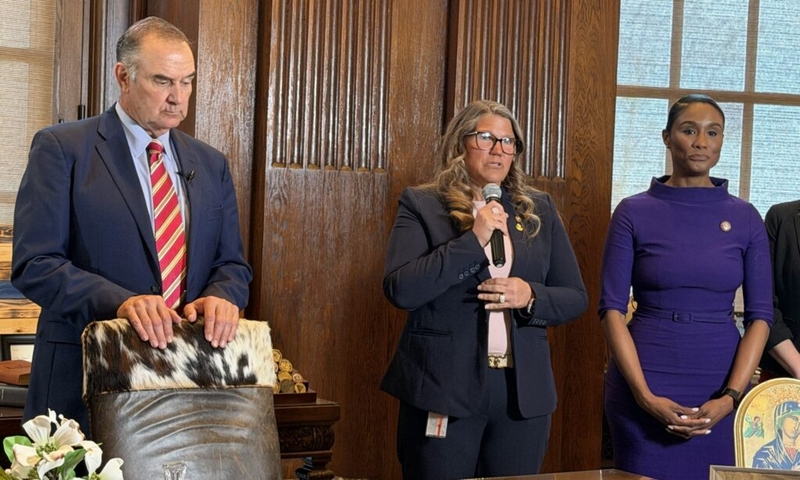
Missouri Republican state Rep. Cecelie Williams, flanked by Republican Gov. Mike Kehoe and Democratic state Rep. Raychel Proudie, speaks in April about legislation that clarifies the right to divorce while pregnant. In recent decades, most of the states that have tweaked their divorce laws have made it easier, not harder, to get one. But that may be changing. (Photo by Steph Quinn/Missouri Independent)
Cerina Fairfax, a Virginia dentist and mother of two, spent nearly two years living in the same house as her husband while she was trying to divorce him.
Virginia state law required couples with children, like the Fairfaxes, to wait a year before being allowed to file for divorce. Cerina’s husband, former Virginia Lt. Gov. Justin Fairfax, had also tried different legal tactics to prolong the process.
In March of this year, a judge granted Cerina sole custody of their children and ordered Justin to move out.
A few weeks later, with just days left before his move-out deadline, Justin fatally shot Cerina and then himself, police say, while their two teens were also in the house.
The tragedy focused national attention on state divorce laws, which have remained mostly static since 2010, when New York became the last state to allow no-fault divorce. In the years since, most of the states that have tweaked their divorce laws have made it easier, not harder, to get one. Virginia, for example, relaxed some of its requirements just days before Cerina Fairfax’s death.
Now that could be changing.
In recent years, more conservatives have turned to divorce as a “family values” talking point, with some pushing to make it harder for couples to divorce. By doing so, they’ve relaunched a national conversation that would have been nearly unthinkable just a few years ago.
In 1969, California became the first state to allow no-fault divorce, which allows one member of a couple to file for divorce without proving that the other person engaged in wrongdoing such as adultery, abuse or abandonment. No-fault divorce emerged from the women’s rights movement of that era, promising women greater freedom to escape from unhappy or abusive marriages.
But the loss of that freedom suddenly seems more plausible, particularly for those whose confidence in federal protections for women’s rights was shattered after the U.S. Supreme Court overturned the constitutional right to abortion in 2022. And as state lawmakers ramp up restrictions around birth control, fertility treatments and pregnancy loss, new limits on divorce seem less far-fetched.
“What’s different now is that it’s actually gaining some traction,” said Marcia Zug, a family law professor at the University of South Carolina School of Law whose work focuses on the legal history of marriage. “Simply the idea that we’re talking about it seriously, that it’s part of some Republican party platforms, that it’s not just laughed out of the room.
“Even if we’re not anywhere near eliminating it, that is the major change.”
Earlier this year, for example, an Iowa Senate subcommittee approved a bill that would allow couples to opt out of no-fault divorce when they’re registering for marriage licenses.
“In the last generation, we have seen the chaos of — the circus of — pure no-fault divorce, (and) the ugliness of divorce and the breakdown of marriage,” Iowa state Sen. Jesse Green, a Republican, told his colleagues during a February hearing on his bill, which later died in committee.
“A lot of people are not getting married anymore because maybe, in some cases, they feel the lack of support and accountability with our law,” he said.
Oklahoma bill would end incompatibility as grounds for divorce
In Texas and Nebraska, the official state GOP platforms call for ending or limiting no-fault divorce. Other state Republican parties, such as in Louisiana, have considered similar party planks.
Republican lawmakers in states including South Carolina and South Dakota have filed bills to limit no-fault divorce or make the process harder.
Oklahoma state Sen. Dusty Deevers, a Republican and pastor, filed a bill in 2024 to abolish no-fault divorce, after saying he wanted to see public shaming for those who cause divorce.
At the same time, some prominent social media influencers have been using their platforms to call for streamlining divorce laws.
Hadley Vlahos, a Mississippi registered nurse with 2.2 million followers on TikTok, used her platform this summer to talk about her three-year-long divorce, which included an 11-day trial and hundreds of court filings. She has called for changes to Mississippi’s divorce law, one of only two in the country that doesn’t allow a no-fault divorce if one spouse objects. Her petition to change state law has more than 30,000 signatures.
Jen Hamilton, a nurse and content creator North Carolina who has 7.2 million followers across TikTok and Instagram as well as a bestselling book, called for changes to the divorce laws in her state after separating from her husband.
She recently appeared at a fundraiser with North Carolina state Sen. Woodson Bradley, a Democrat who co-sponsored a bill that would shorten the required separation period before divorce in certain circumstances. That bill remains in committee.
Hamilton’s goal, she told her followers, “is to do everything that I can to get North Carolina law changed to protect women — and some men — from these archaic, paternalistic laws that keep people trapped in marriages that are either unhealthy or dangerous.”
A paradox
Divorce has been declining in the U.S. for more than 40 years.
Four of the five states with the highest divorce rates — Oklahoma, Nevada, Mississippi, Wyoming and Alabama, as of the most recently available data — are Republican led; Nevada has a Republican governor but a Democratic-controlled state legislature.
But state laws aren’t an effective way to raise or lower the number of divorces, said Krista Westrick-Payne, a marriage and divorce researcher and assistant director at the National Center for Family & Marriage Research at Bowling Green State University.
“The more significant things that affect whether or not a couple decides to divorce has much more to do with their relationship and their personal situation,” Westrick-Payne said.
Religious areas tend to see higher divorce rates, according to her research. So do areas that are more politically conservative.
“That feels like a paradox,” she said. But those areas generally see more people marrying at younger ages — one of the biggest predictors of divorce.
“So it’s not to say religious people are divorce prone; it’s just they have all these other risk factors, and underlying population dynamics that affect this.
“People like to get on social media and make these overarching statements, flattening a very complex issue,” she said. “And I don’t think that serves anyone very well.”
The most dangerous time
The Iowa proposal to allow couples to opt out of no-fault divorce faced strong opposition from domestic violence advocates, who said such laws especially burden people fleeing domestic violence — who are overwhelmingly women — and can leave them stuck in a dangerous marriage while they try to prove to a court that they’re being abused.
“For someone experiencing domestic violence, leaving is already incredibly complicated, and for a lot of survivors, it is the most dangerous time,” said Lindsay Pingel, director of community engagement at the Iowa Coalition Against Domestic Violence, which represents 25 victim service provider organizations across the state.
Then-California Gov. Ronald Reagan, himself divorced, signed the law that made his state the first to allow no-fault divorce. Prior to that, a person trying to divorce had to prove in court that his or her spouse did something wrong. But such things are difficult to prove in court, and subject to a judge’s interpretation.
“We know that domestic violence doesn’t always come with the kind of documentation that someone who’s never experienced an unhealthy relationship might expect,” Pingel said. “There might not be a police report, or medical records, photographs or witnesses.”
Most survivors of domestic violence don’t talk about it with others until they’ve decided to leave, she said. And many don’t feel safe involving authorities in a situation that could make it more dangerous.
“We have to stop asking why survivors continue to stay in unhealthy relationships when we continue to put barriers in place that prohibit them from leaving.”
Cerina and Justin Fairfax tragedy underscores new Va. laws that could help prevent similar violence
Women who talked to Stateline about their divorces described years-long court battles with convoluted rules, fraught custody arrangements and uneven protections in cases of abuse.
Some states require months- or years-long waiting periods where a couple must be separated before they can file for divorce. At least three states — Arkansas, Arizona and Louisiana — allow so-called “covenant marriage,” a legally binding agreement that comes with additional requirements and is harder to end through divorce. Republican House Speaker Mike Johnson, who is from Louisiana, is in a covenant marriage with wife Kelly.
Recently, some states have made it easier for couples to divorce. Maryland, for example, moved to a purely no-fault divorce process in 2023.
Virginia’s new divorce law includes some narrow changes, including an option for speeding up the divorce process. It also created a legislative work group to study whether the state should eliminate fault-based divorce entirely.
And in Missouri, Republican Gov. Mike Kehoe in April signed a new law clarifying that pregnancy can’t prevent a divorce from being finalized.
Pingel, of the Iowa domestic violence coalition, said supporting healthy marriages and protecting vulnerable people from dangerous marriages aren’t competing goals.
“Children benefit from safety and stability,” she said. “and keeping someone legally tied to a person who is causing harm doesn’t necessarily create a healthier family.”
Stateline reporter Anna Claire Vollers can be reached at [email protected].