Despite initial support, Legislature fails to override Mills’ veto of landmark data center ban
Apr 29, 2026 | 2:06 pm ET

Description
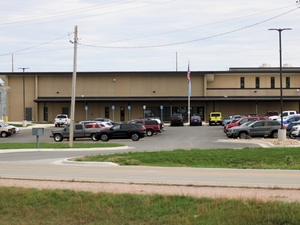
A complex of data centers in Ashburn, Va. (Photo by Gerville/Getty Images)
Maine lawmakers on Wednesday failed to override Gov. Janet Mills’ veto of what would have been the nation’s first statewide data center moratorium.
After Mills vetoed the bill Friday, the House of Representatives took up the legislation again, voting 72-65 on the bill, failing to secure two-thirds of lawmaker support needed to override the governor’s action.
LD 307 would have been the first statewide data center moratorium in the country, banning data centers larger than 20 megawatts until November, 2027.
But despite the vote, supporters of the bill made clear that this would not be the final debate over data centers in Maine.
“I want to close today with a warning to the friendly corporate lobbying crew in the hallways and in the balcony who have maneuvered us into this position today: This is not over,” said Rep. Daniel Ankeles (D-Brunswick).
The bill would also have created the Maine Data Center Coordination Council to assess policy tools for regulating data centers, but Mills signed an executive order Wednesday creating a version of the council.
The 15-member group will make recommendations on large-scale data center development. Mills also directed the Department of Energy Resources to identify and implement ways to protect ratepayers from energy costs resulting from data centers.
Outside the chambers, supporters of the moratorium lined the State House hallways to urge lawmakers to override the veto.
“No one could have listened to that debate and not voted to override,” said Topsham resident Neal Gabler, referring to the robust discussion in the House chamber.
“Well, we know what the hurry is,” Gabler said. “There’s money to be made here, and it’s not going to be made by the people in Jay,” referring to the location of a proposed data center project that the governor had said she wanted carved out of the temporary ban.
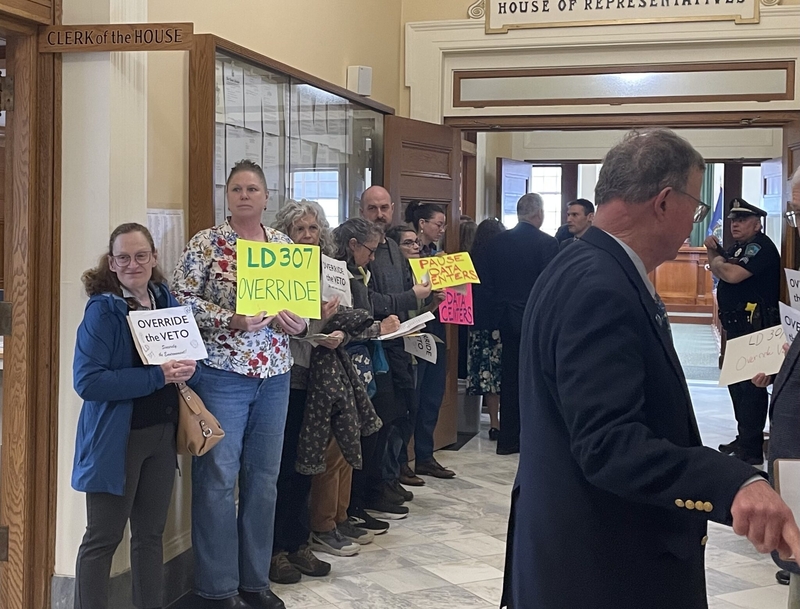
Catherine Whitaker, of Brunswick, said, “We’ve seen other states run into problems with the economy, with ecology and with human health and we don’t want that for the people who live here in the great state of Maine.”
Whitaker said that lawmakers seemed to have made up their minds before the discussion Wednesday.
“I wish that the politicians in the room had listened to the debate, because those words and that evidence overwhelmingly was in support of the bill,” she said.
The motion to override Mills’ veto prompted over an hour of debate in the House. Ahead of the vote, bill sponsor Rep. Melanie Sachs (D-Freeport) said Mills traded a bill that would protect 1.4 million residents for one project that, without proof, promised 100 jobs.
“This is not about being anti-development,” Sachs said. “It is about being pro-accountability. If a project is going to reshape our energy grid, impact our natural resources and potentially cost shift to ratepayers across the state then it must meet a high bar of transparency and proof, and that bar has not been met.”
She said other states have seen the impacts from data centers when development outpaces policy, in their utility bills, noise and light pollution, heat impacts and other environmental effects.
“These are not hypothetical, abstract, impossible impacts,” Sachs said. “These are facts and evidence of actual experiences, so much though, that other states are desperately trying to mitigate the damage.”
Ankeles said that in the rest of the state, support for the moratorium was clear.
“Go outside this building and read the room,” he said. “The public is not happy that we are in this position, and it is not because anyone in here riled them up. It is because they are smart and they know better.”
He said this was the final opportunity to tackle this issue in a modest and reasonable way.
“If we say no today, our electric bills will take further damage,” Ankeles said. “If we say no today, our grid capacity will take further damage. If we say no today, and worst of all, our precious fresh water — which a lot of people here in Augusta seem to have taken for granted this session — will take damage as well.”
But Rep. Billy Bob Faulkingham (R-Winter Harbor) said data centers can be a vital economic driver and key infrastructure to support the expansion of artificial intelligence.
As Gov. Mills weighs data center ban, projects mixed on what the impact would be
“Data centers are not only important for people on a personal level, they’re important for our national security,” he said. “And I can tell you, our enemies are not going to stop putting data centers in their countries.”
In Mills’ veto letter, she cited the economic benefits of a proposed data center in Jay, particularly in light of the “devastating” 2023 closure of the Androscoggin Mill.
“A moratorium is appropriate given the impacts of massive data centers in other states on the environment and on electricity rates,” Mills said. “But the final version of this bill fails to allow for a specific project in the Town of Jay that enjoys strong local support from its host community and region.”
Mills said she would have signed the legislation if it had included an exemption process for projects like the one in Jay.
Mills said that the Town of Jay, the Franklin County commissioners and the regional Chamber of Commerce all reached out to her office to voice support for the development project.
“This project — which is now under contract and which has received several permits — is expected to create more than 800 construction jobs, at least 100 high-paying permanent jobs, and would contribute substantial property tax revenue to the Town of Jay,” Mills said. “The project developers are committed to revitalizing the mill site by utilizing its existing industrial buildings, water, and electrical infrastructure to avoid the adverse impacts cited in the bill, including impacts to ratepayers.”
But Sachs said she looked into the project and found that some permits were for a previous project, not a data center, and other permits had not been issued.
“My colleagues on [the energy committee] and I asked for proof of the claims that the data center, once installed, would use little water and energy and have no environmental impact,” Sachs said. “We were not provided those details.”
Sachs added that although Mills cited local support in Jay, town officials only learned about the data center project after the introduction of her bill.
“I asked the chief executive to meet with me multiple times, or at least furnish details for these assurances around the promises of this project,” Sachs said of Mills. “None of these were granted or forthcoming.”
Sachs said that what the people of Jay, and the rest of Maine, deserved was clarity about the project.
“My father worked at that very mill, and I understand, because most of my family still lives in that area, exactly what is at stake when we talk about economic opportunities for that region,” Sachs said Wednesday, “Which is why the people of Jay, and all of Maine, deserve facts, not promises.”
- 2:37 pmThis story was updated to include details of the executive order establishing the Maine Data Center Coordination Council.
Augusta, ME