Commission denies CMP request for temporary rate increase
Oct 06, 2026 | 4:43 pm ET
Description
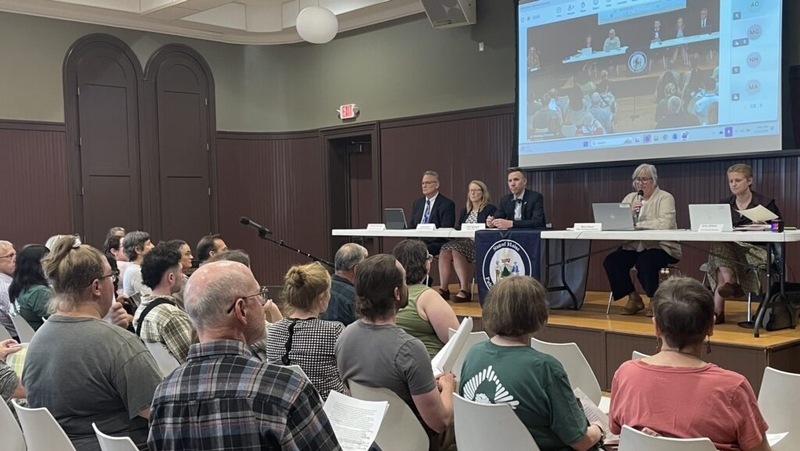
On June 23, the Public Utilities Commission joined staff at Lewiston Public Library, where people filled the room for a public hearing on Central Maine Power's rate case. (Photo by Kaitlyn Budion/Maine Morning Star)
The Maine Public Utilities Commission Tuesday denied a request from Central Maine Power to enact a temporary rate increase.
At the Tuesday meeting all three commissioners voted to deny the request, primarily because the parties to the rate case could not reach an “undisputed” amount for the increase, as required under state law.
“When we deliberated the dismissal of CMP’s last rate case, I indicated an openness to temporary rates given the anticipated delay resulting from terminating that proceeding,” said Commission Chair Philip Bartlett. “But to grant a request for temporary rates, there needs to be a clear amount that is not in dispute. In my view, that is not the case here.”
CMP is seeking to increase its revenue by $189 million, and while that case is pending before the commission, the utility requested a temporary rate increase to provide $69.3 million.
CMP estimated the proposed temporary rate would mean an increase of $7 a month for the typical residential customer using around 550 kilowatt hours each month.
Commissioner Patrick Scully also noted that state law gives the commission the option to grant a temporary increase, but it does not have to allow it, even if there is an undisputed amount.
“I view temporary rates to be the exception and not the rule, and not typically available in most cases, barring a showing of extreme need or the potential of serious harm to the utility or its ratepayers,” he said. “In this case, I do not see that a few months of more time to reach a fully considered outcome in this complicated case will result in significant harm to either.”
Commissioner Carolyn Gilbert also noted that the commission is scheduled to make a final ruling in the case in the spring.
“It seems like we’re actually getting fairly close to the end of the case, and so I think we would benefit from letting the full case run before deciding on a rate increase,” she said.
CMP did not respond to a request for comment Tuesday, but in a statement last week after commission staff recommended against the rate increase, the utility said the decision would have consequences beyond the rate case, extending financial uncertainty for the company.
“CMP has already been forced to defer planned capital work, including projects intended to make power available, strengthen reliability, improve resilience and modernize the system, and will continue to do so,” the utility said. “CMP will now also be forced to evaluate workforce levels and hiring plans that support current operations and future needs.”
CMP on Monday shared a list of reliability projects it said would be delayed if the temporary rate increase was not approved, citing “mounting financial pressures” affecting the utility.
Those projects include upgrades to substations in Lewiston, Auburn, South Portland, Biddeford and Saco, along with upgrades to one of CMP’s poorest-performing distribution lines in Limington, Baldwin, Sebago and Standish.
“For more than a year, we have continued investing in reliability and system improvements while managing rising costs and awaiting the necessary regulatory approval to align rates with the cost of providing service,” CMP President Linda Ball said in the Monday statement. “That approach is becoming increasingly difficult to sustain due to inflation, rising costs and other factors.”
In a statement Tuesday, Rebecca Schultz with the Natural Resources Council of Maine called CMP’s statement on delayed projects “unacceptable” and said the company was threatening Maine residents with cutting union jobs and delaying important work.
Schultz applauded the commission for denying the temporary rate increase.
Public Utilities Commission staff recommends denying CMP temporary rate hike
“No Mainer thinks utilities should be able to make higher profits without accountability while families and local businesses struggle with the escalating cost of everything,” Schultz said. “Today’s decision by the PUC demonstrates that they agree with the hundreds of Mainers who have asked for a thorough and thoughtful review of CMP’s rate increase request.”
At Tuesday’s meeting, Bartlett said he was “mindful” of CMP’s financial considerations, but pointed to the staff analysis and comments from the Office of Public Advocate, which noted that CMP’s capital spending from 2022 to 2025 significantly exceeded its forecast.
“So to some extent, this is a problem of CMP’s own making,” Bartlett said.
Scully said that it is “likely” that the final decision in the case will result in a rate increase, if only because of the investments CMP has already made and the rising business costs that the utility faces.
“We will do our best to find a reasonable outcome that balances the needs of the utility to allow it to provide safe and reliable electric delivery service, with the serious affordability concerns facing customers,” Scully said.
The Fight the Hike Coalition, a consumer defense group, praised the commission’s decision but said there is still work to be done.
“The PUC’s decision is a temporary reprieve for young Mainers grappling with an affordability crisis,” Jackson Chadwick with Maine Youth for Climate Justice said in a statement. “But this fight isn’t over. We continue urging young Mainers to speak out against utility profiteering at the expense of our hard-working communities, who are simply trying to make a living.”

Augusta, ME