Coal miners could pay for savings if inspectors lose offices on DOGE list, advocates warn
Apr 07, 2025 | 5:50 am ET
Description
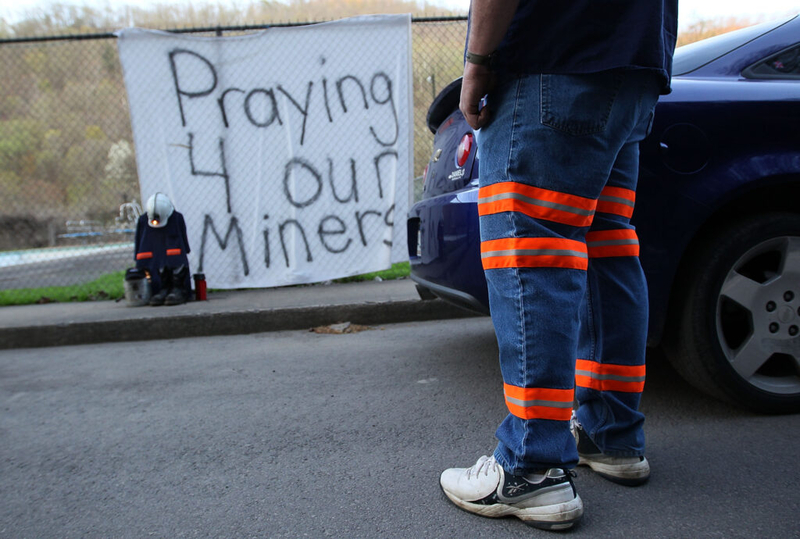
On the 15th anniversary of the Upper Big Branch mine disaster in West Virginia, the Trump administration is considering closing 33 federal mine safety field offices around the country. Twenty-nine miners died at a Massey Energy coal mine after an explosion deep underground on April 5, 2010. Two days later, Terry Bailey stood with a banner he hung to honor local coal miners in Whitesville, West Virginia. (Photo by Mark Wilson/Getty Images)
Federal inspectors conducted more than 300 safety inspections at coal mines in Harlan County over a recent 14 month-period, checking that toxic gases were ventilated, flammable materials under control and equipment working safely. Such inspections could become less frequent if the Trump administration carries out a plan to terminate the leases of dozens of mine safety field offices, warn advocates for miners.
The inspectors conducting those hundreds of inspections in Harlan County traveled from offices in Barbourville and Harlan, both of which are on a list of seven in Kentucky slated for closure by the federal Department of Government Efficiency (DOGE). That’s according to an analysis of federal Mine Safety and Health Administration (MSHA) data by the nonprofit Appalachian Citizens’ Law Center.
Closing those offices, the analysis says, could turn a 30-minute drive to inspect a rural coal mine into a three- or four-hour round trip.
“We are really worried that any kind of cutting to field office capacity or requiring longer commutes of these inspectors just means that they’re spending less time at the mines,” said Rebecca Shelton, the center’s director of policy.
Especially worrying, Shelton said, is the possibility that inspectors would no longer have time to conduct inspections that are classified as discretionary but are “critical” to worker safety in one of the country’s most hazardous occupations. She said discretionary inspections can be made in response to complaints from miners to the agency about mine hazards or when an inspector decides a follow-up visit is needed after noticing an issue. Some inspections are required by federal law.
News outlets first reported last month that DOGE had listed the leases of dozens of MSHA field offices across the country among numerous “lease cancellations” for federal agencies. The lease terminations are part of cost-cutting efforts to eliminate waste, fraud and abuse, according to Trump officials and Trump adviser Elon Musk who’s played a leading role at DOGE.
If the government cancels the leases on the list, MSHA would be left with Kentucky offices in Lexington and Pikeville.
A spokesperson for MSHA did not directly answer questions from the Lantern about the status of MSHA offices that were on the DOGE list or if and when the offices’ leases would be terminated.
“Mine Safety and Health Administration inspectors continue to conduct legally required inspections and remain focused on MSHA’s core mission to prevent death, illness, and injury from mining and promote safe and healthful workplaces for U.S. miners,” a U.S. Department of Labor spokesperson said in a statement.
The Appalachian Citizens’ Law Center, based in Whitesburg, compiled and analyzed data from the federal Mine Data Retrieval System on the number of inspections conducted and cumulative hours worked by inspectors at each of the 33 MSHA field offices designated for lease cancellation by DOGE. The analysis looked at the first two months of this year and all of 2024. Offices slated to have their leases terminated stretch across the country and are concentrated in Appalachia and the Ohio Valley.
While thousands of coal-mining jobs have been lost in recent decades, MSHA inspectors remain busy, the analysis found. Out of the 33 MSHA field offices listed by DOGE, 16,639 inspections were conducted accounting for more than “234,000 hours on site at mines and over 399,000 total hours completing inspection duties.”
Willie Dodson, the coal impacts program manager for the environmental advocacy nonprofit Appalachian Voices, told the Lantern last month that MSHA operates under a legal and regulatory framework that came from “massive grassroots movements” in the 1960s and 1970s to address dangerous working conditions in mines. Congress created MSHA as part of the Mine Safety Act of 1977 after the deaths of 26 miners in two underground explosions at the Scotia Mine in Letcher County the year before.
The rate of mining fatalities and injuries has plummeted since MSHA was established in 1977, Dodson said.
Dodson said new regulatory obligations being taken on by MSHA to monitor and control silica dust in mines that’s contributing to a surge in cases of the occupational disease coal workers’ pneumoconiosis — commonly known as “black lung” — is coinciding with a decline in staffing at MSHA over the past decade. Shelton also pointed to the firing of federal researchers who were studying “black lung” as another safeguard for miners that is “on the chopping block.”
Adding the potential termination of field office leases to the mix makes Dodson say “the math doesn’t work out” for regulating active mines.
“I am very concerned that certain inspections just aren’t going to happen, or inspectors are going to be so rushed that they’re going to miss things that they need to take note of,” Dodson said.
Frankfort