Ciscomani, Mendoza spar over Trump’s spending law in CD6 debate
Sep 11, 2026 | 9:51 am ET
Description
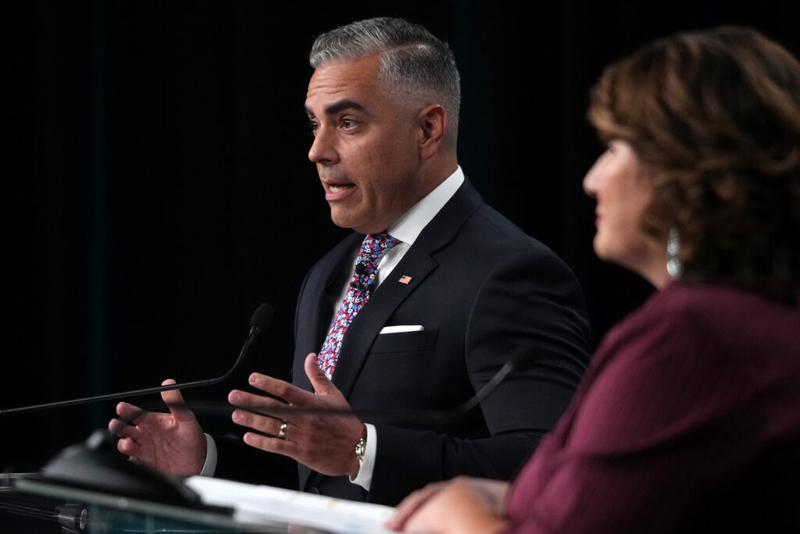
Republican U.S. Rep. Juan Ciscomani debates Democratic candidate JoAnna Mendoza in a Clean Elections debate on Sept. 10, 2026. (Photo by Joe Rondone/The Arizona Republic/pool)
Republican Congressman Juan Ciscomani and his challenger, Democrat JoAnna Mendoza, both tried to woo voters Thursday night in a debate by trying to distance themselves from the divisive partisan politics that have dominated in the era of Donald Trump.
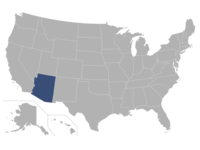
Since it was drawn at the beginning of the decade, Congressional District 6 has been Arizona’s most competitive district, with an electorate that is nearly evenly divided between Republicans and Democrats.
Ciscomani has won the last two elections by 1.5% and 2.5%, respectively. The seat has become a key battleground race in the state with money flowing in from both sides as Republicans seek to hold onto their majority in the House while Democrats seek to flip it.
Both candidates leveled attacks at one another while also trying to convince voters that they would buck their party if need be.
Ciscomani highlighted his opposition to parts of Trump’s “One Big Beautiful Bill Act,” or OBBBA, that slashed funding for Medicaid, which provides health insurance to low-income Americans, including more than 1.6 million Arizonans. The spending package slashed federal government spending in order to enact massive tax cuts, primarily for businesses and the wealthy.
Still, the final version of the bill included deep cuts to Medicaid, and Ciscomani voted for it despite that earlier opposition. Budget analysts have estimated the bill will mean a $110 million reduction in funding for rural hospitals in CD6.
Mendoza, meanwhile, said she’d likely vote against her party on issues relating to water and border security or law enforcement, although she did not provide specifics.
The first question of the debate focused on the OBBBA and specifically how it has impacted the Supplemental Nutritional Assistance Program, also known as SNAP, which provides food aid for low-income people. The measure cut SNAP funding by an estimated $186 billion and 5 million Americans have already lost their benefits, including 770,000 children.
“We need to strengthen the safety net for so many families that need it,” Ciscomani said, adding that OBBA has helped affordability by eliminating the tax on overtime and tips. He also touted the extension of the Child Tax credit under the bill. “So, when you say you oppose this bill, that is exactly what you are opposing.”
The left-leaning Institute on Taxation and Economic Policy analysis of that extension found that 30% of all children in the country would not even qualify.
Mendoza said that eliminating the cuts made by the OBBBA, stopping Trump’s tariffs and reinstating funding to SNAP are what would be needed to help families that have been impacted by the OBBBA.
Trump’s omnibus spending bill was a major focus for Mendoza, who repeatedly connected Ciscomani to the legislation while Ciscomani touted the inclusion of monies to rural hospitals that will likely be impacted by the cuts made by the bill.
The $50 billion infusion of cash to rural hospitals has seen bipartisan support, however, cuts to Medicaid and Obamacare are around $1 trillion and states that adopt Trump favored policies have gotten larger injections of money.
Ciscomani shot back at Mendoza’s claim that the OBBBA supported “tax cuts for the wealthy” by reiterating that state health programs have to be protected and have been found to have issues with fraud.
“When you talk about billionaires and tax cuts for them. I don’t know many billionaires working for tips,” Ciscomani said about the bill, referencing the elimination of taxes on tips.
“He stated that he knew how devastating it was going to be if those cuts happened to AHCCCS and he voted for the bill anyways,” Mendoza said in response.
Ciscomani accused Mendoza of “nitpicking and cherry picking” from the bill to distort his support of it.
“Do I agree on everything on every bill? Of course not, nobody does,” he said.
But Mendoza said Ciscomani’s attempts to evade responsibility for backing the bill are too little, too late.
“It is like bringing a glass of water to a fire you started,” she said.
Ciscomani tried to emphasize his reputation for reaching across the aisle to work with Democrats, noting that he had worked with President Joe Biden during his tenure and now is working with Trump, claiming he is the most bipartisan lawmaker in Congress. He also repeatedly directed voters to a website his campaign launched Thursday highlighting Mendoza’s work as a lobbyist and contrasting it with his work in Congress.
Mendoza also worked to tie Ciscomani to Trump and his policies, citing his support of Elon Musk’s Department of Government Efficiency and the war with Iran that Trump launched without congressional approval.
Both agreed that Iran should not get nuclear weapons, though Mendoza said that any intelligence pointing to that inevitability should have been brought before Congress to allow a vote on the president’s war powers.
Ciscomani said he supports the war effort and that the focus is now on opening the Strait of Hormuz, which has largely been under Iranian control since shortly after the war began.
On immigration, both candidates brought up their direct experiences with immigration as a driving motivation behind their stances.
For Ciscomani, who immigrated from Mexico with his family and became a citizen in 2006, he said it is an issue that is “very near and dear to my heart.”
Ciscomani said that, under Biden, the borders were “wide open” and that made it harder for “good people” to come into the country and become citizens.
“I’m a product of the American Dream, I want people to have access to that American Dream,” Ciscomani said, adding that he believes in both border security and reform to the process and claiming that Mendoza supports “open borders.”
“To say I’m for open borders is not truthful,” Mendoza responded, adding that Trump’s tariffs are hurting the country and state’s relationship with Mexico.
Mendoza, who said her step-father was an immigrant from Mexico who became naturalized under President Ronald Reagan, said she would try to “work across the aisle” on issues of border security. Both seemed to agree that reform to the immigration process is needed.
An area where Ciscomani tried to distance himself from Trump politics was on the issue of elections.
“I fully support mail-in voting,” Ciscomani said, adding that he trusts the system. Trump has attacked mail-in voting making unfounded claims of voter fraud, and is waging a battle against the states over his executive order that would severely restrict voting by mail and potentially disenfranchise millions of Americans this fall.
Ciscomani said he also supports the SAVE Act, the controversial GOP bill to nationalize elections and require documented proof of citizenship at the time of voting, among other changes.
Ciscomani said that the changes in the legislation are not “out of this world” and are “common sense measures” that he said Mendoza does not support.
Mendoza said that Arizona already requires a voter ID — something she supports — so the federal legislation brings “nothing new to the table.”
“Sounds like an endorsement for the SAVE Act from JoAnna Mendoza,” Ciscomani said.
“Don’t put words in my mouth, Congressman,” Mendoza shot back.
Both candidates have claimed victory in the debate.
CD6 is expected to be one of the most watched races in the state and early voting begins on October 7. You can check the status of your voter registration at my.arizona.vote.
Phoenix, AZ