With Christie by his side, Bobby Charles distances himself from Trump
Sep 24, 2026 | 5:44 am ET
Description
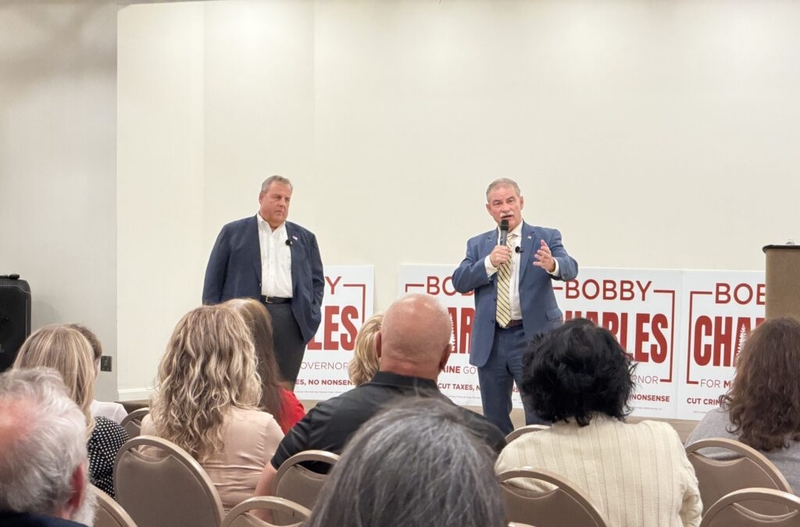
Republican gubernatorial nominee Bobby Charles with former New Jersey Gov. Chris Christie during a Sept. 23 town hall in Lewiston. (Photo by Eesha Pendharkar/Maine Morning Star)
At a town hall in Lewiston joined by Chris Christie, Bobby Charles hopscotched across the Republican Party line.
Campaigning with the former New Jersey governor 41 days before the Nov. 3 midterms, the GOP gubernatorial nominee broke with the Trump administration on several key issues affecting Maine, including tariffs and environmental policy, while echoing the president on others.
He told the cheering crowd of 75 supporters that he wanted to dismantle Maine’s largest state agency, the Department of Health and Human Services. He blamed overdose deaths on syringe exchange programs and said he would get “socialism out of schools.” The latter stance is part of Charles’ pitch to rebuild the fraught relationship between Maine and White House, which has targeted the state since Gov. Janet Mills’ told President Donald Trump she’d see him in court over the state’s inclusive policies.
“A governor can disagree with the president, but can repair the relationship with the federal government at large,” he said. “When we turn this state red, one of the things we get out of that is a rebuilding of the relationship together with an independent voice to confront the president.”
Republicans running for office across the country are distancing themselves from the president as his approval ratings have plummeted. In Maine, only 31% of voters approve and 63% disapprove of the way he is handling his job, according to Civiqs’ rolling tracker.
Immigration
Charles struck a different tone on immigration on Wednesday. Having previously called state Rep. Deqa Dhalac (D-South Portland) a “radical Somalia-first” representative and saying he’d ask the Trump administration to send federal immigration agents to the polls, Charles was asked by a Bates student from New Jersey about the fear immigration enforcement has caused in Maine.
In an apparent reference to the July killing of Johan Sebastián Durán Guerrero in Biddeford,
Charles said he was “mystified by why … we didn’t have body cameras on people.”
He also called himself pro-immigrant while advocating for balance, saying “this country was built on immigrants, but it was also built on respect for the Constitution and on respect for law.”
But Charles also blamed a recently enacted Maine law that restricts how local law enforcement agencies can cooperate with U.S. Immigration and Customs Enforcement, saying the limits on communication have led to bad outcomes.
“I think Bobby’s approach is absolutely right, he’s got to take both sides,” Christie said.
“We cannot allow any leaders in this country to be telling us that immigrants are the problem,” Charles added. “Let’s make sure we protect people’s belief that if you come to this country and you work hard and you follow the law, that you can become anything. If we lose that, then we lose our identities as Americans.”
Christie, who ran unsuccessfully for the Republican presidential nomination in 2016 and 2024 and later became an outspoken Trump critic, seemed to back Charles in that approach. Introducing Charles, he highlighted the nominee’s stance on Canadian tariffs as evidence that Charles would diverge from the party when he believes it benefits Maine.
“When he sees that something is happening that’s hurting Mainers, he stands up and he’s told the president … stop fighting with Canada,” Christie said.
“That’s the kind of governor you want. It’s not someone who’s going to pick on every little thing that happens in Washington, D.C. just to get themselves on TV, you want people who are going to focus their fire on the real problem.”
But while Charles and Christie emphasized places where the Republican nominee would break with Trump, their shared focus at the town hall was criticizing Mills and Democratic nominee
Hannah Pingree. Several of Charles’ campaign promises involve rolling back policies and programs enacted during Mills’ two terms as governor.
“We are living in a state in which Governor Mills and Hannah Pingree together have driven every single major positive indicator down, and many of the negative indicators up,” he said.
Pingree, Charles and independent gubernatorial candidate Rick Bennett have all emphasized lowering costs, but Charles has focused on reducing property and income taxes as the solution.
Earlier this month, Charles’ sister, Anita Charles, endorsed Pingree. During a Sept. 9 press conference, the educator from Lewiston said her brother’s campaign was built on “denigrating others and targeting Mainers with mean-spirited rhetoric that aims to incite fear and hatred towards vulnerable groups.”
A focus on crime and drug use
Several supporters at the event said Charles’ positions on taxes and crime were among the reasons they backed him.
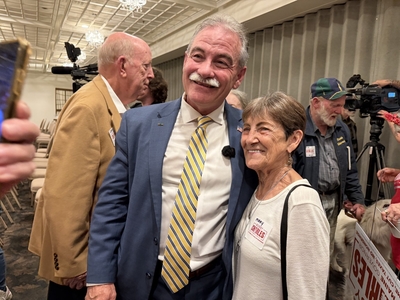
Mary Leonas, a Greene resident and former academic advisor at the University of Southern Maine, said she switched her party affiliation from Democrat to Republican a year ago. Leonas sat in the front row at Charles’ event and lined up to take a picture with him after. She appreciated Charles diverging from Trump on issues that impact Maine.
“Nobody agrees totally with President Trump, there are some things that he does that are really questionable,” she said. “I appreciate that (Charles) thinks for himself.”
In particular, his promise to reduce crime was one of the primary draws for her.
While Maine continues to have one of the lowest rates of violent crime in the country, several Charles supporters said they are concerned about what they said was increasingly visible homelessness, crime and syringe waste on the streets of Lewiston, Portland and Bangor.
Cracking down on drug use was also a major theme of Wednesday’s town hall. Charles praised Christie’s record of addressing opioid addiction while critiquing the expansion of syringe exchange programs in Maine. During Mills’ tenure, Maine shifted from a one-for-one syringe exchange model to one that allows syringe service programs to distribute up to 100 sterile syringes per participant per visit.
“How Orwellian is it that every single death in this state that occurs by injection drugs is probably occurring on a state-provided needle?” Charles asked while advocating for increased addiction services.
Research has found that syringe service programs reduce the spread of HIV and hepatitis C and do not increase illegal drug use or crime. But syringe litter has prompted some Maine communities to impose local restrictions. Sanford, for example, adopted a one-for-one exchange requirement in 2025 after city officials cited concerns about discarded syringes.
But Leonas said she believes Charles’ approach will limit syringe litter, which she said is a major concern in Lewiston.

Augusta, ME