The Chesapeake Bay’s young rockfish are still struggling. It may be the ‘new normal.’
Oct 19, 2026 | 8:36 pm ET
Description
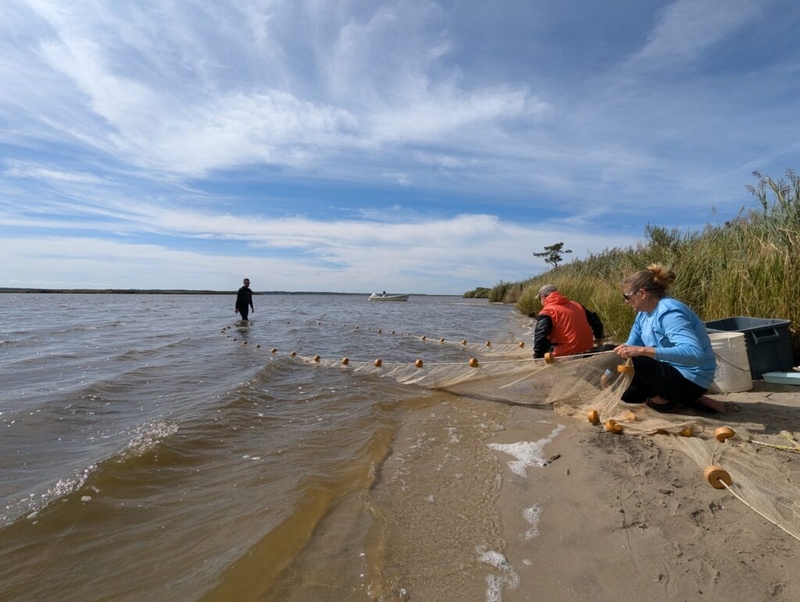
Maryland Department of Natural Resources fisheries biologists sample a site on the Nanticoke River with a seine net as part of the annual juvenile striped bass survey. (Photo courtesy Joe Zimmermann/Maryland DNR)
For the eighth straight year, Maryland scientists found well below average numbers of young rockfish in the Chesapeake Bay.
This summer’s survey, released Monday, showed the best results since 2018, the last time that surveyors counted an above-average quantity of juvenile striped bass, or rockfish. But with “young of the year” index of 5.5 this year — compared to a historical average of 10.8 — Maryland scientists aren’t really celebrating.
“The important piece of information is that it is still below average, and it is now the eighth year of low abundance,” said Carrie Kennedy, the Tidal and Coastal Monitoring and Assessment Division director for the Maryland Department of Natural Resources.
Virginia scientists also released their results Monday, showing a slightly better picture. The state’s index was 9.52, a bit above its historical average of 7.77.
In Maryland, it’s possible that these continued low numbers of rockfish at or below 3 inches in length are “the new normal,” Kennedy said. Fisheries scientists believe that changing environmental conditions, including water temperature, could be altering the species’ reproduction in some way. Maryland’s survey has been running since 1954, making it one of the longest-running fish surveys in the nation, according to the DNR.
Bipartisan group of Maryland legislators call for menhaden harvest reductions
“Maybe we need to have a conversation about new reference points and new expectations,” Kennedy said. ”I don’t think that we should expect the population to be where it was in the early 2000s. We have a different Chesapeake Bay. We have a different planet than we had in the early 2000s.”
It isn’t just striped bass, Kennedy said. Low spawning numbers have persisted for other anadromous species, such as white perch and yellow perch — which are born in freshwater, migrate to the ocean to mature, then return to freshwater to spawn.
“They’re all showing similar trends of low recruitment in the last seven to eight years,” Kennedy said. “To me, that’s a pretty good indicator that it’s not just a striped bass situation.”
But rockfish are an iconic species — and fishery — in the Chesapeake Bay region, which serves as a key spawning ground, attracting large adult fish that swim upriver to reproduce in the springtime.
In 2024, Maryland canceled what was known as the spring trophy fishery, when anglers were allowed to catch — and keep — those large fish. Since then, recreational anglers have only bee allowed to catch and release rockfish from Jan. 1 through April 30.
The state has also closed the fishery for the month of August, when warmer water places greater strain on the fish, making them more likely to die after being caught and released.
Despite the lackluster findings, Maryland officials say the numbers are not expected to trigger changes to the state’s rockfish regulations next year. That’s because Maryland is waiting for an assessment of the entire striped bass stock, likely next spring, After that, the Atlantic States Marine Fisheries Commission, which includes Maryland, will decide on new fishing restrictions coastwide.
The commission declared Atlantic striped bass overfished in 2019, and the species is subject to a plan that requires the stock to be rebuilt by 2029. The new stock assessment will provide a progress update.
“Either it’ll say, ‘Hey, you met your rebuilding target,’ or it’ll say, ‘Nope, you have a ways to go.’ Or the board will say, ‘Maybe we need new targets based on this information,’” Kennedy said.
After the commission decides, Maryland could add more stringent rules of its own. But they wouldn’t likely arrive until the 2029 season, Kennedy said.
There are reasons for “cautious optimism” about the overall stock assessment, Kennedy said, with recent figures showing that adult rockfish could be at a healthy population.
Last October, the commission’s striped bass board declined to move forward with a proposed 12% cut in fishery removals, after preliminary data through June 2025 showed the recreational catch throughout the Atlantic region was lower than expected.
But as below-average classes of baby fish reach maturity, the adult population will look smaller and smaller, Kennedy said.
“It generally takes seven to eight years for a fish to become mature enough to spawn,” Kennedy said. “So now, we’re really at the point where we’re going to start seeing it and feeling it in the adult population.”
Eight years of poor survey results “paints a bleak picture,” said Allison Colden, Maryland executive director of the nonprofit Chesapeake Bay Foundation.
“What happens in the Chesapeake Bay is a prediction for striped bass’s future up and down the Atlantic Coast. Roughly 80 percent of the coastwide striped bass population spawn here in the Bay,” Colden said in a statement.
The foundation is “encouraged” by DNR’s recent seasonal changes, including closing the fishery in August, Colden said.
“But striped bass need coastwide commitment and action from ASMFC if we want this beloved fish to have any chance to rebound,” she added.
For ths summer’s survey, biologists repeatedly sampled at 22 sites in four Maryland rivers known to be striped bass spawning areas. On each visit, the scientists cast a 100-foot seine net twice from the shore, and counted the small striped bass they collected. The index is the average number of juveniles counted in one sweep of the net.
Maryland officials believe the slightly stronger numbers this year could be due to weather conditions. Cold winters tend to be favorable for the species, as can a large amount of melting ice and snow, which improves water flow, Kennedy said. But drought conditions, which have been an issue for much of the state this year, can lower river flows, reducing areas the fish can reach to spawn, and causing other harms.
This year, the best results came from the upper Chesapeake and the Choptank River, according to the DNR.
In total, the surveyors caught nearly 72,000 fish of 62 species in their nets this year. Atlantic menhaden — the fish at the base of the bay food chain that is the subject of hot debate heading into the Atlantic States commission’s meeting next month — had a strong showing, Kennedy said.
Annapolis, MD