In capital punishment, failure is a feature
Oct 12, 2026 | 5:25 am ET
Description
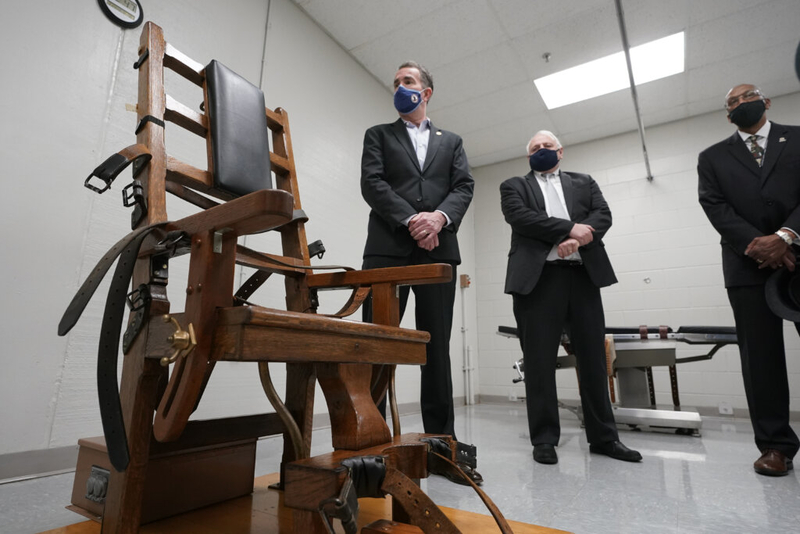
Then-Virginia Gov. Ralph Northam, left, looks over the electric chair in the death chamber at Greensville Correctional Center with Operations Director, George Hinkle, center, and Warden Larry Edmonds, right, prior to signing a bill abolishing the penalty in Jarratt, Va., Wednesday, March 24, 2021. (Photo by The Associated Press/Steve Helber)
In his 1975 book, “Systemantics,” John Gall hypothesizes that complex systems tend to fail, and not because of bad intentions, incompetent operators, or a few correctable defects. Organizations and other human-made systems develop unanticipated behaviors that often thwart their intended purposes. As we begin to recognize these tendencies toward failure, we assume that a new, more complex system will solve the problem.
Nowhere is this theory truer than in the U.S. capital punishment apparatus. As of October 7, 27 U.S. states and the federal government retain the death penalty, either actively or passively. Five of those states, now including Tennessee, have government-imposed moratoriums.
Virginia permanently dismantled its apparatus in 2021, becoming the first Southern state to do so. (The electric chair, lethal injection gurney, and numerous related implements — even a can of brass cleaner — are in storage at the Virginia Museum of History and Culture.)
Virginia abolished biased, inefficient, botched executions; more states should follow suit
On September 30, Tennessee attempted to execute Christa Gail Pike with two doses of lethal pentobarbital. She survived and was hospitalized, receiving life-saving care from the same state that just tried to kill her.
Earlier in May, Tennessee abandoned its attempt to execute Tony Carruthers after personnel could not establish the required IV access. Gov. Bill Lee halted the remaining execution scheduled for the year and ordered an independent review.
The Tennessee Department of Corrections insists that it strictly followed every step of the established protocol. Pike survived anyway. This raises a pointed question: if the prescribed steps were followed and the intended result did not occur, is the problem simply noncompliance with the protocol (human error), or the protocol’s original design?
Calling Christa Pike’s botched execution “human error” does not absolve the system that failed to kill her. Because the system depends on people, design must account for human limitations.
Nashville court rules state must preserve all records from botched Tennessee execution
Capital punishment demands that fallible institutions deliver an infallible result. Its safeguards reveal how often the system gets things wrong and how little control the state has even at the final step.
Now, the federal government plans to add yet another cog to this horrifically damaged system.
The capital punishment mechanism starts failing at the trial level. A Columbia University-led study examined capital cases from 1973 through 1995 and found serious, reversible error in a jaw-dropping 68% of judgments during this period.
The errors included egregiously inadequate defense representation, prosecutorial misconduct, and faulty, confusing jury instructions. This figure does not even account for race, gender, and class bias.
If, after the requisite two trials (one to establish guilt, the other to mete out punishment), a conviction is secured and death is ordered, the failures persist through a labyrinthine appeals system that drags on frequently for decades.
This proves that a punishment requiring repeated litigation to review and correct errors cannot be described as efficient or reliably administered. The state cannot placate those who howl for a shorter appeals process by promising a shortcut to execution while simultaneously guaranteeing exhaustive protection against its own mistakes. Appeals give the convicted a fighting chance, but also prove the original machinery is defective.
The electric chair is a dirty, dangerous, and unpredictable method of killing. History records inadequate electricity delivery, poor electrode contact, burst eyeballs, cooked organs, smoke and even heads bursting into flames, as with Virginia’s Frank Coppola and Florida’s Jesse Tafero.
The Lethal injection system (LI) was introduced in 1982 to solve the electric chair problem. It was meant to make execution resemble a medical procedure performed by medically qualified personnel.
In her 2025 book, “Secrets of the Killing State: The Untold Story of Lethal Injection,” University of Richmond Law Professor Corinna Barrett Lain describes LI as smoke and mirrors, an execution method built around questionable science, torturous drugs with unknown origins, inept executioners, and dogged secrecy. Those are interacting institutional flaws, not merely a succession of unusually sloppy employees.
Lain notes that LI has a “botch rate” of 7.3%, far higher than that of hanging and the electric chair. The most common problem with LI is a condemned inmate’s compromised vascular system. Corrections officers with little to no medical training poke and jab them with needles, sometimes for hours, hoping to find a suitable vein.
Other LI failures include illegal drug procurement, improper storage, and preparation and administration errors, drugs entering the tissue rather than the bloodstream (such as with Pike), inadequate anesthesia, and a prolonged, painfully unconstitutional death from any combination of these.
Ironically, the victim’s survival is the ultimate failure.
In 2018, Alabama attempted to address its LI problems by introducing a nitrogen gas system option. Four more states (Arkansas, Louisiana, Mississippi, and Oklahoma) have since followed suit.
Troubles with gas include an imperfect mask seal, vomiting and aspiration into the mask, the risk of oxygen deprivation for witnesses and spiritual advisors, and an uncertain assessment of suffering. Witnesses in Alabama and Louisiana reported condemned inmates convulsing and thrashing. Anthony Boyd took more than 30 minutes to die, and he reportedly gulped for breath over 200 times.
As noted, the system’s failures extend beyond the mechanics of killing. The Pentagon plans to publicly execute Nidal Hasan, convicted of killing 13 people at Fort Hood in 2009, by firing squad on December 3 and to livestream his death.
Defense Secretary Pete Hegseth says the public should be able to watch because “people need to understand that there’s [sic] serious consequences for these types of things.”
Here, the institutional failure is not an inability to carry out a sentence but, like lynching, a willingness to turn a bankrupt process into a high-tech public spectacle. A system that introduced lethal injection to make killing look like medicine now proposes broadcasting a noisy, violent firing squad execution as a lesson in deterrence and, more importantly, to showcase the state’s power to kill.
NPR reported that after South Carolina executed Mikal Mahdi by firing squad in April 2025, a state-commissioned autopsy showed that the shots had missed his heart, damaging his liver and other organs. A forensic pathologist retained by his lawyers concluded that Mahdi lived for up to one minute, experiencing “excruciating conscious pain and suffering.”
Changing the machinery of capital punishment does not remove the fallibility of the people who operate it, nor can an institution claim reliability and then dismiss foreseeable mistakes by its own personnel.
If an execution is successful and the inmate dies quickly and painlessly, it is not because of the system but in spite of it.

Richmond, VA