CAIR-Michigan praises court ruling as protecting pro-Palestinian student speech at U of M
Mar 20, 2026 | 3:59 pm ET
Description
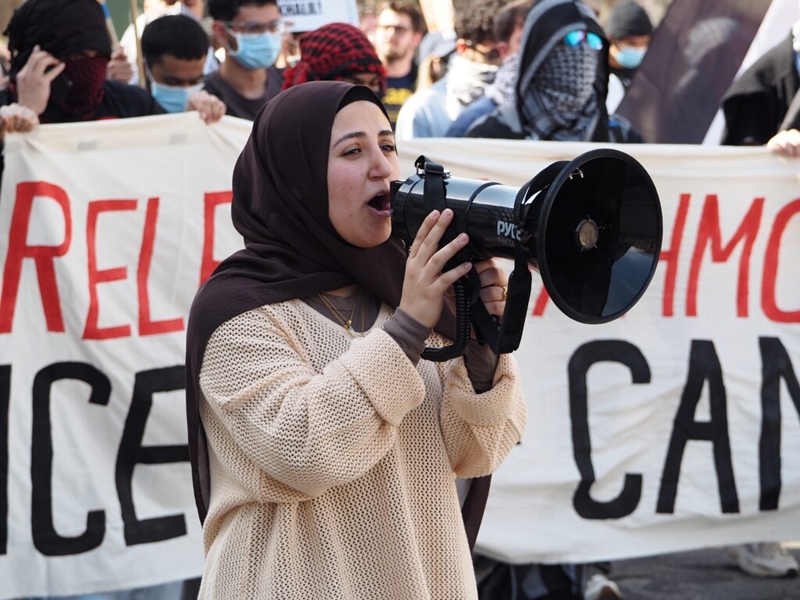
Pro-Palestinian protestors gather on University of Michigan's Ann Arbor campus on March 14, 2025 to call for the release of Columbia University organizer Mahmoud Khalil | Photo: Anna Liz Nichols
The state’s chapter of the Council on American-Islamic Relations lauded the U.S. District Court for the Eastern District of Michigan’s Friday decision to partially allow a civil rights lawsuit to move forward against the University of Michigan.
CAIR-Michigan, in partnership with the Sugar Law Center and additional civil rights attorneys, filed the lawsuit on behalf of U of M students and the Students Allied for Freedom and Equality or SAFE.
The case challenged the university’s disciplinary actions against students who engaged in nonviolent, pro-Palestinan protests on campus, as well as the university’s suspension of SAFE, which was the only student group on the Ann Arbor campus dedicated to advocating for the liberation of the Palestinian people in Gaza and the West Bank from Israeli occupation.
In a decision issued Friday by U.S. District Judge Laurie Michelson of the Eastern District of Michigan, two of the six civil issues brought before the court in Hilgart-Griff v. Regents of the University of Michigan were dismissed.
The bulk of the lawsuit, however, remained intact and survived motions to dismiss brought by the university. The plaintiffs can now proceed on claims raising serious and credible constitutional violations, including viewpoint discrimination and infringement on students’ First Amendment rights.
“This ruling makes clear that the University cannot evade judicial scrutiny for punishing students based on their viewpoints,” said Amy V. Doukoure, Esq., lead staff attorney with CAIR-Michigan, in a statement. “Disciplining students for nonviolent advocacy and dismantling a student organization for its message strikes at the core of the First Amendment.”
Paul Corliss, assistant vice president for Public Affairs and Internal Communications at U-M, declined to comment on the decision after it was issued Friday.
The complaint argues that the university imposed sanctions not due to any misconduct perpetrated by the pro-Palestinian demonstrators, but rather for exercising their constitutionally protected right to express their political views — targeting students for the advocacy in the process.
CAIR-MI further argues in the complaint that public universities have a constitutional obligation to protect, not suppress, political speech, even if that speech challenges a dominant political narrative or belief. The suspension of SAFE, the council added, has had a chilling effect for on-campus student activism, creating barriers to student organizing, political dialogue and express advocacy.
“What we are seeing is not neutral enforcement of policy—it is selective punishment aimed at silencing pro-Palestinian voices,” said Dawud Walid, executive director of CAIR-Michigan, in a statement. “The Constitution does not permit public institutions to decide which viewpoints are acceptable.”
Lansing, MI