Budget officials ask agencies to tighten belts, including a 10% cut scenario
Sep 14, 2026 | 5:00 am ET

Description
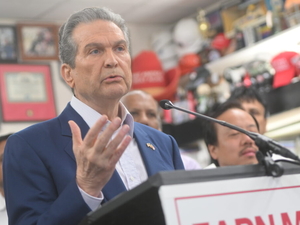
Budget Secretary Yaakov "Jake" Weissmann, in a January photo with Gov. Wes Moore, said asking agencies for up to 10% in cuts for next year's budget planning is a "prudent approach" to the state's ongoing fiscal problems. (Photo by Bryan P. Sears/Maryland Matters)
State agencies are being asked to tighten their belts as they finalize budget requests for the coming difficult fiscal year.
Emails to every executive branch agency, as well as state universities, told them to prepare fiscal 2028 budget requests that include reductions of roughly 3%, with two dozen Cabinet-level agencies told to prepare budgets with up to 10% reductions.
The memos come as the state heads into a 2027 General Assembly session in January that will be dominated by efforts to eliminate a projected structural budget gap of about $3 billion in the coming fiscal year, with wider gaps predicted in coming years.
“We’re having these conversations and having the tough conversations, and we’re going to continue to,” said State Budget Secretary Yaakov “Jake” Weissmann. “They’re going to have to be genuinely tough decisions that are going to make impacts on how the budget is taken. Hopefully, this sets us on course for the next 20 years if we do this right.”
Lawmakers left Annapolis after the last session with a balanced budget — a legal requirement. Even so, the state faces troubling structural gaps, with projected revenues falling short of expected spending.
Any cuts will have to come from the state’s general fund spending. For context, Weissmann said cutting everything but health, education, public safety and human services spending would not be enough.

“That’s the magnitude of the problem that we’re facing,” he said. “Asking agencies to share what a 10% cut looks like is just a prudent approach to figuring out how we solve this budget shortfall.”
Not all the news is bad. A recent report released by Comptroller Brooke Lierman showed the state closed fiscal 2026 with hundreds of millions more in surplus than expected.
Senate Budget and Taxation Committee Chair Sen. Guy Guzzone (D-Howard) said the better-than-expected report to end the last fiscal year could be an indicator of more good news to come. But fiscal leaders will still be monitoring a Sept. 24 Board of Revenue Estimates meeting to gauge how the state’s revenues are faring.
“It doesn’t have an effect on BRE [Board of Revenue Estimates],” Guzzone said of the comptroller’s report. “But what led to that? What led to the good closeout numbers should also play a role … as we move forward.”
Weissmann said the state has made “significant inroads” into the state’s recurring deficits “because of the work we’ve done over the last couple years. We have done that work. The obstacles we’re facing this year are different in that regard.”
The Department of Legislative Services in June projected a nearly $2.6 billion structural gap in the fiscal 2028 budget — about $150 million lower than a December estimate. The Department of Budget and Management’s email to agencies said budget officials are “carrying a (projected deficit) figure of closer to $3 billion.”
Pulling back on aspirations
Fiscal 2028 is also the first year in which costs of the Blueprint for Maryland’s Future education plan will exceed dedicated revenues. To cover the balance, the state will have to dip into the general fund, as a first-in-the-nation digital ad tax meant to help pay for the education plan remains in legal limbo.
Maryland’s $71 billion total budget includes just under $30 billion in general funds — money collected directly by the state through sources including personal and corporate income taxes and sales taxes.
The amount needed from the general fund is expected to grow in following years, with gaps of roughly $3.4 billion projected in each of the following two fiscal years.
The state’s “sizable and growing out-year budget gaps” were cited by bond rating agency Standard & Poor’s in May when it downgraded the outlook on the state’s debt.
“It is our understanding that, ahead of the January 2027 fiscal 2028 budget introduction, the state intends to establish a consensus budget framework that will meaningfully address these gaps through structural adjustments that better align revenues with spending, which will be critical, in our view, to maintain the state rating,” S&P wrote.
Guzzone the state has “always lived within our means,” but that recent budgets “had higher hopes for where we would be by now.”
“The reality is, the economy, the federal government, lots of different forces have put us in a place where we are not where we thought we would be,” he said. “We thought we would have been better off.

“We have to pull back on some of our expectations now because it is clear those aspirations are not going to be able to be met at the levels we had hoped they would be met,” Guzzone said.
Slowing spending on the Blueprint could be part of the discussion. Administration officials also point to salary growth as a driving factor in the budget growth.
A 10% solution?
Weissmann declined to say if the administration had a target amount it was looking for from cuts.
Individual targets were laid out in agency memos. For some, the reductions represent actual cuts to current budgets, for others, it’s a reduction of increased spending.
Budget officials will review each proposed reduction. Not all will be accepted.
Weissmann said such target memos are part of the annual budget drafting process.
“We did this last year, right? The 3% reduction isn’t new. The 10% reduction is,” Weissmann said.
“The 10% gives us this big picture so we know what we’re walking into and we can have those conversations,” he said.
A 10% cut would also close the $3 billion gap in general fund spending and close the structural gap.
Earlier this year, an email to those departments requested a “short memo outlining the reductions your agency would need to take to absorb a 10% reduction in your GF (General Fund) budget.” The emails said the department memos would “help provide some perspective on what balancing the budget solely through reductions would look like.”
Budget officials asked that the memos — due at the end of July — include information on how such cuts would impact programs, operations and staffing, and how they would affect “services and support provided to Marylanders.”
Senate Minority Leader Stephen S. Hershey Jr. (R-Upper Shore) welcomed the move, but said the 10% budget request could also be used as “political cover rather than a governing plan.”
“The governor can say, ‘I asked agencies for cuts,’ knowing the General Assembly would rather find another tax or fee than make many of those difficult decisions,” Hershey said. “If he’s serious about 10%, show us the plan, identify the programs that aren’t working, and then fight for those reductions during the legislative session.”
‘All options are on the table’

Del. Ben Barnes (D-Prince George’s and Anne Arundel), chair of the House Appropriations Committee, said it’s “no surprise to the House that the governor is taking a look at cuts.”
“I believe that for the Speaker and for the entire House, all options are on the table,” he said. “I think that we are committed, and I think our partners in the Senate and the governor’s office are as well, to tackling not just any shortfalls this year, but the out-year shortfall head-on this session.”
One option — taxes — is difficult to discuss in an election year, but it is also one that can be politically tempting in the first year of a term, which 2027 will be.
There are a number of potential tax options.
Some, such as a sales tax increase, would be easiest to implement. New taxes, like the recently passed IT and data tax, take longer to implement, which means the money might not available for near-term problems.
Maryland has not raised its sales tax since 2008, when it went from 5% to 6%. Going from 6% to 7% — a penny on the dollar — could generate an additional $1.2 billion.
In 2020, lawmakers considered a bill to lower the sales tax to 5% but expand it to most services, which would have raised an extra $2.6 billion. That bill did not get out of committee. A 2024 bill to expand sales tax to all services also failed.
But sales taxes are seen as regressive, as they hit lower-income families harder, proportionally, than higher-income taxpayers. Progressives — who control the House — could revisit the Fair Share Act, a 2024 package that included changes to corporate income tax reporting, increased taxes on the wealthiest residents, more auditors and increased capital gains surcharges.
That package would have raised $1.6 billion, but while there was support in the House, the Senate dismissed it out of hand.
“Our first reaction is always, always to see what kinds of cuts, or slowing down of growth in various programs can be made,” said Guzzone. “That is number one.”
‘Acknowledging… a spending problem’
Gov. Wes Moore in past years rejected calls for across-the-board budget cuts, calling such cuts “lazy” last year and saying last year he favored a nuanced and targeted approach.

While that might seem at odds with the current set of budget memos, a spokesperson said both efforts are parts of an ongoing analysis that will help craft the spending plan that will be sent to lawmakers in January.
“This evaluation is a continuation of Governor Moore’s approach to fiscal discipline,” said Rhyan Lake, the spokesperson, in an email. “After inheriting long-standing structural budget challenges compounded by the Trump administration’s hits on Maryland’s economy, closing next year’s deficit will require a targeted look at where the state can save — and this analysis is part of that process.”
Hershey said he was “glad the administration is finally acknowledging Maryland has a spending problem and meaningful cuts are necessary.”
An across-the-board cut “isn’t strategy,” he said, since it “treats every dollar of spending as equally valuable. It isn’t.”
Hershey called for an approach that examines spending to see what can be protected, reformed or eliminated.
“The goal shouldn’t be to make government 3% cheaper. It should be to make government smaller, smarter, and more accountable,” he said.
Annapolis, MD