With ‘Blockchain Basic Laws,’ some NH lawmakers say the state is open for (crypto) business
Jul 29, 2026 | 5:00 am ET

Description
Blockchain technology was first applied to a financial product in 2008 by the anonymous inventor of Bitcoin, the first digital or "crypto" currency. (Photo illustration by Namthip Muanthongthae/Getty Images)
For Rep. Keith Ammon, a New Boston Republican and the prime sponsor of House Bill 639, regulating cryptocurrency is a matter of getting the state out of the way.
The goal, he said in a phone interview Monday, is “to protect from too much regulation.”
Gov. Kelly Ayotte signed HB 639 — deemed the “Blockchain Basic Laws” by Ammon and six Republican co-sponsors — earlier this month. The move brought New Hampshire a step closer to the other states moving to legislate the fast-evolving technology within their borders.
The New Hampshire Blockchain Council, which Ammon chairs, applauded the move in a press release, saying the law’s passage “further position(ed) New Hampshire as a national leader in blockchain innovation.”
Others said the state has a lot of work to do if it truly wants to be a player in the industry, which is also burdened by the prevalence of crypto scams and high energy use.
The “Live Free or Die” politics of New Hampshire make the state, in some ways, primed to welcome the cryptocurrency industry, which was founded on ideals of decentralization, said Lee McKnight, an associate professor at the Syracuse University School of Information Studies. But the state faces other barriers, he added, that will require more than the passage of the “basic laws” to conquer.
“New Hampshire is now in the game, which is great,” he said. “But I guess, from my point of view, there is more to come.”
What do the new laws govern?
The Blockchain Basic Laws begin by defining what blockchain is.
The technology is a secure method of storing and sharing information across a network of computers. It forms the backbone of technologies like cryptocurrency, which uses the public database created by the blockchain to record transactions in a process billed as transparent and mutually verifiable.
A central feature of blockchain technology involves participants in a network working off of, sharing, and maintaining copies of the same data, called a “distributed ledger.” Any time those participants exchange something — a quantity of Bitcoin, for example — they append a record of that transaction to the ledger, thus adding a “block” of information to the shared chain. That process includes verification work, shared across the network, completed to ascertain that each transaction is legitimate.
In this way, blockchain — in practice, a very long, complex string of data “blocks” spread across a large network — may serve as a public, permanent, and inalterable record.
The technology was first applied to a financial product in 2008 by the anonymous inventor of Bitcoin, the first digital or “crypto” currency. In the years since, new applications of blockchain technology have emerged in the form of new cryptocurrencies: think Tether, Ethereum, Dogecoin, and Trump Coin, for a few examples, though the field is vast. And non-currency applications, such as auto-enacting “smart” contracts written on the distributed ledger, have also emerged.
What the Blockchain Basic Laws cover
HB 639 protects certain blockchain-related activities, stating that “no state or local government agency or subdivision thereof shall prohibit, restrict, or otherwise impair the ability of an individual” to engage in them.
Those include using “digital assets,” like cryptocurrency, to purchase legal goods and services, and the ability to “self-custody” one’s holdings, a term referring to a person’s right to hold digital assets via their own (digital) wallet and key, without needing to go through a third party like a bank.
The law prohibits the application of a crypto-specific tax to purchases made with digital currency and protects the ability of an individual to participate in a blockchain network. It also exempts people who are mining for digital assets from the requirement to obtain a money transmitter license.
Furthermore, it establishes a dedicated court docket for disputes related to blockchain technology. Because the technology can be obscure, the intent of such a docket is to allow a judge to develop expertise on the subject, then to route relevant cases to that judge’s desk, Ammon said.
Regulating decentralization
From the beginning, proponents of blockchain technology and cryptocurrency have championed it as a way to decentralize the monetary system, said Dan Hersey, who founded the Rhode Island Bitcoin Policy Initiative and advocates for policies promoting the use of Bitcoin in the state.
“We have a separation of church and state, and ideally, we should have a separation of money and state,” he said. “We currently do not, and I think that this (Bitcoin) is the closest opportunity we’ve ever had.”
At their best, argue Hersey and other proponents, cryptocurrencies allow users to remove the government, banks, and middlemen, such as credit card companies, from their transactions while offering an inherent limit to inflation through artificially limited supplies of coins and tokens.
Ammon shares that dream. He traces his belief in cryptocurrency’s potential to disillusionment with the establishment banking system, which began with the 2008 financial crisis.
“It’s sort of, like, a maniacal game going on,” Ammon recalled thinking, considering the ability of the U.S. government to adjust the rate of issuance of the dollar, which has been fully untethered from the gold standard since 1971.
Ammon said he viewed cryptocurrency as an opportunity to “limit the supply (of money) just using mathematics.” The independence of it also appealed to him, he said.
“It’s an idea of self-sovereignty, where you’re not trusting the middleman to hold the value that you worked hard for,” he said.
Yet, given that blockchain proponents bill the technology as a pathway to decentralizing our monetary system, philosophies about what, if any, role state or federal law should play in regulating that process are mixed.
Other states interested in regulating blockchain have taken a range of approaches. From McKnight’s point of view, Wyoming has done the most, passing numerous laws that he characterized as favorable to entrepreneurs and business development.
New York has also taken steps to regulate cryptocurrency, though more focused on the consumer protection side, McKnight said.
New Hampshire has focused on the technology more than its other New England neighbors, according to Hersey. The recent passage of HB 639 signals that New Hampshire is interested and open to the industry, he said. Yet, the bill isn’t enough to position New Hampshire as a national leader in the space, said McKnight.
“(HB 639) is very much ‘blockchain basics,'” he said.
Ammon said he had been proposing blockchain-forward policies in New Hampshire since 2015. Past products of those proposals include the report of the Governor’s Commission on Cryptocurrencies and Digital Assets, which contains an array of recommendations.
He hopes to see New Hampshire act on some of those, and catch up with states like Wyoming that have taken aggressive pro-blockchain stances.
“Wyoming, you know, they sort of leapfrogged us at one point,” Ammon said. “… It’s been a very slow, very slow, frustrating process. I wish more people got it sooner. I feel like we’re blowing our lead.”
Success, Ammon said, would see New Hampshire attracting more businesses and seeing widespread adoption of digital currency. He said such uptake would have positive ripple effects in the state’s economy.
“You’d have a financial district. You’d have commerce happening much faster and more globally,” he said.
The New Hampshire Token Commission is currently evaluating the possibility of a state-issued stablecoin, a form of cryptocurrency whose value is tied to the U.S. dollar, Ammon said. That’s another move modeled after Wyoming, which issued its own stablecoin early this year, becoming the first U.S. state to do so.
The commission’s report, due in November, will contain recommendations for future directions for the state, Ammon said.
McKnight also identified a state-issued stablecoin as a possible step for New Hampshire. Creating a framework for blockchain-specific financial institutions is another.
But recent attempts to promote blockchain development in New Hampshire have met resistance.
Despite support from Ayotte, a proposed Bitcoin-backed bond failed, 3-2, early this month. Councilor Karen Liot-Hill raised concerns about the volatility of the asset and its novelty, according to reporting by the Boston Globe, and Republican Councilors David Wheeler and Janet Stevens joined her in opposition.
On Monday, Ammon called the vote “short-sighted and uninformed.”
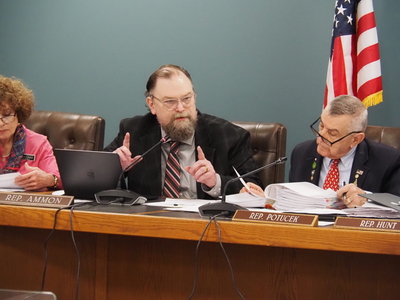
Yet the volatility of crypto assets is a common concern among skeptics. Others point to the high incidence of scams in the ecosystem, which “attracts scam artists,” in part due to the anonymity it can offer, said McKnight. One attempt to crack down on crypto-related scams passed the New Hampshire Legislature this year with Senate Bill 482. The law enacted new regulations on cryptocurrency ATMs, point-of-sale machines where users can convert cash to crypto, but which are tied to high-cash-flow scams often targeting elderly people.
Ammon was a vocal skeptic of that bill during debate on the House floor, saying the bill’s intent was “to ban” the crypto industry from the state. An amendment he authored to that bill was characterized by opponents as too easy on scammers, and not adopted; the bill ultimately passed the House.
Another flash point among critics of the industry is the influence of lobbying groups on blockchain legislation. One such group is the Satoshi Action Fund, which promotes cryptocurrency nationwide. Ammon acknowledged drawing on materials from the Satoshi Action Fund in the drafting process for HB 639.
It’s not just in New Hampshire that the history of blockchain technology has been political, said McKnight. The technology itself arose from groups with deep concerns about government overreach, he said.
“That’s really, literally, the origins of this whole space: These manifestos opposing state influence, very much libertarian influence,” he said.
Ammon, who is affiliated with the Free State Project, acknowledged that history, but also stated that his own interest in cryptocurrency and blockchain is driven by “personal philosophy.”
“My philosophy includes personal and individual sovereignty, and these are tools for that,” he said. “So to that extent, but I’m not — no one’s giving me direction.”
He said he was eager to see New Hampshire build on HB 639 and make up what he sees as lost ground.
“When there’s a new innovation, opportunities only come around — there’s a short window, every so often, to … jump on it and have your state become attractive to that industry,” he said.

Concord, NH