Black voters urged to cast a ballot in ‘most consequential election of our lifetime’
Sep 17, 2026 | 5:38 pm ET
Description
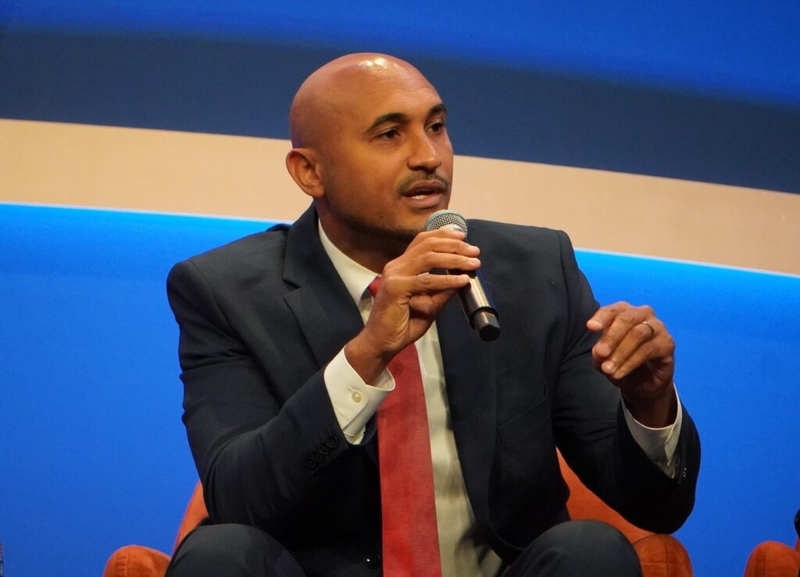
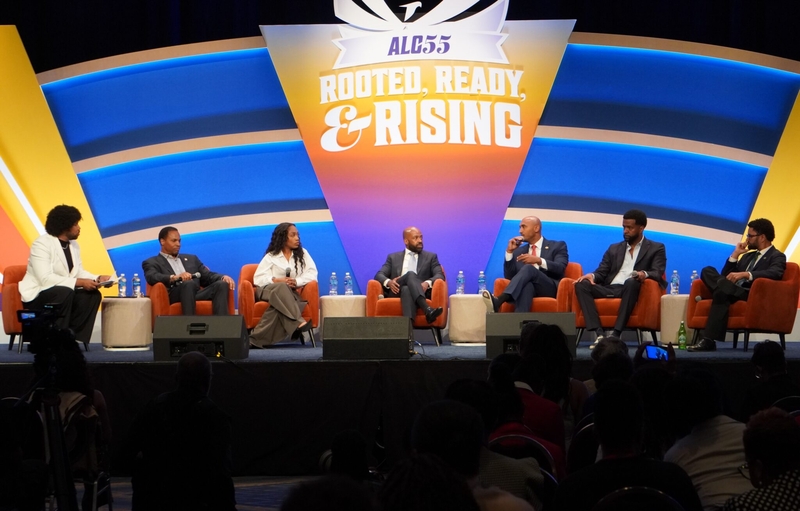
Rep. Shomari Figures (D-Ala.) gives remarks Thursday during a national town hall at the Congressional Black Caucus Foundation's legislative conference. (Photo by William J. Ford/Maryland Matters)
Congressional representatives implored Black citizens to vote this fall during a two-hour plus town hall at the Congressional Black Caucus’s annual legislative conference Thursday.
“This is the most consequential election of our lifetime,” said U.S. Rep. Gregory Meeks, a New York Democrat. “So the message is: If you’re concerned about the Supreme Court, get out and vote. If you’re concerned about making sure we’re taking care of the poor and the children, get out and vote.”
Meeks was part of a panel that assessed the last 18 months, finding that “Black America” hangs in the balance against the Trump administration’s push to limit voting by mail, changing who and what counts in the U.S. Census and dismantling various federal agencies.
President Donald Trump has demanded that Congress pass the SAVE America Act, which would require additional documents, such as passports and birth certificates, to register to vote and cast a ballot. Trump also issued an executive order pushing limits on vote by mail that would have required specific designs for ballots and mandate states to collect certain information from voters. Democratic-led states and voting rights groups sued, warning the change could disenfranchise 50 million voters set to receive ballots for this fall’s midterm elections..
Last week, the U.S. Supreme Court blocked Trump’s plan.
Janai Nelson, president and director-counsel of the NAACP Legal Defense Fund, said one necessary change is Supreme Court reform.
Earlier this year, the nation’s highest court ruled 6-3 in Callais v. Louisiana that the state’s use of race-based redistricting amounted to an “unconstitutional racial gerrymander.”
State lawmakers had drawn maps that created a second majority-Black congressional district represented by Cleo Fields, a Baton Rouge Democrat who is not seeking re-election. After the court decision, the GOP-controlled legislature revised Fields’ district to favor a Republican, leaving Louisiana with one Black-majority district out of six. The state’s Black population is around 30%.
“For the longest time, people who want to advance the extremist agenda have had their eyes on the Supreme Court,” said Nelson, who argued the Callais case before the Supreme Court in support of Black representation. “The Supreme Court is the highest court in the land. It dictates the law. It can strike down legislation. It is a powerful arm of government.”
Fallout from the Callais decision prompted Republican majorities in several Southern states to reshape congressional districts making them less favorable to minority voters in the midterm elections. Analysts have said possibly 20 of the Congressional Black Caucus’s 62 members could lose their seats this fall.
Among those affected is Rep. Shomari Figures, an Alabama Democrat. The Alabama Legislature redrew Figures’ district to decrease the Black voting age population from nearly 49% to 39%.
Figures talked about the real life impact on Black communities without representation.
He said 88% of people in his state graduate from a public high school. But a school voucher program called the CHOOSE Act grants $7,000 tax credits that can be used for private school tuition. Nearly 14,000 of the 24,000 granted awards planned to enroll in private school last year.
Figures said he represents one of the worst congressional districts in the country when it comes to healthcare: 1 in 5 people is diabetic.
“That’s why it is vital that we continue to push back against these redistricting efforts, against the gerrymandering efforts that we’re seeing across the country,” he said.
Black policy playbook
Conference attendees also received a copy or a digital version of “Forward Together: The Black Policy Playbook for An Equitable America.”
The report, developed by the caucus foundation and the Joint Center for Political and Economic Studies, covers eight policy areas from voting rights and civic engagements to education, immigration and technology.
Recommendations included: requiring federal funding to states to modernize voter registration systems, voter education and protections against discriminatory election practices; require the U.S. Treasury Department to develop a fair lending oversight program that’s consistent with other federal financial regulators.
“When we talk about economic mobility, when we talk about creating sustainability, we have to shift from the politics of the self [and] back to the politics of the community. That is the only way we survive,” said Alphonso David, president & CEO of Global Black Economic Forum.
Annapolis, MD