Birth centers are linked to better health outcomes, research shows, but 10 states have none
Oct 20, 2026 | 3:14 pm ET
Description
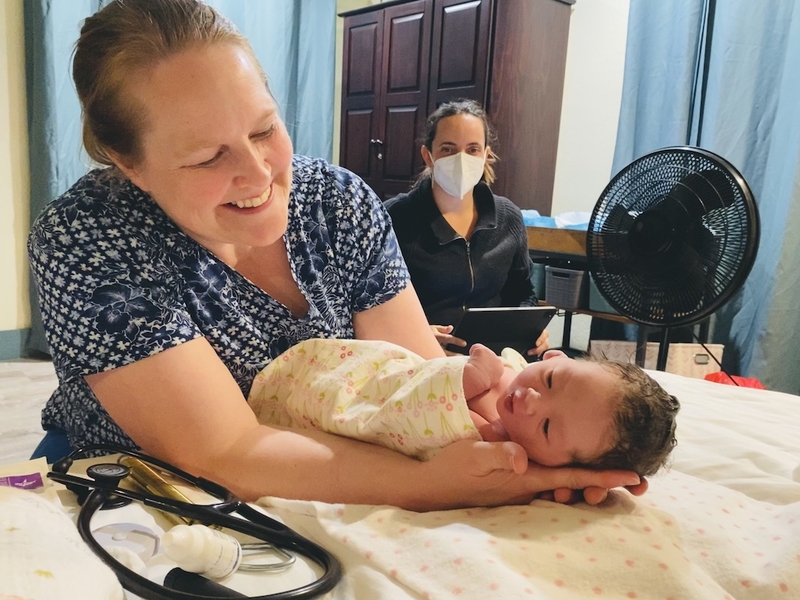
Sarah Simmons, a midwife and co-owner of Maple Street Birth Center in rural Okanogan County, Wash., holds a newborn. Washington state has among the highest number of birth centers in the country, but a new report identifies 10 states that have none amid a spate of closures over the past three years and reported difficulties with state regulations and costs. (Photo courtesy of Sarah Simmons)
Birth centers are an option for those with low-risk pregnancies and are correlated with more positive health outcomes, but 10 states do not have any birth centers at all, and more could be built with certain state policy solutions and different models of care, a new report suggests.
Birth centers can be an attractive option for pregnant patients seeking fewer medical interventions and a more “home-like” childbirth experience that is still attended by professionals. Centers are often chosen by Black, Indigenous and Hispanic patients, who experience negative maternal and infant health outcomes at disproportionately higher rates than white patients, research shows.
The Commonwealth Fund, a nonpartisan, private foundation that supports independent research on healthcare issues, released the report Tuesday. Using data from the federal Centers for Disease Control and Prevention, the American Association of Birth Centers and other state-level data, the report found 10 states — Arkansas, Hawaii, Iowa, Kentucky, Mississippi, Missouri, Nebraska, North Dakota, Rhode Island and Vermont — have zero birth centers.
Eight other states have only one birth center. Conversely, the states with the highest number of centers are California, Florida, Texas, Virginia and Washington.
Black midwives are suing Southern states, claiming regulations make it harder to help patients
Birth centers are usually staffed by midwives, and are sometimes subject to tight state regulations such as certain staff requirements and referral relationships with local hospitals. The report shows the number of people choosing birth centers for delivery is still quite small, at about 1%, but the popularity of home births and birth centers surged during the COVID-19 pandemic. About 75% of those using birth centers were non-Hispanic white women, the study data showed, while about 12% were Hispanic and 6.6% were Black.
Gene Declercq, professor of community health sciences at Boston University School of Public Health and lead author of the study, told Stateline the number of home births has remained steady in recent years, but that birth center rates have declined slightly as more centers close nationwide. Stateline reported earlier this year that two dozen centers closed between 2023 and 2026, with some publicly blaming onerous regulations and steep increases in malpractice insurance.
“The problem is not that there’s been closures, the problem is the closures are random, they have to do with other things, not what the state needs at that time,” Declercq said. There is no plan to replace that care, he added, which sometimes forces people to seek care even further from home.
Regardless of regulations, Declercq said the financial side can still be difficult to navigate if the center is solely reliant on births, especially if it wants to take patients using Medicaid. Low reimbursement rates in addition to high costs of renting or purchasing a building can make it challenging or impossible with a low number of births per year. According to the study, about 40% of patients at birth centers did not use insurance and paid out of pocket.
Declercq, who has studied maternal health policy for nearly 20 years, said more birth centers could be possible under different health models, including as part of a community health center or women’s health center that would provide a steadier source of revenue in addition to births.
“That provides an infrastructure that can be really helpful to the provision of care, because now … the birth center can go under the umbrella of the health center’s malpractice,” he said. “They have a billing system already in place and the population is right there.”
One of those models identified in the study is in Washington, D.C., at the Community of Hope Family Health and Birth Center. That center combined midwives, doulas and home-based postpartum support with primary care, behavioral health, dental care, transportation and food assistance services, and served more than 700 pregnant patients in the span of a year and a half.
Close to 90% of those patients were Black, and 71% were insured by Medicaid. The study said the center’s patients had better perinatal outcomes compared with others in the surrounding D.C. area, with a lower proportion of low birthweight babies, especially among Black patients.
“Tying together community care with enhanced maternity care when women need it can be really effective, because then they have a place to go back to after they have their babies that knows them,” Declercq said.
Editor’s Note: Five Stateline reporters are 2026 fellows for the Association of Health Care Journalists’ U.S. Health System Reporting Fellowship, a program that is financially supported by The Commonwealth Fund.
Stateline reporter Kelcie Moseley-Morris can be reached at [email protected].