Another normal year expected for Bristol Bay sockeye salmon, Alaska biologists say
Nov 10, 2026 | 5:10 pm ET
Description
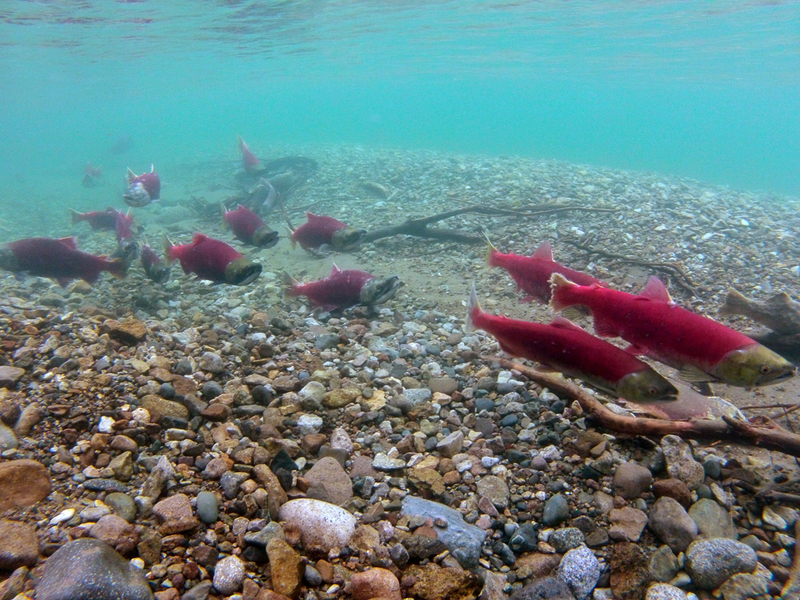
Spawning sockeye salmon returning from Bristol Bay swim in 2013 in Lake Clark National Park and Preserve's Tazimina Lake. (Photo by D. Young/National Park Service)
Alaska fishery biologists expect next year’s run of sockeye salmon in Bristol Bay — site of the world’s largest sockeye runs — to be about normal.
The forecast for 2027, released by the Alaska Department of Fish and Game last week, estimated a return of 49.31 sockeye salmon in the coming summer season. That would support a harvest of 33.97 million fish, the department forecast said.
The forecasted totals are about normal compared to the last 20 years, and would follow another normal run this year, when 45.7 million sockeye returned to the bay. But it would be 31% larger than the long-term average dating back to 1963, according to the department.
This year’s forecast, like others produced by the department, includes a range of uncertainty. The run could be as low as 35.47 million and as high as 63.14 million fish, according to the department.
Estimating future salmon returns “is inherently difficult and uncertain,” the department forecast said. Over the past two decades, the forecasts have underestimated actual runs by an average 13%, though there have been occasions when the forecast total was higher or almost exactly the same as the actual run total.
The tendency to underestimate run sizes is partly related to some outlier years when runs hit record high or near-record highs, said Fish and Game Area Biologist Stacy Vega. The model that the biologists use in their forecasts does not fit very well when there are super-large runs, as has been the case in some recent years, Vega said by email.
Forrest Bowers, director of Fish and Game’s Division of Commercial Fisheries, concurred with that assessment.
“There is considerable uncertainty inherent in forecasting salmon returns and in periods of strong productivity it is common to see realized returns greater than the preseason forecast,” he said by email. “This is the situation we have been in with Bristol Bay sockeye salmon for over a decade.”
Once the fishing season is underway, the department is able to manage based on actual numbers of fish and catches, making the preseason forecast less important, he said.
The preseason forecast for 2026, however, turned out to be nearly spot-on once the actual run materialized. The department had a mean preseason forecast of 45.32 million fish for the sockeye run, just slightly lower than the actual return to the bay.
“We did get very close with last year’s forecast, which is always nice,” Vega said.
The accuracy was helpful to the industry, Bowers said.
“The fishing industry relies on our forecast to plan for tender vessel needs and placement, shipping containers, and processing worker staffing and an accurate forecast helps maximize the value of the harvest,” he said.
The fishing industry strives to have estimates as early as possible, even if they are preliminary estimates that precede the department’s official forecasts. To help with its planning, the industry uses estimates of not just the size of runs but the size of individual fish.
The total catch this year was 30.1 million fish. Thanks to significantly higher per-pound prices, fishers earned more money on this year’s total catch than they did in 2025, when they harvested 41.2 million sockeye out of a run totaling 56.7 million fish, according to the department.

Juneau