Amid renewed attacks on LGBTQ+ voices, pockets of hope prevail
Sep 23, 2026 | 5:59 am ET
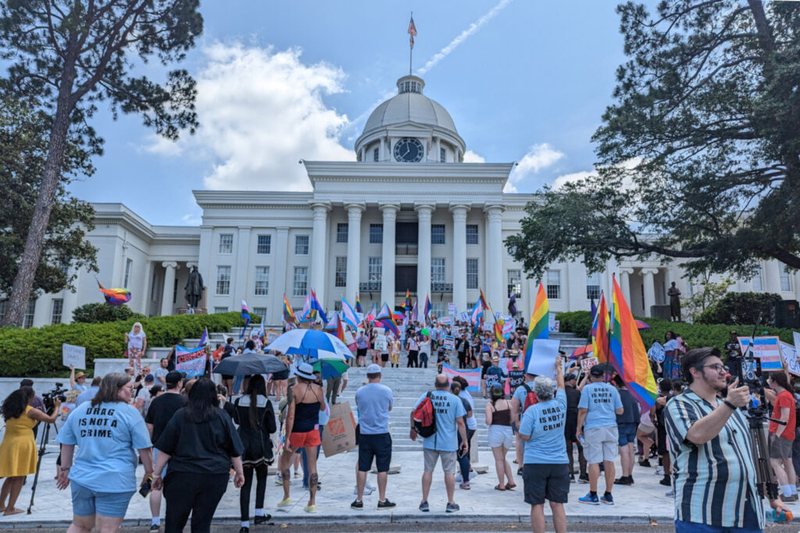
Description
"Drag me to the Capitol" protestors stand in front of the Alabama Capitol and advocate against anti-LGBTQ+ legislation on May 16, 2023. (Alander Rocha/Alabama Reflector)
A few years ago, in the course of reporting a story about the rising tide of anti-LGBTQ+ legislation in the South, I heard something profound.
It happened toward the end of an interview with Jasmine Beach-Ferrara, the executive director of the Campaign for Southern Equality and a minister in the United Church of Christ. At the time, she was also a county commissioner in Buncombe County, North Carolina.
She framed the march toward equality as something that happens not only in the public square, but also in smaller, more personal moments. “People are always coming out,” she said. “Any community in the South, any congregation, can have the experience of someone who’s a beloved member of that community coming out.”
When it happens, the community faces a reckoning — a movement toward either rupture or reconciliation. “More times than I can count, I’ve seen that lead to transformation,” she said.
I’ve often recalled that conversation in the years since we talked. It’s an ember of hope whenever the narrow-minded chorus from elected officials and religious leaders becomes especially obnoxious. I’ve come back to it again in recent weeks, as conservative crusaders against LGBTQ+ people have returned from their summer break with renewed vigor and a fighting spirit.
In downtown Mobile this month, banners hung from city poles proclaim, in all-caps letters: “Protect our children from gender ideology.” Beneath the text, a graphic shows a group of skinny children clutching each other’s hands, silhouetted before an American flag washed in a sickly yellow hue.
The privately funded banners are a direct response to another batch of privately funded banners that lined Mobile’s streets to celebrate Pride Month in June. Those banners ran the message “National Pride Month” against a rainbow background. (The horror!)
The graphic design tit-for-tat has led the city of Mobile to scrap its private banner display program entirely. The Rev. Travis Johnson of Pathway Church in Mobile, who coordinated the “gender ideology” banners, called that outcome “perfect.”
From his side of the pulpit, it is indeed perfect: He has successfully silenced LGBTQ+ voices in a public space.
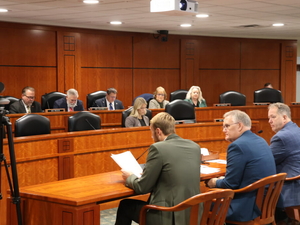
Meanwhile in Montgomery, Amy Minton and John Wahl of the Alabama Public Library Service executive board have resumed their exhausting campaign against library books that acknowledge the existence of queer people. Masked under the guise of protecting children from obscenity, Minton in particular has championed revoking state aid from libraries that offer materials with “gender ideology” and “inappropriate” content (whatever that means) to youth under 18.
At the board’s August meeting, Minton seemed frustrated that APLS couldn’t simply tell libraries which books to move. She had to be reminded by APLS staff that the agency isn’t a dictatorial body; policies and procedures exist at both the local and state levels, and she can’t simply leapfrog over them.
She picked up the thread again at the board’s next meeting on Sept. 17. This time, she was buttressed by a small but vocal cadre of citizens who showed up to accuse their local libraries of willful noncompliance and advocate for them to be defunded.
But of course, the theme isn’t confined to one boardroom at one state agency. Every prominent conservative politician running for office this cycle has been parroting the same tired lines about “faith, family, freedom” and “Alabama values” — folksy cliches that invite Alabamians to cast stones against their neighbors in the name of Jesus. Never mind what the gospels actually say; inclusion has been branded, somehow, as hateful.
Citing hostility from conservatives in Alabama, the nonprofit group Invisible Histories, which researches and archives Southern LGBTQ+ history, this spring decamped from Birmingham to North Carolina.
One of the group’s founders, Maigen Sullivan, in 2023 ruffled a bunch of feathers when she delivered a guest talk on Alabama’s LGBTQ+ history at the Department of Archives and History. The backlash to her presentation included wildly performative calls to defund the department and restructure its governing board, none of which succeeded — though Sen. Chris Elliott, R-Josephine, has vowed to revisit the issue during next year’s legislative session.
It feels as though conservative leaders are determined to keep pressing their case until they’ve squashed every last voice preaching inclusion and acceptance.
But I return to that conversation with Beach-Ferrara.
While the South is the epicenter of the country’s anti-LGBTQ+ movement, she contended that it’s also the place where our very fabric of life offers a path forward. Relationships are baked into our culture. We know how to coexist with our neighbors even when we disagree.
“If, as a country, we are going to figure this out anywhere,” she said during that memorable interview, “I believe in my heart it will be here in the South.”
It is simply not possible to stuff every queer person back in the closet. Nor is it possible to pray the gay away. Leaders can holler about it all they want, but individuals will keep discovering themselves and find the courage to come out. Brothers. Sisters. Best friends. Church friends. Each one a private moment of reckoning, an opportunity for a bud of acceptance to bloom.
Voices may be stifled in the public sphere, but truth is inevitable.
Montgomery