Alaska drops to 47th in the nation in overall child well-being, new report says
Jun 08, 2026 | 9:25 pm ET

Description
Children's bicycles are parked outside of the Interior Alaska Center for Non-Violent Living in Fairbanks, Alaska on September 14, 2023. (Photo by Claire Stremple for the Alaska Beacon)
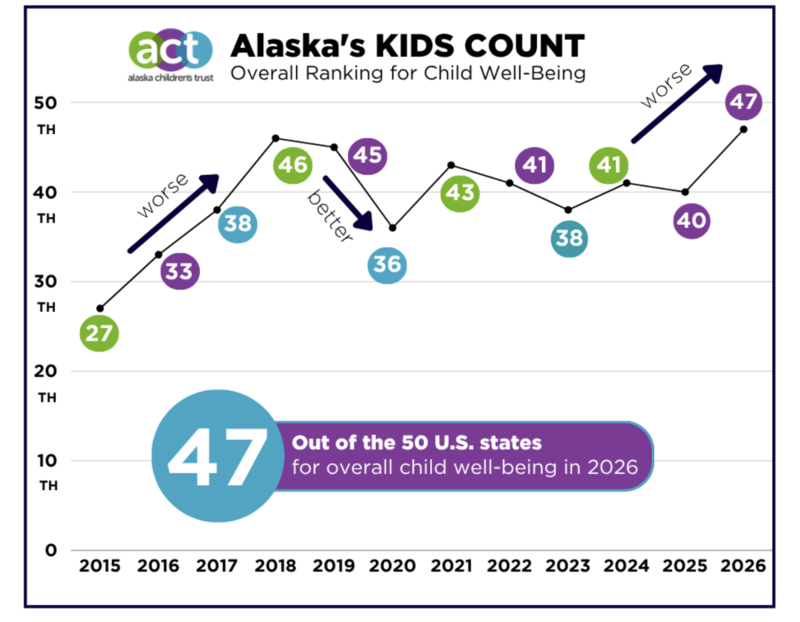
Alaska dropped seven places to rank 47th in the nation in overall child well-being, according to a nationally recognized survey by the Annie E. Casey Foundation. Advocates say the decline is troubling and reflects years of declining investment in Alaska children and families.
The scoring system is part of Kids Count data book, an analysis of all 50 states to gauge how children are faring across 16 indicators in four areas — economic well-being, education, health, and family and community. The latest score reflects outcomes over a five-year period from 2019 to 2024, to compare between states and against the baseline of 2019, before the COVID-19 pandemic. Alaska received an overall score of 385 out of 1,000.
Alaska’s overall score dropped 41 points since 2019, among the largest decline of any state in the nation.
“Dropping seven spots in a single year is not a data point — it’s a warning,” said Trevor Storrs, president and CEO of Alaska Children’s Trust, in a statement highlighting the survey. The non-profit advocacy group focuses on supporting Alaska children and families and preventing child abuse and neglect.
“We have been seeing year after year the overall trend of Alaska’s investment in children and families going down, and that is automatically going to result in less success or less thriving children and families,” Storrs said in an interview Monday. “So us not doing as well as other states is not a surprise, and dropping to 47th is a major step backwards.”
Alaska saw the steepest decline in education, where the state ranked 49th in the nation, just above New Mexico. In 2024, 78% of Alaska fourth graders were not proficient in reading, and 78% of eighth graders were not proficient in math, several points worse than 2019 levels. In the five year period, 64% of young children — ages 3 and 4 — were not in school. Among high schoolers, 22% did not graduate on time in 2024.
In economic well-being, Alaska ranked 48th in the nation. Thirteen percent of children were living in poverty in 2024, with no change since 2019. Roughly one third, or 34% of children’s parents lacked stable employment, up from 29% in 2019. Eleven percent of teens were not working and not in school.
In the health and family and community sectors, Alaskans fared slightly better — ranking 38th and 30th respectively. However, 31% of children and teens were overweight or obese, and 9% of children had no health insurance. Teen birth rates improved slightly to 15 per 100,000, but infant mortality rates and child death rates worsened over the five year period.
Alaska continues to have among the highest rate of youth suicide in the nation. In 2024, teen deaths by accident, homicide or suicide were nearly double the national average at a rate of 70 per 100,000.
Nationwide, challenges and progress were reflected across all states: 29 states saw overall declines, 15 states saw improvements and six states were stable, across the scoring system. Education outcomes remain the most concerning across the board, according to the Kids Count analysis – nearly every state, or 47 in total, saw declines in education since 2019, highlighting the pervasive impacts of the COVID-10 pandemic.
Storrs and Alaska education advocates across the state say state funding has failed to keep up with Alaska school districts’ needs, as costs increase and budget deficits have ballooned, resulting in severe budget cuts and the closure of 12 schools statewide this year.
“Our education isn’t doing poorly because of not the right teachers or not the right system, it is literally being strangled and deprived of the options that it needs to survive, and that is the funding,” Storrs said.
Storrs said that greater investments in Alaska’s schools alone won’t improve educational outcomes, as health and socio-economic factors greatly impact how a child shows up at school.
“Children and families live in an ecosystem, and we need to make sure all aspects are well maintained, because if one goes bad, it can and will impact. And we’re definitely seeing that the educational side is not doing so well, that’s definitely impacting so many areas of our state,” he said.
Storrs said despite the decline, recent policy investments in child care and broadened access and funding for the Supplemental Nutrition Assistance Program has been beneficial, Storrs said, as well as legislation that passed this year to expand paid parental leave, increase funding for early intervention programs, and establish a mental health curriculum in schools.
An analysis by the Alaska Children’s Trust found that the state last year reduced funding levels for services and programs to specifically support Alaska children, youth and families by an estimated 21% compared to average funding levels from FY2014–2017, adjusted for inflation.
Storrs said the group is advocating for more funding “upstream” for support services, rather than “downstream” funding for things like corrections. Storrs pointed to the all-time high budget approved for the Alaska Department of Corrections this year.
He said the organization is also urging serious consideration and development of new state revenue measures that would provide funding for social services and support for families.
“It’s a warning that if we continue to do this, our numbers are only going to get worse,” Storrs said. “Our children and families are going to suffer, and we’re going to continue to see trends, not just in the sense of poor outcomes, but people leaving our state.”
As Alaska is headed into a major election year, set to vote on a new governor, U.S. Senator, U.S. House Representative and dozens of Alaska House and Senate members, Storrs said he hopes Alaskans will ask questions and push candidates to consider these complex issues, and investing in children and families.
“Kids make up about 25% of our population, but 100% of our future,” Storrs said.
Juneau