Alan Wilson declares victory in SC governor’s race; Johnson concedes
Nov 03, 2026 | 10:32 pm ET

Description
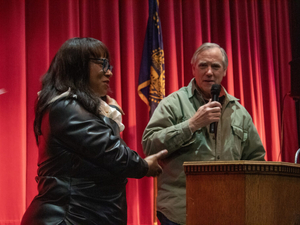
South Carolina Republican Party Chairman Drew McKissick addresses the crowd at the GOP election night watch party on Tuesday, Nov. 3, 2026, at the Moore Building on the South Carolina State Fairgrounds in Columbia. (Photo by John A. Carlos II/Special to the SC Daily Gazette)
COLUMBIA — South Carolina’s four-term GOP attorney general is moving to the Governor’s Mansion, but the closer-than-expected finish gave Democrats reason to rejoice.
Voters elected Republican Alan Wilson as South Carolina’s next governor and state Sen. Mike Reichenbach as lieutenant governor.
When Democratic state Rep. Jermaine Johnson conceded at 10:31 p.m., Wilson was leading with 52% of the vote, with 90% of votes counted, according to unofficial results.
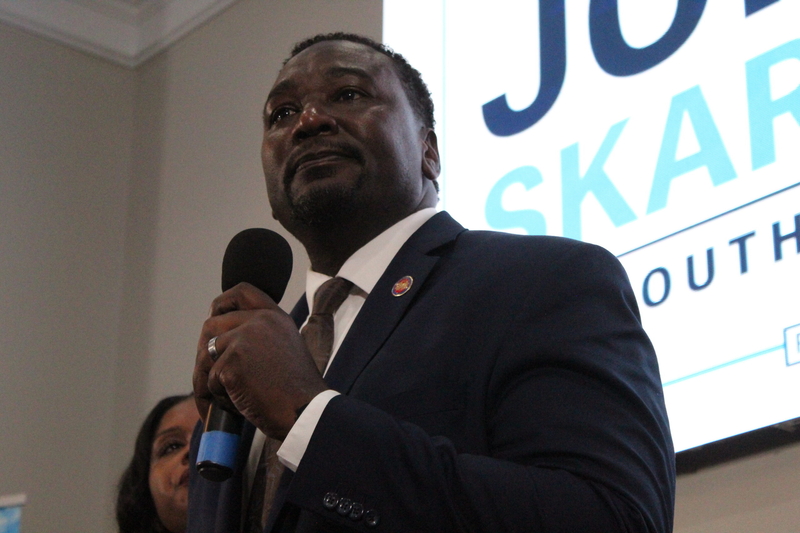
Johnson said he spoke to Wilson, who said he needed Johnson’s help to unite South Carolina. When he gets home, he’ll pray for Wilson, Johnson said.
“I believe that when we wish our leaders to fail, we are wishing our own selves to fail,” Johnson said at his election night party at Brookland Baptist Church in West Columbia. “So, I don’t want him to fail. I want him to be the best governor this state has ever seen.”
The results were much closer than expected. The Associated Press had yet to call the race when Johnson conceded.
Wilson will take the helm from his former boss, Gov. Henry McMaster, South Carolina’s oldest and longest-serving governor in state history. Wilson was an assistant attorney general when McMaster was the state’s chief prosecutor.
Wilson, whose 31 years in the Army National Guard includes a combat tour in Iraq, campaigned as a career prosecutor and career soldier who will “continue to fight for the state of South Carolina.”
His platform included familiar GOP pledges to push for lowering taxes, expanding school choice, and continuing to “back the blue.”
He’s touted working with local, state and federal law enforcement officers in a tenure that spanned two Democrats and one Republican in the White House.
“I earned the respect of a large majority of the sheriffs and law enforcement in this state because they trust me to fight for you,” Wilson said last Thursday during a GOP rally in Rock Hill ahead of President Donald Trump taking the stage.
“I’m honored that they have my back, and I’m going to have their back because they’ve got your back. And I’ve also got Donald Trump’s back because he has your back.”
He’s gone to court repeatedly to combat the Obama and Biden administrations and support the Trump administration. Last year alone, Wilson’s office announced joining other Republicans or declared victory on more than 60 multi-state lawsuits.
Inside Alan Wilson’s historic GOP primary victory over Pamela Evette
Yet, he didn’t initially have Trump’s endorsement.
The president instead backed Lt. Gov. Pamela Evette ahead of a contentious, five-way GOP primary in June, propelling her into a first-place finish heading into the runoff, though by less than 3 percentage points. With Wilson showing momentum and picking up endorsements from their former competitors, Trump endorsed Wilson too — saying voters couldn’t go wrong with either candidate.
Wilson then trounced Evette by 37 percentage points, a historic margin, to become the GOP nominee.
Wilson, a native of Lexington County, noted during the runoff debate that Evette, the lieutenant governor since 2018, moved to South Carolina from Ohio 20 years ago.
He was the first gubernatorial candidate of either party to pick a running mate. He chose a Pee Dee legislator with a common bond: Like Wilson, the adopted son of U.S. Rep. Joe Wilson, Reichenbach was adopted as a child.
The Florence Republican, first elected to the state Senate in a 2022 special election, becomes the first Black lieutenant governor since Reconstruction.
His role is largely up to Wilson. The job of lieutenant governor has no official duties in state law, other than stepping up if something happens to the governor.
When Wilson announced his pick in January, Reichenbach said he hopes to use the job as a metaphorical megaphone to advocate for issues that are deeply personal for him, such as making adoptions easier and more affordable.
Johnson campaigned on a “New SC,” arguing that the Republican dominance over state politics hasn’t delivered for residents.
South Carolina hasn’t elected a Democrat to the governor’s office since 1998, when state-Rep. Jim Hodges ousted David Beasley. It’s been 20 years since a Democrat won any statewide office.
It was the first open gubernatorial race since 2010, when state Rep. Nikki Haley became the state’s first female and first minority governor. Mid-way through her second term, Haley became Trump’s first United Nations ambassador, allowing then-Lt. Gov. McMaster to ascend to the job in January 2017.
In South Carolina, governors can’t be elected to more than two consecutive terms. But McMaster was in office for nearly two years before voters first elected him, giving him 10 total years.
Columbia