Alabama Legislature passes most bills in Gov. Kay Ivey’s public safety package
May 19, 2025 | 7:57 am ET
Description
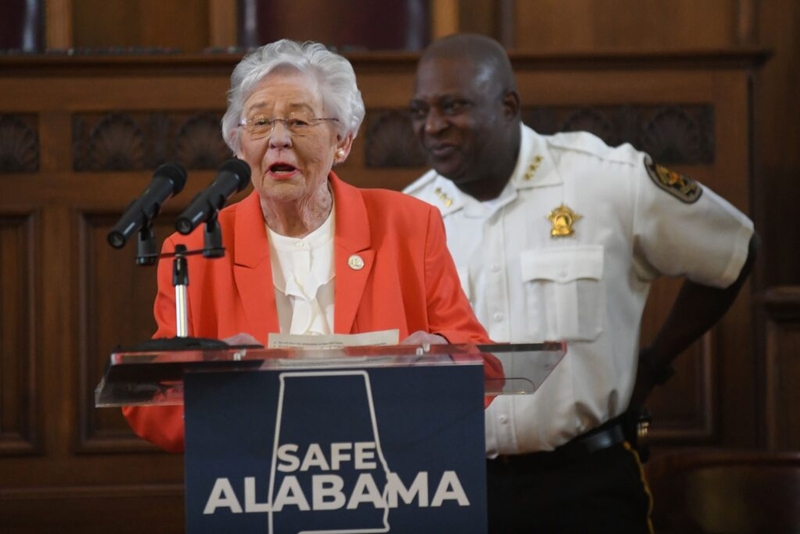
Alabama Gov. Kay Ivey speaks at a press conference urging passage of a package of law enforcement bills on Feb. 12, 2025 at the Alabama State Capitol in Montgomery, Alabama. Behind Ivey is Montgomery County Sheriff Derrick Cunningham. Most of the bills in the package passed the Legislature this year.(Brian Lyman/Alabama Reflector)
In her State of the State address in February, Gov. Kay Ivey called on the Legislature to pass a large public safety package.
“To back the blue, we will provide law enforcement with enhanced legal protections that allow them to carry out their duties courageously and effectively without fear of Monday morning quarterbacking in the courts,” Ivey said.
By the end of the 2025 legislative session last week, nearly all of them had been approved.
Ivey on Thursday signed HB 202 a controversial bill sponsored by Rep. Rex Reynolds, R-Huntsville, that provides law enforcement with enhanced immunity protections.
“I was very proud to have two former law enforcement agents sponsoring this important bill in the House and the Senate,” Ivey said in a news release regarding the legislation. “Rep. Rex Reynolds, a former police chief in Huntsville, and Sen. Lance Bell, a former deputy sheriff in St. Clair County, both did an excellent job moving the bill through the legislative process.”
Despite support from Ivey and leadership in the chambers, the bill faced significant opposition from Democrats and civil rights groups, who expressed fears the bill would allow law enforcement to act with impunity. In the final Senate debate over the measure on Wednesday, several Black Democrats discussed encounters with law enforcement, the dangers Black Americans often encounter in them and the warnings they give to their children during those encounters.
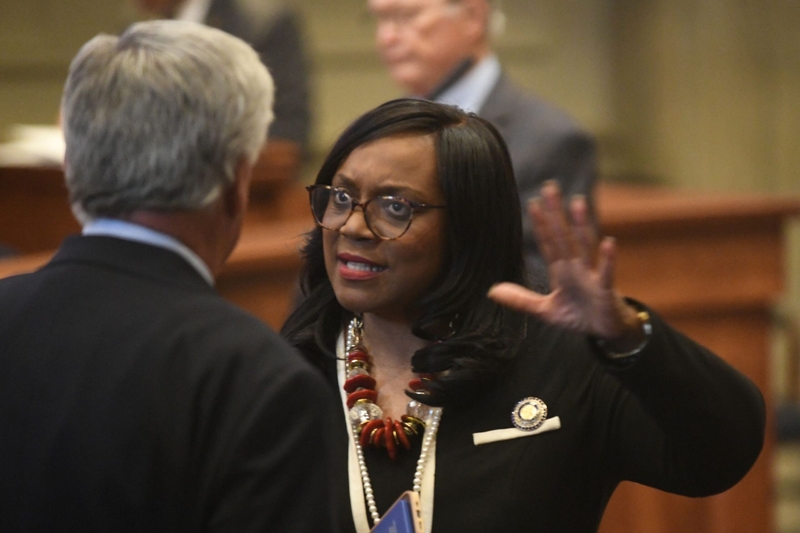
“Somebody will look at my baby, and because he’s six-foot, dreads in his hair — they won’t see an honor student,” said Sen. Merika Coleman, D-Pleasant Grove. “I can serve here now because my son helps with my father, who is a disabled vet. But there’s somebody that will look at my baby and will decide he is a threat. This bill opens the door for more, not only my baby, but other babies to be at risk in the state of Alabama.”
The bill was amended through the process and only received final approval in the last hour of the 2025 regular session Wednesday evening.
Bills in the package focused on punishment and incarceration, from enhancing Aniah’s Law that creates additional obstacles. Reynolds and other supporters of the immunity bill also argued the measures were needed to improve law enforcement recruitment in the state. Many big city departments, like Birmingham and Montgomery, have reported shortages of staff.
Other bills included in the package enhanced penalties for people charged with crimes that involve firearms, allow agencies to revoke parole and electronically monitor people released from incarceration, as well as make it more difficult to release juveniles after arrest.
Some bills in the package received bipartisan support, including one that criminalized converting semiautomatic pistols into fully automatic weapons.
- SB 115: This bill would broaden the existing crime of “impersonating a peace officer” to include individuals who accept employment as a peace officer while knowing they are ineligible to serve or knowing that their Alabama Peace Officers’ Standards and Training Commission certification has been revoked or suspended.
- SB 119: This bill would expand the current “certain persons forbidden” law to include individuals with any prior felony conviction unless they have had their gun rights restored by pardon. It expands Aniah’s Law and increases the penalty for shooting into an occupied dwelling, vehicle or other designated space from a Class B felony to a Class A felony. It requires the Alabama Board of Pardons and Paroles to revoke parole, or a court to revoke probation, when a parolee or probationer has been convicted of unlawful firearm possession and revokes probation or parole when the parolee or probationer is found in possession of a firearm by his or her parole or probation officer.
- SB 116: This bill would make it a Class C felony for a person to knowingly possess a “Glock Switch”— a part or combination of parts designed to convert a pistol into a fully automatic machine gun.
- HB 199: This bill clarifies that the Alabama Board of Pardons and Paroles, or any other state agency, can provide electronic monitoring services to children released by a juvenile court pending disposition of their case, and repeals the 72-hour limitation on confinement of juvenile status offenders who have violated a valid court order.
Democrats fully supported the Glock switch bill, which Rep. Phillip Ensler, D-Montgomery, had brought in prior sessions.
“As we always do, we are going to stand up for what we believe in and work in a bipartisan way, but then, when there are things that we oppose, like the immunity bill, we are going to fight back on those,” Ensler said in an interview on Wednesday.
Ensler opted to view the package as separate bills instead of one large package that was a compendium of several pieces of legislation.
“Look, I would say in general though, between the Glock Switch bill, between those other restrictions on who can access firearms, and then the ankle monitors … there were some good things that came out of it,” he said.
One bill that did not pass was HB 188, sponsored by Rep. Alan Treadaway, R-Morris, to provide scholarships for law enforcement dependents to attend post-secondary education institutions. The legislation won approval from the House in February and got Senate committee approval just over a week later, but did not come to the floor for a vote.
Immunity
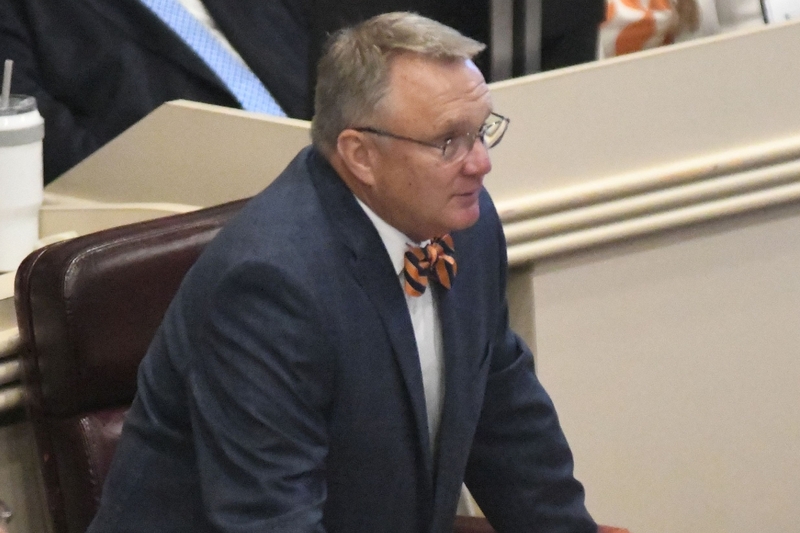
HB 202 enhances the standard by which law enforcement may claim immunity from any wrongdoing from actions while performed on duty. Senate Minority Leader Bobby Singleton, D-Greensboro, managed to add reporting requirements to the bill, but the core of the legislation remains largely intact.
Reynolds said in an interview Friday that the legislation “clarifies a 30-year piece of legislation and allows for ‘pause and review’ within 45 days so that a Judge of jurisdiction can review and determine if they in fact have immunity under this law.”
Civil rights groups remain skeptical that the legislation will enhance public safety. Jerome Dees, policy director at the Southern Poverty Law Center likened the legislation to the federal crime legislation that former President Bill Clinton sponsored in the 1990s that was supported by Republicans and eventually passed into law.
“I think after 30 years’ worth of data and multiple Democratic administrations, those policies, those tactics, are not what actually moves the needle on public safety,” Dees said. “What does work are things like the accountability courts, occupational licensure, that crime is often driven by economic opportunity for folks. What I would have liked to have seen from the administration and the Legislature is a greater focus on creating pathways and opportunities for individuals that they may see as at risk.”
A’Niya Robinson, policy director for ACLU of Alabama, said she had questions about creating additional immunity protections for a class of individuals because of their professions.
“There is also a lot of references in the bill to an officer’s ‘discretionary authority,’ and for us, that is very subjective, and of course it varies from officer to officer because part of it is based on their interpretation of the law, which can differ from person to person,” she said.
She added that she was encouraged that the legislation included provisions for reporting, adding that it was an important bill in the package and one that only one that the ACLU of Alabama had been tracking.
“I think part of it is that it touches on so many things that matter to us all, as well as so many topics that have been in the news for the past couple of years,” she said. “There have been a lot of law enforcement-involved shootings in the past couple of years, not just across the country but right here in Alabama. And that hits home for a lot of folks in this state. I think there are a lot of concerns with how law enforcement interacts with Black folks but other communities in this state, for example LGBTQ+ folks, people who have disabilities, and even folks who are in the media.”
During debate over the bill on Wednesday, Democrats in both chambers said they wanted to support police officers who exercise restraint, and said they knew what happened if they did not.
“There’s a reason that we are the ones speaking on this side of the aisle about this bill,” said Sen. Kirk Hatcher, D-Montgomery. “Far too often, we are the victims of it.”
Alander Rocha contributed to this report.
Montgomery