Alabama Court of Civil Appeals says birth centers are subject to state hospital regulations
Jan 09, 2026 | 3:17 pm ET
Description
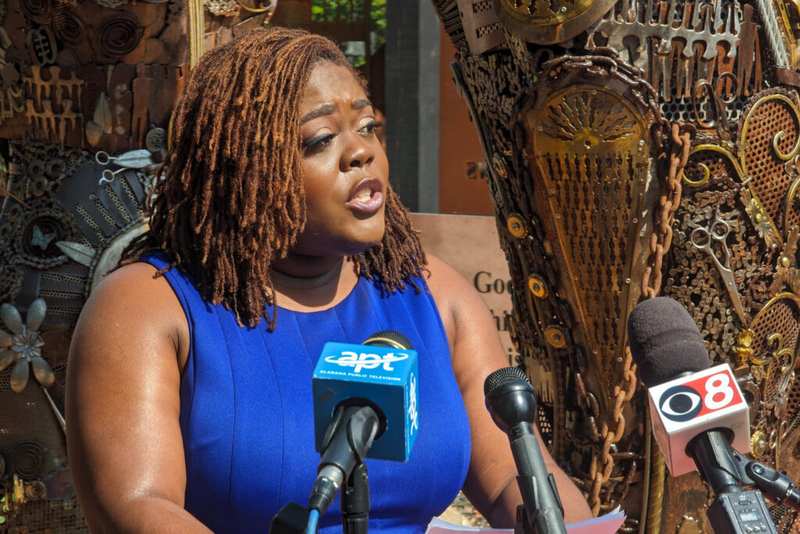
Dr. Heather Skanes, OB-GYN and owner of Oasis Family Birth Center in Birmingham, discusses ACLU's lawsuit against the Alabama Public Health Department on Aug. 8, 2023 in front of the Mothers of Gynecology Monument in Montgomery. The Alabama Court of Civil Appeals ruled Friday that freestanding birth centers are hospitals under Alabama law and can be regulated as such by ADPH. (Alander Rocha/Alabama Reflector)
An Alabama appeals court ruled Friday that the state can license and regulate freestanding birth centers as hospitals.
In a unanimous opinion overturning a lower court ruling, Alabama Court of Civil Appeals Judge Terry Moore wrote that birthing centers were hospitals under state law and subject to regulation by the Alabama Department of Public Health.
Moore wrote that the centers were delivering “obstetrical care . . . to the public generally” under a 1949 state law defining and governing hospitals.
“We do not believe that the legislature intended that only institutions utilizing obstetrics to treat pregnant women should be treated as ‘hospitals’ and be regulated by the ADPH while institutions providing alternative midwifery care, which implicates identical health and safety concerns, should not be considered ‘hospitals’ and should not be regulated by the ADPH,” Moore wrote.
Oasis Family Birthing Center in Birmingham and Alabama Birth Center in Huntsville filed suit against ADPH in 2023, a few months after the agency adopted new regulations requiring centers to be under the oversight of a physician or medical director and to be within 30 minutes of a hospital with OB-GYN services.
The centers, which provide an in-between option for individuals who do not feel comfortable with a home birth but prefer an out-of-hospital birth, said the regulations would make it difficult or impossible for them to provide services around the state, particularly in rural areas that lack hospitals.
The Alabama chapter of the American Civil Liberties Union (ACLU), which represented the plaintiffs, said in a statement Friday that the decision could lead to birth centers not being able to provide midwifery care in the state.
“Birth centers are needed here. Midwives and doulas are needed here. We are committed to continuing this fight on behalf of our clients and all Alabamians,” JaTaune Bosby-Gilchrist, ACLU of Alabama’s executive director, said in a statement.
The ACLU said it will seek “further court review” and that the birthing centers will continue to operate while that continues.
A message seeking comment from ADPH was left Friday afternoon.
Alabama has long struggled with higher-than-average infant mortality rates. According to ADPH, the state’s infant mortality rate was 7.1 babies per 1,000 live births in 2024. That was down from 7.8 deaths per 1,000 births in 2023, but still significantly higher than the national infant mortality rate of 5.5 deaths per 1,000 live births
Infant mortality rates for Black Alabamians remain disproportionately high and racial disparities wide. According to the ADPH data, the infant mortality rate among white Alabamians was 5.4 deaths per 1,000 live births in 2024. For Black Alabamians, the rate was 11.8 per 1,000. In 2023, the rates were 5.7 and 13.1 deaths per 1,000 births, respectively.
Birth centers help bridge the gap for mothers in rural Alabama. Only 30% of the state’s rural hospitals have labor and delivery units, leaving many expectant parents to drive long distances for care.
“We will continue to fight for pregnant Alabamians to be able to access high-quality midwifery care in birth centers without burdensome and unnecessary interference from the state,” Whitney White, staff attorney with the ACLU Reproductive Freedom Project, said in a statement. “The essential care birth centers provide to Alabama families has never been more necessary than it is right now, with Alabama facing a serious maternal and infant health crisis that is disproportionately affecting Black Alabamians, those with low incomes, and rural communities.”
Montgomery