ACCS relieved that Trump budget bill doesn’t include Pell Grant changes
Jul 14, 2025 | 7:57 am ET
Description
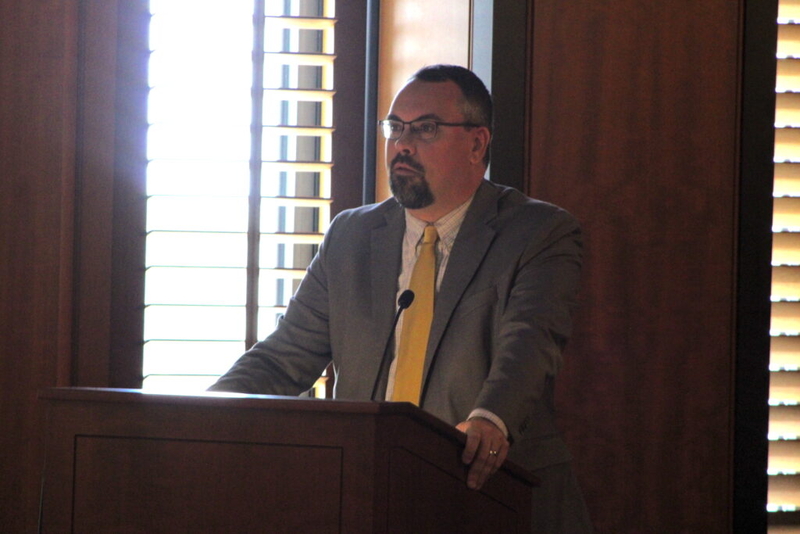
Boone Kinard, executive director of external affairs at the Alabama Community College System, presents a federal update to the ACCS board of Trustees on July 9, 2025, in the ACCS building in Montgomery, Alabama. He told the board that the impact of President Donald Trump's reconciliation bill was not as large on community colleges as expected, but to still move forward with caution. (Anna Barrett/Alabama Reflector)
The chancellor of the Alabama Community College System said Wednesday he is more optimistic about the impact of President Donald Trump’s reconciliation bill after changes were made to the legislation during the process.
“I think the update is a much better dose compared to what we thought it might be in the beginning,” Chancellor Jimmy Baker said at the board’s meeting Wednesday.
At the June board meeting, Baker expressed concerns about the implications of the reconciliation bill, especially in regards to federal Pell Grants and the eligibility requirements for it.
The Pell Grant is given to students based on their expected family contribution, among other academic factors, and often goes to students with “exceptional financial need,” according to the Federal Student Aid Office. According to ACCS, its students receive an average of $4,300 in Pell Grants every year, about $500 less than the median ACCS yearly tuition.
The first version of the bill included changing the definition of a full time student to be a student enrolled in 15 credit hours, up from 12 credit hours. The final version did not include that change.
“That certainly would have had major implications on our students,” said Boone Kinard, the executive director of external affairs for ACCS. “Again, those were not included in the final version of the bill, and we are very happy that they were not.”
The changes on federal student aid that did make the final version of the bill will not impact community colleges, Kinard said. However, he said there are some additional accountability measures for community college students that do receive federal aid.
“Now the earnings of students who have gone through programs will be tracked on the federal level and will be looked at a lot more closely moving forward than they have been in the past,” he said. “Certainly, we want to see what the guidelines are on that.”
Although Kinard said community colleges were not impacted as much as expected by the bill, there may still be threats to federal funding for the next fiscal year.
“President Trump has proposed some cuts, and that will be through the congressional appropriations process, which is a completely different process from what they’ve just done,” he said. “There’s a lot of unknown at this point of how all that’s going to play out.”
Moving forward, Kinard told the board members that they should be prepared for federal funding cuts and expect money to be used differently.
“Our expectation is not as bad as it looked like six weeks ago or four weeks ago, but that doesn’t mean that we shouldn’t be cautious,” Baker said. “I do think the odds of continuing funding at the current level down the road is not going to be a good chance.”
Montgomery