Up to 300,000 Hoosiers could face Medicaid work mandate
Aug 12, 2026 | 4:30 am ET
Description
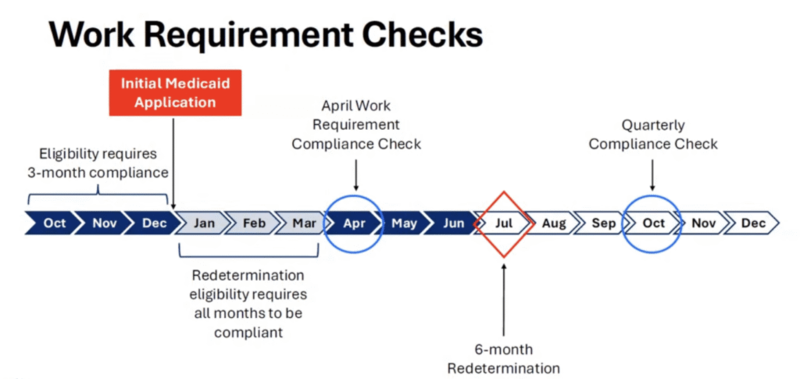
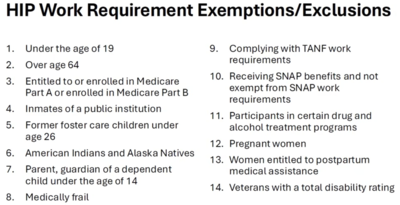
Indiana will begin enforcing work requirements for certain Medicaid expansion recipients on Jan. 1, 2027. Members must complete 80 hours of qualifying activity each month unless they receive an exemption. (Screenshot from Medicaid Advisory Committee presentation)
As many as 300,000 low-income Hoosiers could be subject to Indiana’s new Medicaid work requirements, state officials estimated Tuesday.
But key parts of the compliance and exemption process remain unfinished.
The first deadline is less than two months away. Although the mandate takes effect Jan. 1, 2027, anyone applying for or renewing coverage that month must document 80 hours of work, school, job training or volunteer activity in each of the three preceding months — October, November and December.
Family and Social Services Administration Secretary Mitch Roob offered what he called a “guesstimate” of 200,000 to 300,000 people who could remain subject to the mandate after exemptions are considered. FSSA does not yet know precisely how many Medicaid expansion adults will qualify for an exemption.
“I can’t overemphasize how important it is that people who are receiving their Medicaid benefit through the expansion population become aware and become compliant with this new requirement,” he told the Medicaid Advisory Committee.
Yet lawmakers and health advocates said some of the Hoosiers most at risk of losing coverage still lack clear answers about how the state will determine medical frailty, document fluctuating health conditions and accept proof of qualifying activities.
The mandate applies to Medicaid expansion adults ages 19 through 64, rather than every Healthy Indiana Plan member.
Exemptions and exclusions include pregnancy, Medicare enrollment, medical frailty, participation in certain drug and alcohol treatment programs, and caring for a dependent child younger than 14.
Roob said caregivers of disabled children older than 14 also would not face a work requirement.
The state will check compliance quarterly and conduct full eligibility redeterminations every six months, up from once a year. Paper reporting will be accepted, Roob said, although electronic submission is preferred. He said an online reporting system was not yet finished.
HIP enrollment has already fallen sharply, from about 815,000 people in April 2023 to roughly 487,000 in June.
That decline has been a source of dispute.
An Indiana Capital Chronicle investigation found that beneficiaries and advocates blamed confusing must-return mailers, repeated verification demands and administrative errors for some coverage losses, while FSSA officials have pointed to stricter eligibility checks and wage growth.
Estimates from the Urban Institute and Robert Wood Johnson Foundation suggest 102,000 to 116,000 Hoosiers could lose coverage under the work mandate.
The work requirements are part of a broader HIP restructuring. FSSA is also seeking federal approval for a new HIP 3.0 waiver that would create point-of-service copayments and offer reduced charges to members who complete recommended preventive care.
Concerns in committee
The medically frail exemption drew the most concern Tuesday.
Roob said federal rules will narrow it to people a clinician determines cannot complete the 80-hour monthly requirement. State employees, rather than Medicaid managed-care companies, will make the final determination.
Indiana’s Senate Enrolled Act 1 also bars self-attestation during the first year, even though federal rules otherwise permit it. Roob acknowledged that FSSA is still developing parts of the process while federal officials face litigation over medical-frailty rules.
“This is not going to be easy,” he said.
Sen. Shelli Yoder, D-Bloomington, questioned what happens when a recipient considered medically frail is reassessed and loses that designation without having completed three prior months of qualifying activity.
She said the unknowns are stressful and frightening for Hoosiers with serious health concerns, particularly because January is approaching quickly.
More potential upheaval awaits Indiana Medicaid as work requirements, new rules arrive
“So many unknowns here for people who are facing serious healthcare concerns,” Yoder said. “We even, you know, as a state, we chose to go a little further than what we were required by the feds.”
Behavioral health providers said the uncertainty is especially acute for people with serious mental illness or chronic conditions that fluctuate.
Alan Witchey, president and CEO of Damien Center, told the committee that patients with HIV, cancer and other chronic illnesses may be able to work during one quarter but not the next. Losing access to medication could worsen their health and make future work less possible, he warned.
“Right now, there isn’t a way for somebody in that chronic condition where their health is fluctuating month to month or quarter to quarter to have stability in their health care,” Witchey said.
He also said providers do not know how to verify the volunteer or training hours their patients complete.
The concerns spilled into a broader discussion over whether committee members have enough time to scrutinize Indiana’s rapidly changing Medicaid program.
Tuesday’s meeting was scheduled for one hour but ran about 20 minutes longer and ended without a planned presentation of the annual HIP report.
Rep. Robin Shackleford, D-Indianapolis, asked FSSA officials to schedule longer meetings so that members can provide input and hold a special session on Medicaid denials.
Roob said the request would be taken under advisement. The committee’s next meeting is currently scheduled for Oct. 20.
Indianapolis, IN